







Posted 12 years ago
 scottvez
(977 items)
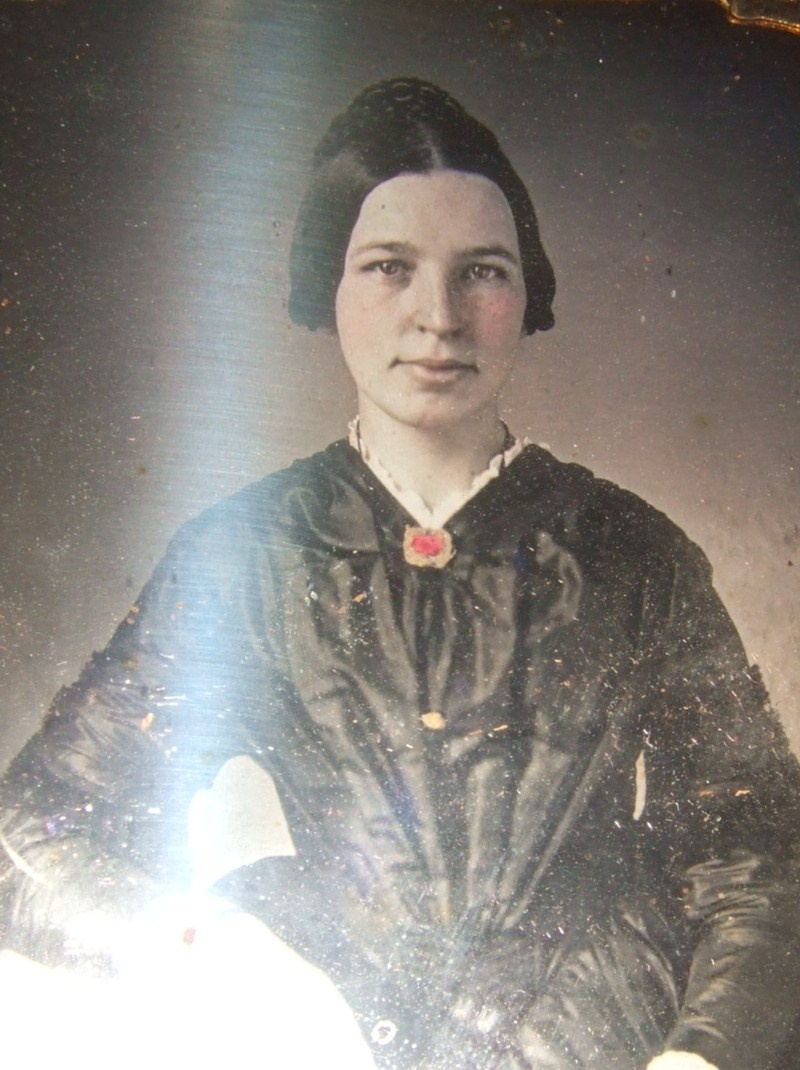
This sixth plate daguerreotype dates from the late 1840s to about 1855.
The silver surface makes photography tough-- the light streak in the center is NOT on the actual image.
I found her expression interesting and that along with the jewelry solidified my desire to own it.
She has a large brooch at her neckline. I am not certain but the red may be coral. She has a similar red and gold bracelet on her wrist.
I showed the back of the image as a warning for new collectors. The paper seals are desirable on images-- do not open or remove original seals. Daguerreotype surfaces are very easily scratched and when the seals are removed, there will be some "play" in the image ultimately causing scratches all around the matting edge.
Reproduction of this image in any form is not authorized.
Scott



Thanks eye4beauty-- Thanks for looking and commenting.
Some of the appearance of large hands is due to the image cant in order to get a viewable image.
They don't look as large on the actual image.
Scott
It is the size of the image-- these come in standard sizes.
It is about 3 1/4" X 2 3/4"-- may be off a little, I am going off of memory.
Scott
With all other factors being equal (which is hard with unique photographs), the larger the image, the more desirable and costly.
Scott
Thanks for looking vetraio and longings.
Scott
Thanks amber.
scott
Nice image. Going back to the image size question, 1/6-plate is in reference to a standard known as whole-plate (6.5" x 8.5" format). This was the original size used by Daguerre in 1839 which became a standard measurement. In concept, 6 of these small plates could fit into to a single whole-plate as a 2 x 3 array; hence 1/6th plate.
Also refer to my Collectors Weekly Show and Tell posting that shows a form of daquerreotype camera that could shoot this type of image: http://www.collectorsweekly.com/stories/9985-palmer-and-longking-daguerreotype-camera?in=user
Thanks for looking and commenting rniederman.
Scott
Thanks for looking bones!
Scott
Thanks agram and tlmbaran.
Scott
Thanks vintageloveantiques.
scott
Thanks tlmbaran.
scott
Thanks again for looking smiata!
scott