








Posted 2 days ago
 Patriotica
(51 items)
Mars is an average of 140 million miles from Earth and can take 6 to 8 months to get there.
Except - wait for it - Mars is already here!
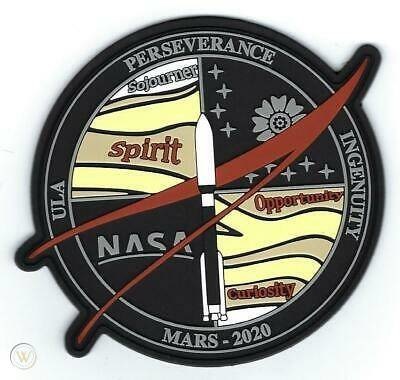
As of this writing, NASA's rolling scientific rover named Perseverance (image 1) has been taking selfies and images of Mars since it successfully landed in 2021. According to NASA, Perseverance "...has abraded 62 rocks, collected 27 rock cores in its sample tubes (25 sealed, 2 unsealed), and traveled almost 26 miles (42 kilometers) — in other words, just shy of a marathon (26.2 miles, or 42.195 kilometers)." Such great work.
Any scientific discoveries into the origin of the Red Planet and its possible ability to sustain life could bode well for possible human habitation sometime in the near future. With the Earth expected to have a population of near 10 billion by 2050 or so, sustainability may become more of an issue such that Mars could be a long-term solution. At least, that’s the idea.
Except, as it turns out, Mars has already visited Earth many times over thousands of years. No, not little green men (why green anyway when the planet is red?), but extraterrestrial bits and pieces that somehow managed to finally make it through our atmosphere after millions of years traveling through space. We’re talking about meteorites.
How Many Meteorites Are There?
According to cosmos.com, about 17 meteorites fall to Earth on average every day. There haven’t been any fatalities as most are rather small and fall into more remote areas or in the ocean. On occasion, though, there is a much larger event such as the one in February 2013 where a 20 meter (65 feet) meteorite broke up in the atmosphere, making quite the spectacle in Chelyabinsk, Russia causing some destruction and injuries. The meteorite was determined to be from a long orbiting asteroid and not planetary.
Of the meteorites found on Earth, only 400 have been classified as being Martian, a bit over half of a percent of all the 77,000 meteorites classified so far, according to the Meteoritical Society that keeps track of such things. Martian meteorites, therefore, are quite rare.
Ok, so you may ask, how do we know if a meteorite is from Mars? By its unique mineral composition, of course, say scientists.
What Makes a Meteorite Martian?
So far, we have been talking about meteorites from Mars, large pieces that were broken off from the surface of Mars due to a collision millions of years ago. These pieces have been traveling through space ever since until they ultimately broke up in our atmosphere. Up to now, there have been probes on the surface that have relayed information about the Martian atmosphere and the contents of its rocks back to NASA, but no actual rocks have been brought back – yet. So pieces of meteorites have been examined, compared to the known composition of Mars from earlier planetary probes, and, bob's your uncle, easily classified as being of Martian origin.
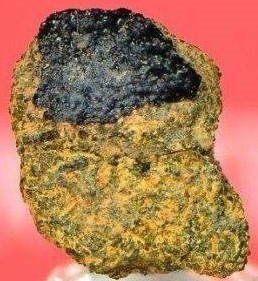
With that information, the short answer to the question “What makes a meteorite Martian?” is that there are generally three types the meteorites most fall into: Shergotty (India), Nakhla (Egypt), and Chassigny (France), meteorites named for where the first ones were found, otherwise known as the SNC group. The Mars atmosphere is unique enough that the relevant isotopes of gases, minerals, and general composition within the SNC groups of meteorites positively identify them as Martian. One of the SNC group of meteors is a 2.3 gram sized nakhlite Martian meteor piece that actually features the outside crust, the part that was burned during reentry into Earth’s atmosphere that sold for $2,300 in 2016 (image 3).
And just to be clear, unlike moon rocks, which NASA legally owns (except for those from Russia), once meteorites fall to Earth, they become the property of where they are found and can be legally bought and sold on the open market.
Collecting Meteorites
So, what does it mean to collect Martian meteorites? According to geology.com, there are several different collecting categories, each of which can affect their overall value.
First, there is “fall vs. find,” meaning that if a meteorite is actually witnessed landing on Earth, it is classified as a “fall” and has a higher overall value than one that is just picked up on the ground called a “find.”
If a meteorite makes the news because of the unusual way or place that it lands (one fell on a mailbox in Georgia in 1984, for example), it’s considered a historic meteorite and has a higher value still.
If a meteorite piece has a catalog number, it is considered a Nininger Meteorite, named for Harvey H. Nininger, who collected and created a museum for his meteorite collection in Arizona in 1946, one of the very first meteorite collectors.
If the meteorite has some unusual features such as a hole, indentations called “fingerprints,” or is just aesthetically pleasing, almost like a work of abstract art, then the value to collectors at auction is rather high.
But collectors of meteorites, as in any collectible category, tend to specialize within a specific interest. For example, some collectors will only be interested in those found where they live; others will want meteorites that are aesthetically pleasing in some way; still, others will like slices as opposed to those in strictly rock forms. Even further, many collectors will collect only irons (made mostly of iron and nickel), stones (the complete rock of chondrite itself), or stony-irons (equal parts of both, but rarer).
Value of Meteorites
What can you expect to pay for meteorites? Of course, it depends on what category it falls under, but generally, meteorites are bought by the gram and measured by the centimeter and millimeter.
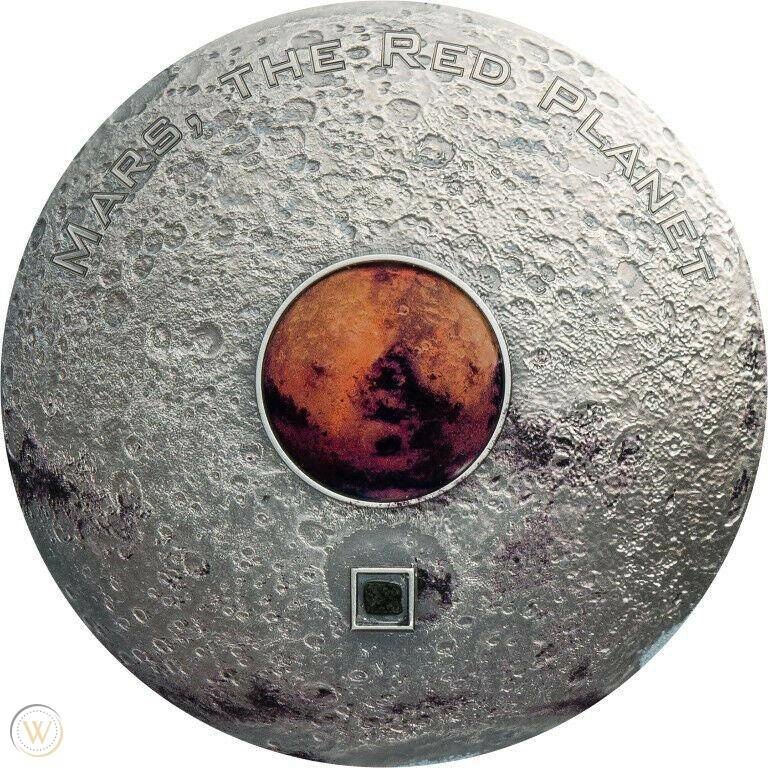
Common iron meteorites, or “fall” ones, can be valued at only about 50 cents a gram, while stone or “find” ones can be valued from $2 to $5 a gram. For the most unusual aesthetic or stony-irons, prices can easily be up to $1,000 a gram. Meteorites, especially Martian ones, are rarer than gold or diamonds but not subject to severe fluctuations in value over time. The Cook Islands, for example, made it easier to collect a bit of Mars with its 3 oz silver $20 coin with a bit of Mars embedded in it (image 2).
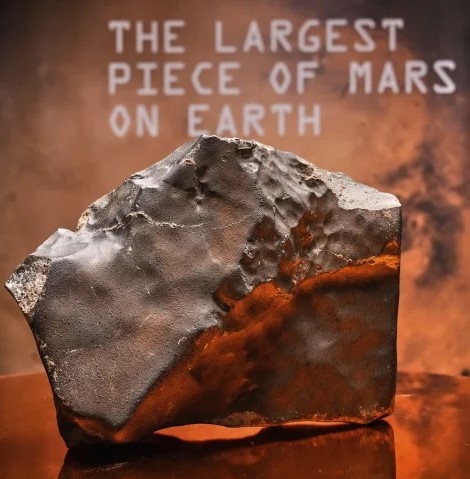
Yet the largest piece of Mars ever found is a 54 pound (24.5 kg) “olivine-microgabbroic shergottite,” a type of Martian rock formed from the slow cooling of Martian magma. It has a course-grained texture and contains the minerals pyroxene and olivine, according to Sotheby’s when it was sold at auction in 2026 for $5.4 million. It also has a glassy surface, likely due to the high heat that burned it when it fell through Earth’s atmosphere. Not to fret, just a small piece of Mars is available for the rest of us that can be in your hands for just around $100, too.
More Information
There is quite a lot to learn about the origins, composition, history, and types of meteorites, especially those from Mars, our possible second home. To learn more about the intricate study and collecting of meteorites, whether Martian or planetary, 'fall' quietly and 'find' The International Meteorite Collectors Association for a list of members, reliable dealers, and updates on all things meteors.
Once you collect meteors, the history of the universe will be in your hands. Imagine the stories of interplanetary experiences it could tell if it could.
This article was adapted from one originally published at WorthPoint.com