An Interview With Silver Bookmark Collector Howie Schecter
[caption id="attachment_2513" align="alignright" width="216" caption="American made by S Kirk & Sons 1921 - 1940"][/caption] I’m a packrat, so in 1995, I was itching t… Read more
+ Fashion | Watches | Furniture | + Glass | Photos | Books | Movies | Games | Outdoors | Signs | Themes | ![]() |
|---|---|---|---|---|---|---|---|---|---|---|---|
| 1970s | 1960s | 1950s | 1940s | 1930s | 1920s | 1910s | 1900s | 1890s | 1880s | 1870s | 1860s | Pre-1860s |
The first decade of the 20th century signaled the end of the Victorian Era, which came to its formal conclusion with the death of Queen Victoria in January of 1901. The subsequent crowning of her son Edward VII ushered in an age of enlightened extravagance.
The new, multilingual and gregarious King enjoyed fine clothes and the perks of emerging modernity available to the wealthy classes, while openly and vocally rejecting bigotry of all sorts. That same year, on the other side of the Atlantic, an assassin gunned down U.S. President William McKinley, elevating Theodore Roosevelt to the presidency. Like Edward VII, he was known for progressive policies, including land conservation and civil rights.
Thanks to the leadership of both, the Belle Époque that had begun toward the end of Victoria’s reign continued apace, with growing acceptance of 19th-century inventions such as the telephone, light bulb, and phonograph. Changes in fashions moved similarly fast—at the beginning of the decade, women were squeezed into S-shaped corsets, but by the end a straighter, less suffocating silhouette was the preferred look.
Not everyone was impressed by the march of technology and preoccupation with fashion, as the decade’s numerous, alternative aesthetic movements attest. Proponents of Arts and Crafts rebelled against the mass-produced sameness of the Industrial Revolution, while those aligned with Art Nouveau saw both architecture and the decorative arts as opportunities to promote social change.
The first Ford Model A was built in 1903 and the first Model T appeared in 1908. Only 11 Model Ts were offered for sale in its first month of production, but by the end of the decade 12,000 of the iconic automobiles had been sold. Production methods were efficient for their time, but the car’s hand-crafting meant that teams of workers at Ford’s Piquette Plant in Detroit could only crank out a new Model Ts every 12-13 hours. In 1913, when Ford opened a new assembly-line plant in nearby Highland Park, workers there could roll a new car off their line every 90 minutes.
On December 17, 1903, Orville Wright flew his and brother Wilbur’s motorized Flyer I airplane for a full 12 seconds, taking him a distance of 120 feet over the sands of Kill Devil Hills, North Carolina. In 1906, in Paris, Alberto Santos-Dumont, after whom Cartier named its Santos wristwatch, did only a little bit better, flying 200 feet and landing on wheels instead of skids. It was a bumpy beginning for aviation, but by 1909, the French aviator Louis Blériot had flown across the English Channel in a flight that lasted 37 minutes.
Some of the intellectual advances of the 20th-century’s first decade were purely theoretical. Physicist Max Planck put forth his quantum theory in 1900, Albert Einstein formulated his Special Theory of Relativity in 1905, and Sigmund Freud wrote up his Theory of Sexuality the same year.
Other innovations were more practical, at least from an impact-on-daily-lives standpoint. For example, there was the invention in 1907 of Bakelite, a plastic that would be widely used in everything from kitchenware and radios to costume jewelry. No less vital to some was the invention of the tea bag in 1908, which made the ritual of sitting down before a tea service of fine china or silver for a spot of afternoon tea that much more pleasant.
For the wealthy swells who reveled in the extravagances of the Edwardian style—the men in their top hats and short dinner jackets, the women whose figures were contorted into impossible shapes—the prevailing cultural trends were warmly embraced. Many artists and designers, however, chafed at the fussiness of the aesthetic, from the diamond-studded filigree jewelry to the ornate floral porcelain of R.S. Prussia. They were interested in exploring simpler designs for everything from homes to the furnishings that filled them.
This discontent was so great that multiple parallel movements sprang up at the end of the 19th century and beginning of the 20th to capture these varied impulses. Two of those movements, one in Britain the other in the United States, waved the banner of Arts and Crafts. Ceramists at Rookwood Pottery in Cincinnati threw cylindrical vases glazed with delicate irises on their rich surfaces.
Artisans in the Roycroft Shops in upstate New York made chairs and other handsome pieces of furniture, as well as decorative objects and hollowware in hammered copper. In the Midwest, Frank Lloyd Wright designed homes as well as the furniture to go inside them, as did Southern California’s Greene brothers.
At the same time, Art Nouveau was also in the air. Where Arts and Crafts rejected the practices of mass-production in favor of artisan craftsmanship, Art Nouveau bent production practices to its social agenda of providing fair wages for workers and an education for their children. That was the goal, anyway—not surprisingly the good intentions could not be sustained. Still, the result was an abundance of gorgeous, naturalistic objects, from the leaded lamp covers of Tiffany to the molded glass panels of Lalique to the iridescent vases of Loetz.
This was also the decade when the performing arts were more widely distributed than ever thanks to advances like the gramophone, which played thin discs rather than bulky cylinders (sound familiar?). In 1900, Nipper the dog was introduced to the world, his head turned to the side as he listened to "his master’s voice" playing on a gramophone. By 1906, the disc-playing Victrola would be introduced, the nail in the coffin of Thomas Edison’s 19th-century cylinder-format phonograph.
Edison had better luck in the cinema when, in 1903, his company distributed “The Great Train Robbery,” a 12-minute silent film. By the middle of the decade, beginning in Pittsburg, Nickelodeons around the United States were showing films like “Rescued by Rover” as well as French fantasies such as “A Trip to the Moon,” in which the man in the moon famously gets a spaceship right in the eye. By 1908, D. W. Griffith would get the chance to direct his first film; the following year, Mary Pickford made her first on-screen appearance.
For those who preferred the theater of their imaginations to such new-fangled contrivances, first-edition books could be found for titles in the “Wizard of Oz” series of children’s books. Adults gravitated to adventures by Jack London, essays by W. E. B. Du Bois, science fiction by H. G. Wells, and social novels by Upton Sinclair, whose “The Jungle” exposed the underbelly of the meatpacking industry, which led to the precursor of today’s Food and Drug Administration.
Fashion for fashion’s sake was the rule at the beginning of the 20th century, even if it meant forcing women into short corsets with names like Adjusto and Reduso. This was the tail end of the Gibson Girl era, when the look was all about big hair, bigger hats, a padded bust above a narrow waist, and protruding posteriors. The alternative was not much better—hobble skirts could be worn with more forgiving corsets, but the garments tapered so tightly at the ankles that women wearing such attire often had trouble walking.
Men’s clothing of that era looks surprisingly similar to the attire of today, although lounge coats tended to be single-breasted, while formal jackets tended to be double-breasted rather than the other way around. Morning coats were the most formal articles you could wear, which is why they were common at weddings and funerals.
Still, not all men went about this way, at least out West. There, Levi’s 501 jeans were made for working men—the denim for these quintessentially Western trousers was shipped all the way from the Amoskeag Manufacturing Company of New Hampshire.
Finally, the first decade of the 20th century also saw the rise of professional sports. The dominance of college football was challenged in 1903 with the formation of the Ohio League, which ended its first season with a win by the Massillon Tigers over the Akron East Ends—Super Bowl rings and memorabilia was still a ways off.
Similarly, the International Professional Hockey League was founded in 1904, and though it only lasted a few years, it gave the then amateur-dominated North American hockey world a taste of what it would be like to watch games played by pros.
These were tenuous beginnings, but the birth of Major League Baseball is even tougher to pin down, although a case can be made for placing it squarely in the 1900s. The National League had been around since 1876 and the American League was founded in 1901, but it was only when the two leagues agreed to be governed by the same three-man commission in 1903 that something approximating Major League Baseball was born.
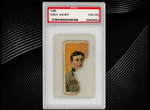
In the early 1900s, though, if you wanted a baseball card of your favorite player, it helped if you smoked or chewed tobacco—baseball cards weren’t packed with less health-hazardous sticks of bubble gum until 1933.
Candlestick telephones, also known to collectors as 'upright desk stands', gained popularity in the 1890s as the telephone became … (more)
Frank Lloyd Wright, who emerged as an architect during the turn-of-the-century Arts and Crafts movement, gave birth to the first d… (more)
Founded by Reinhold Schlegelmilch in what is now Suhl, Germany, R.S. Prussia produced ornate and floral porcelain objects for expo… (more)
Tobacco tins first came into popular use in the mid 1800's, and can be found in a wide range of styles, including figural tins, ba… (more)
While cut glass has been produced for thousands of years, it reached a peak of popularity during the late 19th century in the so-c… (more)
Mission-style furniture grew out the turn-of-the-century Arts and Crafts movement, which like Art Nouveau was a response to indust… (more)
Wood wall-mounted telephones were the first phones put into wide circulation following Alexander Graham Bell's invention in 1876. … (more)
Loetz was the premier Bohemian art glass manufacturer during the Art Nouveau period (or Jugendstil, as it was called in German-spe… (more)
Art Nouveau architecture, furniture, jewelry, and graphics took their inspiration from the curving shapes and flowing lines of flo… (more)
In the 1880s and 1890s, a new style spread across Europe and the United States—Art Nouveau. Unlike the austere Art Deco that event… (more)
In 1893, the Hamilton Watch Company of Lancaster, Pennsylvania began producing pocket watches primarily for railroad workers. Rail… (more)
The Arts and Crafts movement that swept the United States and Great Britain from roughly 1880 to 1920 was a response to the indust… (more)
Hatpins reached a peak of popularity between the 1890s and 1920s, as music hall actresses like Lillian Russell and Lillian Langtry… (more)
Today when many collectors hear the words “tobacco cards,” they think of the T205 and T206 baseball-card sets from the early 20th … (more)
[caption id="attachment_2513" align="alignright" width="216" caption="American made by S Kirk & Sons 1921 - 1940"][/caption] I’m a packrat, so in 1995, I was itching t… Read more
I started collecting jewelry when I was about 13 years old. I was very close to an interior designer who took me to antiques shops. While she looked for paintings and objects… Read more
[caption id="attachment_1137" align="alignright" width="258" caption="Rare copper lamp by Roycroft designer Karl Kipp"][/caption] I started collecting Roycroft around 1992… Read more
I bought my first piece of jewelry—a gold ring with a big lapis stone propped on prongs—when I was about 12 with money my grandfather gave me. Then, as a teenager, I worked i… Read more
I started to get interested in typewriters around age 12. My dad and I stopped at a garage sale and he bought me this typewriter from the 1930s, and I was just learning to ty… Read more
What are vintage magic posters? Posters of magicians printed by the stone lithography method qualify as vintage magic posters. The stone lithography process was in it hig… Read more
I don’t remember the first Rookwood piece I ever bought, that’s getting close to 40 years ago. But I must have liked it, because I kept studying and learning, and it’s been a… Read more
[caption id="attachment_2074" align="alignright" width="243" caption="Victor III, originally "Victor M" (Monarch) model in 1901. Produced until 1920's."][/capti… Read more
Loetz was a Bohemian company. It was a factory; and the region’s biggest and best glass manufacturer. There were other contemporaries like Kralik, Rindskopf, and Pallme-Konig… Read more
[caption id="attachment_729" align="alignright" width="300" caption="Muratti's New Ladies Flat 10 Cigarette Tin, 1900"][/caption] How did I get started collecting adve… Read more
How did I start collecting Victorian trade cards? In the late 60s I was a bottle collector, early American bottles and flasks. I started noticing there were colorful trade ca… Read more
[caption id="attachment_929" align="alignright" width="250" caption="Satsuma hatpin: made in Japan out of ceramic and hand painted"][/caption] Originally my husband and I … Read more
[caption id="attachment_426" align="alignright" width="250" caption="16 size Hamilton model "992" Railroad dial"][/caption] I got started collecting pocket watch… Read more
[caption id="attachment_437" align="alignright" width="250" caption="Sterling Silver Kalo pitcher with monogram"][/caption] How did I get started collecting Arts and Craft… Read more
I started becoming interested in art glass when I moved from Texas to New York, and wanted to decorate my apartment with New York-type things, things I had never seen in … Read more
I started collecting cut glass when I was about 18. My sisters were married, and during the summer, I would go out and stay with them in the Midwest and work. That was back i… Read more
| 1970s | 1960s | 1950s | 1940s | 1930s | 1920s | 1910s | 1900s | 1890s | 1880s | 1870s | 1860s | Pre-1860s |