In this interview, mahjong (also known as mah jong) set collector Carol Ann Harper looks at the variety of materials used to make the game’s tiles, boxes, and accessories. Harper debunks some of the myths about mahjong’s origins and explains the extraordinary difficulty of determining who made many of the fine antique Chinese sets. Harper is working on a book for mahjong collectors, which can be viewed at www.charli.org, her website for all things related to the game.

Hollow tin tiles were an inexpensive choice for mahjong players in the 1920s, when the game was at its height in the U.S.
The first time I saw a mahjong set was around 25 or 30 years ago. It was at a garage sale. The intricate and colorful designs on the tiles drew me in and I have been on a quest to find a set just like it ever since.
Researching all the aspects of the game is a passion, and naturally it has enhanced my interest in Asian culture and art. There are still rare thrills for me when I find a set that I have never seen before, and get that adrenaline rush from the urge to have it. But collecting, for me, is all about studying the materials and methods used to create the sets, plus understanding and appreciating the symbolism behind the designs. China is a very old culture so many designs reach a long way back.
My first love has always been bone and bamboo sets. They make up the majority of my personal collection, but like any avid collector I also have favorites and interests in sets of all materials.
After years of answering questions about identifying sets, I started “THE BOOK.” I put it online to help collectors learn more about their sets, and so newcomers could become more familiar with the vintage sets still among us. My collection has grown over the years in an effort to document as many sets as I can and share it with anyone who has access to the Internet. I’ve learned that it is impossible to have one of everything—at some point I am going to have to part with some of my collection to make room for new finds.
Many people who visit my site have encouraged me to publish my book as a hard copy, but I feel it would be too large and that this format is really a better alternative. Eventually I will have it set up so there will be a way to keep it online long after I am gone.

A pair of French ivory dice, probably distributed by Piroxloid.
Mahjong sets can be difficult or impossible to research all the way back to their roots in China because the tiles arrived from manufacturers in plain cardboard boxes, which usually were thrown away. Distributors and retailers added all the accessories and then sold the sets as we know them today. Adding to the confusion is the fact that players often traded accessories with their friends.
Tracing them in China is nearly impossible because most of the people from the ’20s or ’30s aren’t around any more, and after several political upheavals in China the documentation has been lost forever.
You can still find vintage bone and bamboo sets in almost every country outside of China, but most of the sets coming out of China these days are terrible reproductions. Collectors need to be aware of this.
There are really two types of vintage bone and bamboo sets—the beautiful, elaborate sets made by master craftsmen and the more common sets mass-produced by kids. I have old pictures of barefoot kids cutting bamboo and shaping the bone to make tiles for the men who carved them.
During the ’20s, cow bones were collected from slaughter houses in the U.S. to be shipped to China to satisfy the demand for mahjong tiles. There was also a demand for exotic materials like ivory and jade. Mahjong comes in many types of materials that include paper cards, wood, and many types of plastics. I have a set made from manmade stone and another from Ebonite, which is faux ebony.
“Early on in China, only upper-class men were allowed to play mahjong.”
One of the best mahjong museums in the world is in Japan. They have beautiful sets on display and they’ve published at least two books with really nice pictures. I think that most of their sets are bone, bamboo, ivory, and jade, but they also have stone sets, cards, and a set with designs made from abalone. I am not sure if they have the hollow tin set though. My secret wish has always been to have a museum where all my sets would have a permanent home, with lots of visitors to appreciate their diversity.
Collectors Weekly: Were mahjong sets always made from so many different materials?
Harper: I think they were originally like playing cards. Next came bone or bamboo, and then plastics took over because they were durable and more easily mass-produced. Other materials were also used to satisfy the need of players for something different. That desire still exists, so today there there are two artisans in the U.S., Dee Gallo and myself, designing sets.
Collectors Weekly: What is the origin of the game?
Harper: Mahjong was born in China. In the early 1900s there was a huge European settlement of mostly diplomats and their wives on the Ning Po River; that is most likely where the game got a good foothold. Many of those people brought the sets back to Europe to share with friends and family.

Piroxloid was an American company that imported its two-tone French ivory tiles from China.
There is much debate about the which entity introduced this game to the western world. Joseph Babcock gets much of the credit, but I feel that is due to the fact that he sold his copyright to Parker Brothers, which used its great marketing skills to get the word out. I do have documentation from a German company that sent someone to China on a mahjong mission in 1916. There may have been someone there even before that, but I haven’t found proof yet.
Many department stores in the U.S. imported sets, too. Abercrombie & Fitch imported and sold more than 40,000 sets in one 10- year period. I have no idea how many were sold by Macy’s and Gimbels, and what used to be called “five and dime” stores like Robinsons and Woolworths.
Mahjong organizations like the National Mah Jongg League and the American Mah Jong League also sold sets. Distributors like Eastern Distributors in New York sold sets to many retail outlets while companies like Pung Chow and Parker Brothers marketed sets through department stores and national advertising in magazines.
Collectors Weekly: Has mahjong always been played the same way?
Harper: All rule sets are based on the original Asian rules, but there are many variations. Sometimes I think there are more rules than collectors. In the U.S. some rule sets use jokers, and the most prolific joker rule set is from The National Mah Jongg League. They introduced jokers to the game in the mid 1960s. Other rule sets include The American Mahjong League and Wright-Patterson. Then there are “house rules,” which are adaptations of other rules. I learned to play using Wright-Patterson rules, but I prefer Asian rules because the hands are less complicated.
Collectors Weekly: Can you describe your process of making a complete mahjong set from orphans?
Harper: Around the mid-1960s, the National Mah Jongg League introduced jokers to the game. Sets made prior to that didn’t have them. We’ll take a set from that early period and then search through my collection of orphan tiles—orphans come from broken sets; I probably have 20,000 of them—looking for tiles that match. Then we put stickers on the matching tiles to designate them as jokers. That way people can use them to play by the latest National Mah Jongg League rules.

Sister sets refer to the variety of boxes or sets sold by a single distributor or brand. The brand and manufacturer of these sister sets remain unidentified.
About 10 years ago, an actress wore a mahjong bracelet in a movie, and people went crazy for it. Jewelers everywhere were buying sets and destroying them because they wanted the tiles with flowers and birdies. I stayed busy buying sets to stop them from doing that. Also, if I have a set that needs three or four tiles, I watch auctions for a broken set that has those tiles. That’s how my orphanage got so big.
From trying to fix these sets, I realized there was an enormous variety out there. For example, there must be 2,000 different colors of butterscotch. In the process of trying to put sets back together I discovered that even sets with labels like Royal Depth Control were made in different sizes, colors, and shapes, and out of a variety of materials. Royal made tiles in both Bakelite and Catalin, but many people don’t really understand that they are different things. People use the term Bakelite when they are actually talking about Catalin.
So there can be a lot of variety within one label. If people contact me looking for a tile, I ask them to send me an actual tile to match. There’s too much color variation in photographs, depending on their lighting or whether they used a flash, to match tiles with any certainty from photos alone.
If they don’t put some sort of little sticker on their tile, I’ll put one on for them so I don’t lose it. Then I go through my buckets of orphan tiles, looking for extras to make jokers or replace a tile that’s been lost or destroyed. Of course, I return the original tile in the end.
Collectors Weekly: Do the stickers have symbols on them?
Harper: I design and create thousands of joker stickers. Some are pre-designed but I also do custom work. Since the older sets didn’t come with joker tiles, it is the only way to bring these sets up to date with modern rules. My stickers are at CHarlisStickers.com.
Collectors Weekly: Was there a lot of variety in the game boxes that held the pieces?

This newer box, probably from the 1940s, contains a bone-and-bamboo mahjong set.
Harper: Yes. One of the most popular boxes for bone-and-bamboo sets is a five-drawer rosewood box. You see a lot of those. There were also flat-type travel boxes. There were three-drawer boxes, two-drawer boxes. They had a door that slid down the front to cover up the drawers. I’ve got one that has a Chinese antiquity seal on it that looks like a book. I got that set from someone in Australia. It’s very old and has been used so much that the designs are almost worn off of it. I think that’s probably my oldest set.
The price of bone and bamboo sets was determined by the thickness of the bone—the thicker the bone, the more expensive the set. Very often, the thicker the bone, the more elaborate the box, too. Take Mah Jongg Sales of America sets, for example. Their boxes have two Chinese characters on them which say “Mah Jongg.” That particular spelling and print style was copyright by Babcock in 1924. They used specific tile designs and some of those were also protected by copyright.
If you look at other sets like a Lion set, the box has a lion embossed on the front. This matching was typical of a distributor who wanted to differentiate his set from others by using a consistent design.
Other distinctive designs included a Sparrow with two Chinese characters, a Peacock with two mahjong tiles, a Pagoda, and there are several Dragon sets. Each were from a different company or distributor. When I use the term “label” it’s more like a brand name. One example is Royal Depth Control.
Collectors Weekly: Were the boxes always made out of wood?
Harper: The most common boxes were rosewood with brass trim, but boxes were also made from papier-mâché, tin, leather, and heavy-duty cardboard, which was sometimes covered with silk or a heavy fabric that was coated with paint and called oilcloth. The shapes and designs of the boxes was also varied. The most sought after wood boxes are the ones that are heavily carved or that have a lot of brass on them.
Collectors Weekly: The whole box was carved?

You can tell these are MonoBridge tiles from the 1920s or '30s because the #1 peacock design was only used by this company.
Harper: Yes, the handle, the sides, the front, and the back. Sometimes even the drawers have carving on them. Those boxes and the ones that have a lot of heavy brass on them are very desirable. There are also wood boxes inlaid with mother of pearl. I’m very cautious about those because they can warp. I don’t know what type of wood was used. When manufacturers were mass-producing a lot of rosewood boxes, the wood they used was often green. Once it made the trip across the ocean it shrank and dried. So you get splits in them.
I have a little box with celluloid drawers. I’ve only seen one of those. The tiles are very different, too. They almost feel like hollow plastic. People have put mahjong sets in jewelry boxes, which is pretty neat sometimes. I’ve got about 250 boxes in the bone and bamboo section on my website.
Collectors Weekly: Did sets always come in a box?
Harper: Most vintage sets sold today are in a box, but when they first arrived in this country they were packed in very simple cardboard boxes. That’s when U.S. companies would put the sets into their own distinctive designer boxes. Abercrombie & Fitch placed its own label on sets but also left the original manufacturer’s name intact. I read somewhere that that was their policy.
At least three companies marketed less-expensive wooden sets, which came in simple-to-elaborate cardboard boxes. Some had five trays stacked on top of each other. There are quite a few wooden mahjong sets that were given away as promotional items. Most of those came in cardboard boxes styled after the more expensive rosewood boxes. Insurance companies, a silk company, shipping companies, and newspapers gave these sets away to their preferred customers.
Collectors Weekly: When did the mahjong craze really hit America?

Mahjong collectors and players often put their sets in a box they just like. This embossed box with Bakelite pulls was probably originally used to store stationery.
Harper: The first real mahjong craze in America was in the ’20s, but it has gone through several revivals since. For the last 15 years there has been a huge increase in new players and collectors, many looking for nice vintage sets. It is very hard to find really good ones now unless they are coming from collectors. Fifteen years ago you could find good sets in secondhand stores and at flea markets.
Mahjong offers a lot for a game. In this age of instant gratification, the Internet, and smart phones, we have become a very antisocial society. Mahjong offers players a wonderful social experience, with challenges and fun for all ages and both sexes. I think people are really enjoying just getting back to some having fun.
Early on in China, only upper-class men were allowed to play mahjong. The game was often played in mahjong dens or parlors and linked to prostitution and opium. The game’s early history in San Francisco shared the same associations.
Collectors Weekly: How did the choice of tile materials evolve?
Harper: In the beginning, bone and bamboo were favored because of the availability of materials and their durability. When plastics appeared on the scene, they proved to be just as durable, easy to care for and less labor intensive because they could be mass-produced by machines.
Eventually, though, people realized that Bakelite and Catalin were chemically unfriendly, and that French ivory needed special care or it would just disintegrate. But plastics are getting better all the time. As far as other materials go, ivory is scarce and not always legal. Other exotic materials are also becoming hard to find, which makes them more expensive.
Collectors Weekly: Were the dice always made out of the same material as the tiles?
Harper: No. I’ve got brass dice, ivory dice, and all types of plastic dice. I collect miniature dice, too. During the U.S. Civil War, bone dice were common. Original true mahjong dice were a little bit different than the ones you see from the U.S. Civil War era, but bone has been popular for dice for a long time.
Collectors Weekly: How did World War II affect mahjong?
Harper: It affected the designs on some of the tiles. For example, there are political statements and poems on the “flower/season” tiles. Bakelite and Catalin tiles became thinner for a period near the end of the war and shortly thereafter, the most logical reason being that those materials were needed for the war effort.
During the war, military personnel brought sets home to their families, which introduced the game to even more people in the U.S. For example, Wright-Patterson rules are named after Wright-Patterson Air Force Base in Indiana.
Collectors Weekly: Do the symbols on mahjong tiles vary from set to set?
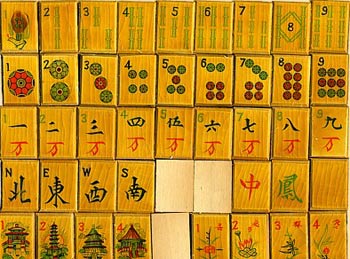
The designs on this inexpensive Pah Lukk wooden set from the 1920s are really decals that have been varnished.
Harper: It’s difficult to explain to someone who doesn’t play the game that certain suits are expected to be the same from set to set, but that the designs can vary quite a bit. If you think of a mahjong set as a deck of cards, then maybe it’s a bit easier to understand.
In the Bamboo suit, for example, the #1 tile is most often a bird, but there is more than one bird in the world so there can be more than one design. Flower and Season tiles have traditional flowers and variations as well. Much of this has to do with the artist who created the designs, and if that artist wanted to take a traditional approach or if he or she wanted to make a statement.
Collectors Weekly: Do the American sets use Chinese symbols?
Harper: Yes. All sets that have Arabic numbers were made for export to the West. In Asia, the only suit with numbers is the Character suit. Character suit tiles have the Chinese number and the Chinese symbol for 10,000. The Bamboo suit and Dot suit are designed to show 1, 2, 3, etc. pieces of bamboo or dots. Flower tiles include the Chinese word for that flower and the Season tiles have the Chinese word for the season.
Depending on the age of the set, Wind tiles have the Chinese word for the different directions on them and Dragon tiles can also have Chinese words or symbols. Flowers and Seasons are associated with the Winds when it comes to scoring so it’s important for Westerners to know the numbers or understand the Chinese ideograms. The only exception is the rule set played by the National Mah Jongg League.
Collectors Weekly: Do we know the names of any of the great tile artists?

Mahjong sets in carved and painted rosewood boxes are highly prized by collectors.
Harper: The only artists I know of are the two mentioned earlier. I have found nothing about the individual masters of the ’20s, but I think that even if a master designed and carved a set himself, he would have had the same name as the manufacturer.
Much of that kind of information was lost during the Cultural Revolution in China, when pastimes like mahjong were forbidden and factories destroyed. Also keep in mind that many of these tiles were mass-produced by child laborers who would not have been given any credit. Only the company name would have made it into any documentation.
Collectors Weekly: What are some of the other really sought-after sets?
Harper: There are always people who want ivory more than anything else. It is very hard to come by and without documentation it’s not legal to sell it or buy it. The only source for these sets is through private collectors. eBay won’t let you sell ivory any more and it cannot be imported. After that I would say the most sought-after sets are Enrobed sets, Two-Tone sets, and Chinese Bakelite sets. Enrobed sets were originally called “Border Tone” because there is a frame around the tile itself. These sets are inching closer to $2,000 every time I see one. Two-Tone sets are nearing half that, and some Chinese Bakelite sets, too.
A friend of mine in the Netherlands sent me some flat bone pieces a few years ago. The Fish and Wildlife Department intercepted the shipment, sent me a registered letter threatening to throw me in jail for importing ivory. Fortunately, they did give me a number to phone them. I did call them and said: “I’m sure those pieces are bone and not ivory.” They said:” Well, even if it’s elephant bone, you’re going to jail.” They did DNA testing on it and eventually returned it to me. It was a terrifying experience.
Collectors Weekly: How many parts or accessories come in a mahjong set?

The picture on this French ivory dice coffin is the same design as the #3 flower tile on Piroxloid sets, so this accessory was probably sold by them.
Harper: You are right to call the extras accessories because they aren’t always necessary. The most common accessories are racks, dice, coins for scoring, banks, and a bettor.
For bone and bamboo sets, bone counting sticks are used instead of coins. Dice often come in a little carved bamboo dice coffin and sometimes there is a little bone Mingg jar with Wind direction disks in it.
All the extras are collectible and some collectors specialize in them. Banks are a very popular collectible. They usually have a Catalin base with four or five posts to hold the coins. Some other must haves are: rule booklets, annual rule cards, dice, the wooden plate, sheet music, magazines with mahjong articles, and old newspaper clippings.
The more accessories that accompany a set, the greater its value.
Collectors Weekly: Do you ever play with your games?

The case on this doubling score calculator is unique because it's made out of Catalin.
Harper: I play as often as I can, and if I can’t play with my sets I will take them out to look at them. It’s like seeing old friends. My better sets—like a wonderful black jade set—are on display, but you can only display so many at a time. With more than 800 in my personal collection, many must remain in secure storage.
One of my current collecting goals is to gather sets that are in catalogs I have, like the Pung Chow catalog of 1924. Pung Chow and other companies sold sister sets, which are sets sold by the same company in a variety of boxes and quality.
Several manufacturers and distributors sold specific materials, so when you hear their names, a certain type of set comes to mind. Piroxloid was known for French ivory, Pung Chow for Pyralin, and Milton Bradley for wood. A.L. Reed and Mah Jongg Sales of America distributed bone and bamboo sets while Parker Brothers marketed sets in cards and wood. Then there were Met Games and Royal, which sold Bakelite and Catalin sets.
Collectors Weekly: Why are there so many different spellings of mahjong?
Harper: I think that it was due to companies trying to create their own identity, along with language translations and different rule sets. You will see it written as “majong” and “mah jong” most often. As said previously, when it is spelled with two Gs, the set should be associated with Mah Jongg Sales of America.
Collectors Weekly: What advice do you have for someone new to collecting mahjong?
Harper: Take your time. If you have just learned to play, you are probably very attached to the designs on the set you learned on. Have a look around to see what else is out there. Check out eBay, look at as many sites as you can. Talk to other collectors and then decide what you really like, or what pleases you. As far as games go, this one is pretty expensive, so be prepared to make an investment.
Mahjong is not like some collectibles with lots of clubs and such to use as a resource for collectors, but collectors do share back and forth and seek each other out to discuss all kinds of things. For the most part they are a pretty friendly group when it comes to sharing. I guess that is a loose definition of a club.
(All images courtesy Carol Ann Harper of www.charli.org)

 At Home with the Maharajas
 Occupy Boardwalk: How Games Got Greedy
 At Home with the Maharajas
 The Mysterious Origins of Ouija Boards
 Mahjong SetsMahjong (often spelled Mah Jong, Mahjongg, and Mah Jongg) is thought to hav…
 Mari Tepper: Laying it on the Line
 Nice Ice: Valerie Hammond on the Genteel Charm of Vintage Canadian Costume Jewelry
 How Jim Heimann Got Crazy for California Architecture
 Modernist Man: Jock Peters May Be the Most Influential Architect You've Never Heard Of
 Meet Cute: Were Kokeshi Dolls the Models for Hello Kitty, Pokemon, and Be@rbrick?
 When the King of Comedy Posters Set His Surreal Sights on the World of Rock 'n' Roll
 How One Artist Makes New Art From Old Coloring Books and Found Photos
 Say Cheese! How Bad Photography Has Changed Our Definition of Good Pictures
 Middle Earthenware: One Family's Quest to Reclaim Its Place in British Pottery History
 Fancy Fowl: How an Evil Sea Captain and a Beloved Queen Made the World Crave KFC
I love your website. I have been a Player for over 50 years. My novel “Clattering Sparrows” ( Mahjong translated) was published in 2010 and the storyline centers on the ancient and addictive Chinese Game of Mahjong. On the back cover, there is a painting of a Chinese Mahjong Set from the Qing Dynasty which I acquired several years ago; I also have many of the early sets that were produced when the game was first brought to this Country in the 1920s, including a cardboard version of the game for children.
Hi Marilyn,
Oh thank you so much for taking the time to put your comments here and for sharing part of your history with all of us. I love to hear personal stories.
CHarli
I have a Mah Jong set with a players book that is titled “Mah Jong For Beginners.” On the book it says “Based on the rules and regulations of the Mah Jong Association of Japan. By Shozo Kanai and Margaret Farrell. Charles E. Tuttle Company. Rutland, Vermont and Tokyo, Japan.” If this book belongs to the tile set I have it is the “revised edition” from 1966. The set is in excellent condition (236 pieces) and I am not even sure it has been played. The top layer of tiles were unwrapped but the bottom layer still had the plastic coverings around them. The tiles are a white or ivory color on top with a wood (possibly bamboo?) on the bottom. They look fairly thick compared to pictures of other sets I have seen on the internet. The symbols are all in color (red, blue and green). I can’t find anything on this set. I am curious to see if there is any value to it? I am not at all interested in selling it as it is a beautiful piece that I would like to hold onto. Any information would help! And thank you for the article above! I loved reading every bit of it!!
I just posted images of 2 pair of Mahjong cufflinks in the gallery. I am trying to identify the ideograms. Any help would be much appreciated!
hi Tracey,
I found the pictures of your cufflinks, the pair on the left (upside down), are North, the pair on the right are South. Hope this helps
CHarli
CHarli is a national treasure! She has been absolutely invaluable to me in my research of mah jongg tiles. Plus, she’s a NICE LADY!!!!
Just wanted to say that as a collector, my most valuable resource is Charli!
Her site, All Things Mah Jong is the go-to place for the history and identification of MJ tiles and accessories. Her patience, her generosity, and her efforts to help me replace missing tiles in various sets is outstanding. She creates gorgeous joker stickers with many different themes and color schemes to dress up any MJ set. Charli has also created custom stickers for me to use on replacement tiles when actual repacement tiles for a set were impossible to find due to age of the set. Her artistry makes it possible for beautiful old Mah Jong sets come out and play once again. Indeed, Charli, you are Simply the Best!
HI Charli.
I like colored tiles. Besides green, did Royal Depth make any other colored tile?
Thanks
Great article.
CHarli your website is wonderful, I wish you all the best with filling out the gallery with images! I hope to purchase a set of Mahjong tomorrow! I was going to buy a brand new (palstic?) set, but realised I should try and find an old set as it may be worth something! Just realised the set has jokers, ans from what I understand, that means it is unlikely to be older than 1960s.
I just posted a picture of a mahjong set passed down to me from my grandfather. I have been desperately trying to find any information I can on this set. I have come up with nothing. Please help!
thanx for sharing your information…It makes me want to collect!!!!!
Paula Robinson
Hi Charlie,
Would you please explain the difference between Royal, Royal Games, Royal Brand and Royal Depth Control. When were these sets produced and what company produced them? Also, what is the Crisloid set and is it considered one of the Royal sets? Thank you very much and have a nice day.
hi Beverly,
It’s very likely Royal used Royal Depth Control like a different model — Royal Brand means the same as Royal – and then I believe that they all became Crisloid, Crisloid was a plastics manufacturer. The designs used for the bams determines whether it’s Royal or Royal Depth Control. With Crisloid, I think they just combined all the designs. For the most part these labels just help collectors describe which set they have. Hope this helps.
Thanks for asking.
I recently purchased a vintage mahjong set at an antique/flea market show. It is exactly like the French Ivory and amber set on your site which was adopted for $855! I didn’t pay nearly that amount and am thrilled to have found this rare set. I am interested in finding an original box that this set would have come in. Is the box as rare as the set, expensive, and hard to find? I am glad I found your site so I could identify my set! Thank you!
What can you tell me about a black enrobed ebony and bone set? How rare is it?
Thank You – Spencer
hi Spencer,
Thank you for writing, I have only seen one set like this, on ebay. But I have seen similar work, quite recent re-styling of vintage set. As with the boxes, sometimes the bamboo shrinks and becomes detached from the bone. There aren’t too many options for repair but it’s not impossible. One solution is to remove the bone and inlay it into ebony (or dark stained wood). Hope this helps.
CHarli
For quicker responses to these questions, please contact me through my web site, thanks so much
lately I bought a complete Mah jongg game. But the problem is that the wooden box is missing. I only have the five drawers and one panel of the box. On this panel, probably the backpanel, are painted two large chinese characters maeaning; east and west. Is their somebody who can explain the general outfit of the complete box? Are the characters for noth and south maybe painted on the sidepanels?
Constant
I was given a Vintage bone and bamboo MJ in rosewood box with drawers from 1920’s (found out thru research) that was my Great Great Aunt’s. I am missing “9 Crack”, “8 Bam” needs to be recolored. There are extra blanks, but no white dragons or jokers. Were they not used then? How do you clean bone without damaging? where can I get replacements?Thank you! Sally
Mom and Dad bought a mah jongg set, probably in the 1940s. It appears to be bakelite or catalin, and it has 148 tiles, four blank. These blank tiles could be used as jokers, but to play the modern game, I would need four more. Tile dimensions are 2 cm. x 3 cm. x 1 cm. I have the original instruction booklet and scorepad.
The set is in a leather box with a lock and carrying handle. There are no racks. The 1 Bam looks like a pineapple. The “pineapple” tip curves to the upper right. I have not seen any images of sets with this bam.
I would appreciate any help you could give me about how old the set might be, where it was made, and how to get four blank tiles or jokers.
hi Sally, Please contact me through my web site for help finding the missing tiles, I have tons of orphans in my orphanage. Four of the blank tiles in your set are “white dragons” and since the NMJL didn’t start using jokers until the mid 60s, of course your set won’t have them. If I can find enough extra tiles then you use joker stickers to create the needed jokers. I would also like to see the bone that needs cleaning, sometimes what some think is dirt is actually the structure of the bone and if it is, there is nothing that will help. Best to be sure what I am talking about though. Hope to talk to you soon. Thanks for visiting and leaving a comment.
CHarli
Hi Philippa,
I have seen several sets with a Bamboo shoot as the #1 Bam (not a pineapple), I may be able you help you find extra tiles for it so you can play modern NMJL rules. Please contact me on my site:
http://www.CHarli.org
I would like to see a picture or two of your set too. Thanks
CHarli
Hi,
I recently purchased a set from Ebay called gold medal crisloid. I was told it was Catalin tiles with Bakelite racks. Excellent condition I paid 475 do you think that is fair price? Do you have any opinion on caitlin? Tiles seem white and not faded. I was charmed by the crown on the 1 bam. Any info would be great. Thank you!
hi Elizabeth,
Congratulations!
People have been confusing Catalin and Bakelite for a long time and it is tough to educate folks when most people don’t know what Catalin is. As far as the formula of each, they are very similar, however they look quite different. Catalin can have swirls where Bakelite is a solid color. Catalin tiles tend to age more uniformly than Bakelite, which can get a bit crazy. Some of the very early Bakelite tiles were ivory color, but 80 years later they have turned yellow with pinkish edges…. just an example.
I think you did well in your purchase, vintage sets are being grabbed up by collectors like crazy, if you can get your hands on one in excellent condition, you are doing very well. Enjoy!
Hi, I have been enjoying reading your web pages and am learning quite a bit. I do have a question that I am hoping you can answer. I recently purchase a Mono Bridge Inc, NYC, 144 tile set. The set came with 8 well matched tiles to be used as the 8 jokers; however, the ends of the tiles are very light so they are very evident when playing; therefore, the set is of no use to me unless I can find 8 matching Bakelite tiles. Do you know anything about the Mono Bridge Inc. company and are these sets desirable? I would consider keeping the set if it is worth my extra time and money to find matching tiles. Thank you for any assistance/information you may have.
mwred
Hi Marianne, That set was very mass produced, meaning there are a lot of them out there. The original set, as other sets in that era, did not come with jokers. If you want better matches it may be possible and I would be glad to help you search. Please contact me through my web site. I have not found much documented information about MonoBridge, sorry.
CHarli
I (70 yrs) have my Aunt’s (passed) Maj set, green tint, Royal Crisloid, in original box, all tiles, jokers have Royal Joker on them. There are 5 colored tile holders. Can you help me on their value and where I might research this set further. Thanks, Karen
hi Karen, I would love to help you out, but you will have to get in touch with me directly through my web site:
http://www.CHarli.org
After our initial contact I will get you to send me pictures and we can discuss it.
Thank you for the question.
CHarli
Hi i do yard work for a friend and was cleaning the storage over the garage and came across five green with red felt box type case’s they are wood and they have the wihte tiles with bambo bottoms i asked about them he said a friend had put them up there 25 or 30 years ago i am hoping to have a set that is conciederd desired i can send some photos thanks
hi Shawn,
please contact me through my web site so you can send some pictures, thanks
CHarli
http://www.CHarli.org
I HAVE A SET MY MOTHER’S SECOND HUSBAND GAVE TO ME. HE SAID
HIS FATHER WORKED I ASIA AND SOUTH AMERICA IN THEMID TO LATE 1800S AND BOUGHT THE SET HOME AND GAVE IT TO HIS SON, MY STEPFATHER. I AM 86 SO YOU CAN KNOW ITS PRETTY OLD. I AM JUST CURIOUS AS TO ITS VALUE. THANK YOU
hi Ricki,
I have emailed you and would love to see pictures of your set, I will need those to help you with an approximate value. Thank you for the question.
CHarli
I have a set of Bakelite, Butterscotch/Burgundy, Dovetailed tiles.
Would you have any of these tile I could purchase for Flower replacement tiles or to use as jokers? I’m only asking because these are so rare that you may know if you have any. If you don’t. Do you know anyone I could contact who could maybe help me? Thank You!!
Jerry
hi Jerry,
Please contact me through my website, I am sure I can help.
Thank you
CHarli
One fact in your article is incorrect: Wright-Patterson AFB has been in Dayton, Ohio since 1017.
Why do you say that “Bakelite and Catalin were chemically unfriendly”?
Thanks so much u site was wonderful!!! Im going to keep a watch out for sets of wonder!! Im kinda new to the game. But i own 3 different sets !! From old timers ….dont know if collectables or not !!! But i do play with them ty again
I have a 144 set in a c rude tin box. It came from Hong Kong in 1910 when my Grandfather retired. I think it was old then. The tiles are perfect, the box is battered but original. I can E mail photos if you wish. Any ideas.