Kimberly Wulfert is a quilt historian and collector whose website, www.antiquequiltdating.com, is a member of our Hall of Fame.
Many antique quilt collectors think of themselves as caretakers of historical documents, made at the hands of the needlework sisterhood before them. Their quilts speak to them and tell their story through clues in the style, fabric, pattern, quilt stitches and sometimes stitched or inked words, names, cities or dates.
The first time I went to an all antique quilt auction was in Southern California. One of those large Mid-western quilt dealer auction houses was holding an auction at a nearby hotel and I was very excited to go. I got there early and looked through their quilts as one is supposed to do, but I was rather new to quilt dating. It was crowded with people and I wasn’t able to get though very many stacks before the auction began.

With paddle in hand, I was ready. I believed every word the auctioneer said, big mistake. When they described a small sized log cabin quilt as a child’s or doll quilt I knew they were rare, so I bid and I bid till I won. It was the most I had ever paid for something so small. Excitedly I bid on another, a large early 20th century quilt (so they said), that from a distance was visually dynamic, colorful and in great shape. I bid on some others, and thankfully lost. I say thankfully because when I took my finds to my quilt study group, they told me what I had actually bought.
The early log cabin was a cut down large log-cabin. They told me that the blocks are large, too large for a child’s version, and the binding was another clue. The early 20th century quilt was actually 1940s, That’s mid in my book. It showed wear on many of the tiny pieces in the postage stamp variation. It still is a beauty from a distance, but I would not have paid as much as I did for a 1940s worn quilt. I left deflated and determined I wouldn’t get taken again. Buyer beware was clearly the truth.
It All Starts with the Style

Dating quilts with accuracy includes examination of many parts of the quilts, but the process starts with one aspect and goes from there. For me, the style is usually the first place I start.
The style of a quilt and its pattern are not the same thing. A quilt’s style is a broader classification, i.e. a whole- cloth quilt, charm quilt, utility quilt, signature quilt, medallion quilt, redwork quilt, crazy quilt, appliqué small block quilt, applique 4-block, strippey(photo to the right), Colonial Revival style and so on.
Patterns describe an individual block in a quilt, like Sunbonnet Sue, fan, log cabin, Rose of Sharon, 9-patch, Whig’s Defeat, Pot and Flowers, hole in the barn door, bowtie, and so on. As always, there are some exceptions to this; when the block pattern name is also the name of the style.
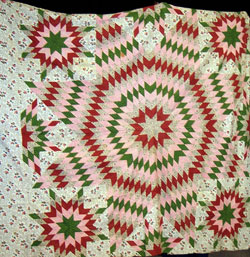
For example, the Star of Bethlehem, an early 19th century quilt pattern is also called Lone Star, a term which came later in the century and is believed to have started in Texas, the Lone Star state. The name difference is regional, but both depict the same pattern and style and the names are used interchangeably today. There is no other quilt style exactly like it. The way it is made changes, but the finished look of one large star made from rows of diamond shaped pieces covering the quilt top is the same through time. It is the manner of style in which the border and the corners are treated, and the fabrics being prints or solid colors that help determine if it’s age is early or later, regardless of what they call it.
Getting a Deeper Understanding
The style of a quilt is the first thing I see when I view a quilt, whether online, in an antique shop or booth, on exhibit or in an auction. A quilt’s fabric is hard to date from a distance, but the style jumps right out and gets the dating process under way quickly. My training to become a psychologist taught me the value of deductive reasoning using the decision (diagnostic) tree. As I go through the various aspects of the quilt, I weigh each characteristic against the era the style suggests from the start and in this way quickly determine the most likely circa date in which the quilt was made.

I do this on the spot during a quilt lecture using the audience’s quilts which I don’t see fully open until they are opened on stage. On the internet, I refer to scans of full shots of the front and back and close-ups of the binding, fabrics, and quilting. Of course there is always a disclaimer with any antique viewed on-line, but things can be overlooked in an antique shop as well. Good questions are asked of the owner to possibly help settle questions the quilt’s clues ask. This is especially important when evaluating a quilt’s age since they are almost never signed or dated. And even when dates are on it, a quilt’s age and value is determined by its newest feature, not its oldest.
This means that a quilt with signatures and dates in the blocks, may actually have been joined together and quilted a generation later. It is easy to assume otherwise, but take care not to jump to conclusions. About the only instance where the date can be taken as the latest feature and credible source of the quilt’s age is when the date is quilted in the quilt stitching itself on the front, as part of the overall quilt stitched pattern. Provenance is not always reliable, even when given in good faith, or when written on an old scrap of paper attached to the quilt with a pin.
In the 20th century, it was more common to name a quilt’s style using its pattern’s name. For example, four of the most common quilt styles made between 1900 and 1950 were Sunbonnet Sue, Grandmother’s Flower Garden, Dresden Plate and Double Wedding Ring. Grandmother’s Flower Garden is made with the same pattern as the late 1700s and early 1800s quilt style called Mosaic or Honeycomb. A similar style is referred to as a One-Patch Hexagon and if each fabric piece is made from a different fabric, it would be a Charm Quilt.
So names can change for a given style. Grandmother’s Flower Garden is the 20th century name; hexagons are arranged with certain colors forming particular designs, and for the 18 & 19th century mosaic style, the colors and designs the hexagons form are usually different, more varied, but not always! With this in mind, when you see or read about a hexagon quilt, if it is described as a Grandmother’s Flower Garden or as a mosaic or honeycomb, you will know what era the quilt is from. This helps when viewing an auction description, a dealer’s sales tag, or reading quilt history!
Desirability and Values

A quilt’s desirability, and therefore availability and value, fluctuates with time, decorating trends, political or historical events and discoveries, regional location, the economy and fads or colors of interest at a particular time.
Collectors tend to focus on a particular characteristic of whatever they collect, but talk to any quilt collector and they will tell you that if a quilt catches their eye and grabs their heart they will probably adopt it too.
I’ve developed a quick guide for dating antique quilts on the run while you are shopping or viewing an exhibit, at auctions, or at home with your own collection. These fold-out condensed charts will quickly point you to a good estimate of the era in which your quilt was made and describe the style so you can find it on the chart. Then you have a name for it and an era! This helps you to tell others about it and look it up in books. You can see more quilts by style here www.antiquequiltdatingguides.com and examples of my Antique Quilt Dating Guides…by Style, 1775-1900 and 1900-1950.
Kimberley Wulfert can be reached at: quiltdating@jetlink.net
Images in this article appear in the following order:
(All images courtesy Kimberly Wulfert)
1. 1940s variation on the Postage Stamp-Style quilt
2. Rare Civil War commemorative fabric, with and canons. Strippey Style c. 1870, Massachusettes
3. Bethlehem top c. 1840
4. Elongated 9-patch blocks c. 1840, later set with 1880 – 1920s pink fabric sashing.
5. Ever popular indigo and white quilt, two-color style c. 1850, New York
Do you have an article you’d like us to publish as a guest column in The Collectors Weekly? Let us know.
 Self-Righteous Devils: What Ozark Vigilantes of the 1880s Reveal About Modern America
 Down the Rabbit Hole: How One Collector Discovered a World of Cast-Iron Doorstops
 For Collectors, Clear Is the New Black
 Fashion to Die For: Did an Addiction to Fads Lead Marie Antoinette to the Guillotine?
 Stuck on Colorforms, the Two-Dimensional Toy Beloved By Mid-Century Modern Kids
 QuiltsQuiltmaking and patchwork have been popular pastimes in the U.S. since the …
 Mari Tepper: Laying it on the Line
 Nice Ice: Valerie Hammond on the Genteel Charm of Vintage Canadian Costume Jewelry
 How Jim Heimann Got Crazy for California Architecture
 Modernist Man: Jock Peters May Be the Most Influential Architect You've Never Heard Of
 Meet Cute: Were Kokeshi Dolls the Models for Hello Kitty, Pokemon, and Be@rbrick?
 When the King of Comedy Posters Set His Surreal Sights on the World of Rock 'n' Roll
 How One Artist Makes New Art From Old Coloring Books and Found Photos
 Say Cheese! How Bad Photography Has Changed Our Definition of Good Pictures
 Middle Earthenware: One Family's Quest to Reclaim Its Place in British Pottery History
 Fancy Fowl: How an Evil Sea Captain and a Beloved Queen Made the World Crave KFC
I recently purchased a handmade quilt, it noticed on the underside it has the words “White Rock” and an emblem I can’t make out. Do you have any information on this or any suggestions where I can research this quilt? I would appreciate any help you may be able to give me.
Sincerely,
Victoria
I recently purchased an “antique” handmade grandmothers garden doll quilt. I love to research my purchases. It appears to be 1930 fabric. Could you make an suggestions on how to research/date an antique doll quilt? I have not been able to find any detailed information on dating antique doll quilts. I would appreciate any help you may be able to give me.
Best Wishes to you and your family,
Mary Beth
My mother (age 82)just gave me several quilts she inherited from her aunt, who died about 10 years ago in her 90’s. They are what I think is called primitive quilts, very old, maybe 80-100 yrs,with coarse backing (flour or feed sacks), pieced by hand, with cotton batting. They have not been washed anytime recently, have some staining and minor tears which are unrepaired. They were definitely made by relatives in Alabama. I don’t know where to start to determine age, style, or value. Please help…
We have a family made civil war commemorative needlepoint. This is quite large 24″ sq. (approx.) This consists of a background of folded flags with a representation of the GAR veteran’s membership medal centered. I believe it was made around 1881-5 for either the 20th anniversary of the end of the war, or perhaps for the 25th of the beginning either way, I would love any info you might be able to offer. Was this a pattern offered in a womans magazine or perhaps a design/kit through the GAR/womens relief corp? It is all needlework except for some 3-d looking pieces (the eagle and star portion of the medal). thank you for any help.
We have inherited quilts (some 20th century some older) from mother in laws estate. Family has chosen ones they wish to keep. What is best way to sell the remaining quilts?
We have a “puff/filled” quilt which appears to be many separate “pockets” filled with a strange filling (looks like some kind of cellulose?) It is very heavy, about crib size, but far to heavy to cover a baby. Any ideas? Can’t find anything like it. Joan Barry
what does a coin in the corner of a old quilt mean? thanks
I inherited a very old quilt passed down for 3-4 generations but never used the last 30 years. Very heavy cotton batting. 1″ squares and all very dark /black colors and I think some flour sacking used as well. I’d like to learn more about it to pass on to my family. We are Mayflower Society and D.A.R. can you help? Thank you
My Mother(she is 86) has given me some antique quilting pieces her Grandmother cut out. One set is for a Dreden Plate pattern and she thought the other pieces in a box were for Grandmother’s Flower Garden. Upon opening the box the pieces are not hexagonal but rectangular in shape. Can anyone tell me what pattern this would be, possibly something popular in the late 1800’s to early 1900’s. Thank you in advance.
I have an antique. Quilt made by my mothers aunt early 1910 to 20. It is in perfect condition, I just want to know who collects and displays these quilts. I would like to have it be remembered in their names. If you know where I can call or write. Please let me know. They lived in Canada and Maine
I enjoyed reading your articles but could not find your quilt dating guide.
Thank you,
Catherine
Could not find the quilt dating guide. Would appreciate having, as I am trying to date several family quilts.
I have some old family quilts with small maybe 1/2 by 1/4 inch brass clips on one corner. One is A1100 – what does this mean – they appear hand stitched and are around 70 + years old
Where an I get information on pricing a very old quilt?
I inherited 3 quilts made by my Grandmother. Born 1886 / died 1971. The quilts are old, hand stitched with cotton batting. One has parts of an old feed sack. Each has their own beautiful pattern.
They have been stored a long time, not recently washed, are in lightly to very lightly used but excellent condition. They were made in Arkansas. How or where do I begin to determine their style and value. Thank you.
I have an antique quilt that my mother told me was made by her grandmother and handed down. My mother-in-law, who quilted all her life looked at the stitches and called them by name, she said she had known about them but had never seen one before. I am just trying to find the name of the stitch. All kids and grandkids have no interest in hand me downs like this, so I am trying to figure out what to do to ensure it keeps its own life. I just past the good old 68, so who knows. Thanks