Often the criticism of vintage ads focuses on their inherent sexism, racism, or other displays of social prejudices, which we find laughable today, despite their continued presence. But what about ads that steered consumers into dangerous territory, espousing outmoded scientific evidence or misleading half-truths to convince people that appallingly toxic products, or even deadly ones, were actually good for them?
While some faulty campaigns were merely the victims of evolving scientific knowledge, many blatantly ignored facts in their race for the dollar, using so-called experts to promote products terrible for public health, like cigarettes. Revered professionals like doctors and scientists routinely told us precisely the wrong things to do, as they are likely still doing today.
“Diet Hint: Sugar might just be the willpower you need to curb your appetite.”
We may take comfort in feeling we’re far beyond the bad old days of deceptive advertising, but our current obesity epidemic suggests exactly the opposite: We’ve simply traded effects like lung cancer and emphysema for diabetes and heart disease.
So here’s a look back at 10 colossally painful advertisements, which make you wonder: What modern “health” products – vitamin water, granola bars, acai berry supplements – might look a little more evil in the future?
1. Junk Food, Now Fortified with Vitamins and Minerals
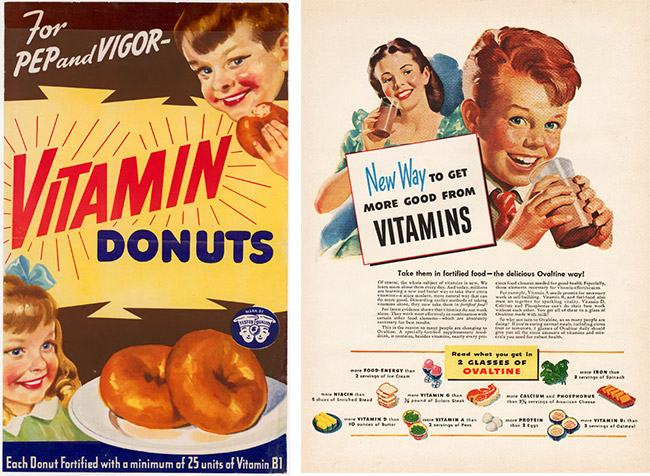
Disguising empty calories with healthful nutritional values has been a trope of the processed food world ever since vitamins were first discovered in the 1910s. This 1942 poster for “Vitamin Donuts” may be a little hard to swallow today, but Ovaltine’s reputation as a health drink is still being disputed, a powerful testament to simple brand positioning. But let’s be real, we’re talking about powdered chocolate milk made by Nestlé, the company who brought us such healthy foods as Butterfinger candy bars and Häagen-Dazs ice cream.
The Ovaltine ad from 1947 still boggles the mind with its display of so many nutritional perks packed into two glasses of powdered milk, and seems eerily similar to the many supposed benefits contained in drinks like Vitamin Water or Gatorade. In reality, even the benefits of ordinary vitamin supplements are now being questioned, despite the fact that around half of American adults take them regularly.
2. Let Them Eat Lead
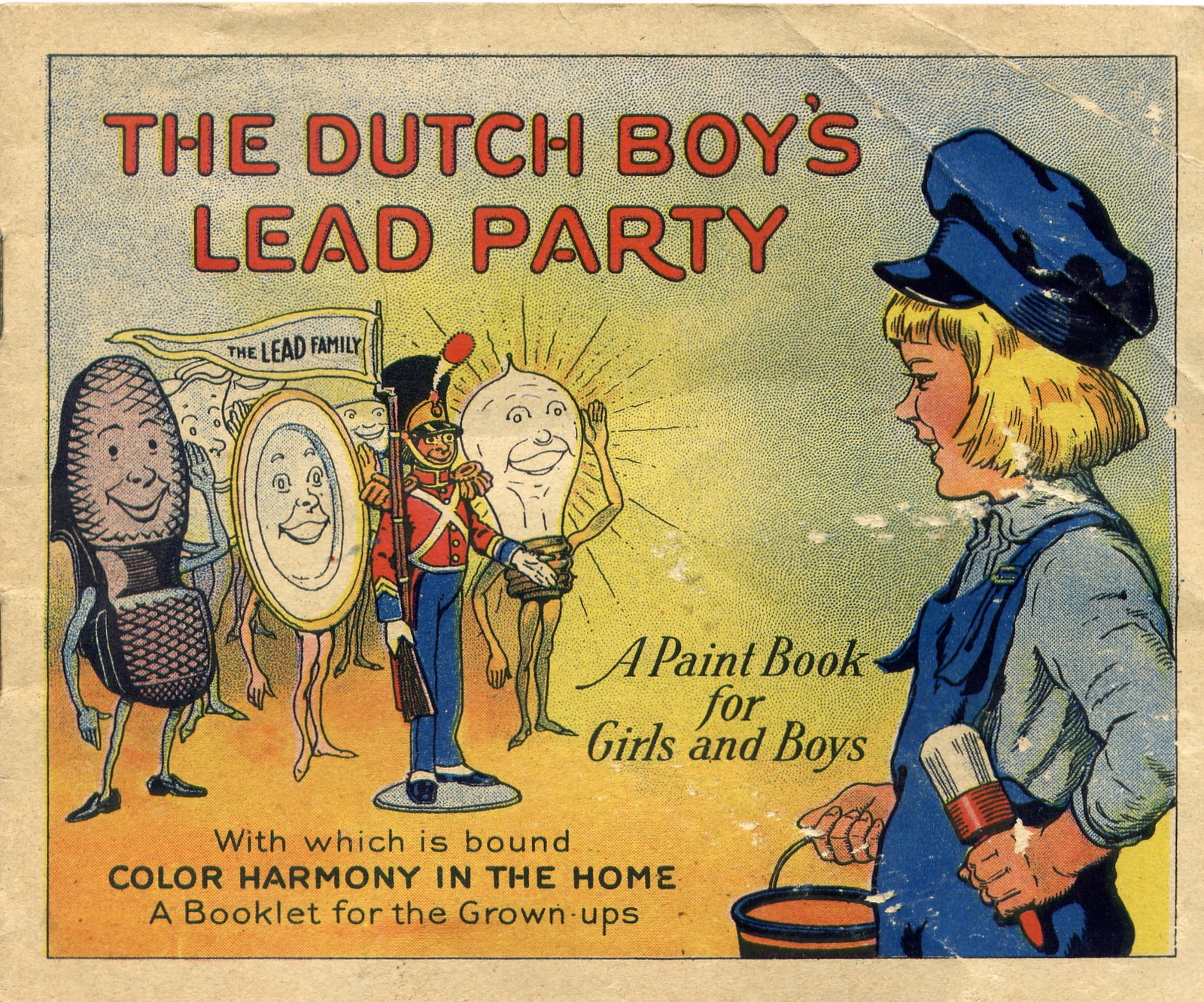
The most heartbreaking part of this 1923 brochure is its emphasis on kids having fun with the whole “Lead Family” of products, whose presence in everything from their nursery walls to their windup toys made young children particularly susceptible to its dangers. Combined with lead paint’s seductively sweet flavor, putting kids in environments literally covered with the stuff was a recipe for disaster.
In fact, the effects of lead poisoning (brain damage, seizures, hypertension, etc.) were known long before the Consumer Product Safety Commission finally banned them in 1977; the industry had simply refused to acknowledge them. An article by Jack Lewis published in the EPA Journal in 1985 covers lead’s history as an additive and poison, and how we’ve consistently downplayed its adverse effects. Lewis writes:
“The Romans were aware that lead could cause serious health problems, even madness and death. However, they were so fond of its diverse uses that they minimized the hazards it posed. Romans of yesteryear, like Americans of today, equated limited exposure to lead with limited risk.”
3. 7-Up is for Babies

Not only were sugary soft-drinks great for adults, but sodas like 7-Up used to help babies grow up strong and fit, or so these ads from 1955 and 1953 would have you believe. That’s pretty disturbing, considering that childhood obesity, linked arm-in-arm with massive soda intake, is shortening our youngest generation’s lifespan. The high amount of refined sugar in soda has also been shown to be particularly harmful for children.
Today it seems crazy to show a baby drinking a soda, as the tide finally turns against the sugary drinks: School districts across the nation have removed soda machines from their schools and New York City’s Board of Health has proposed a ban on over-sized sodas. However, many adults today opt to serve kids “healthy” fruit juice, which may be just as bad, despite its deceptive nutritional marketing.
4. Cigarettes: Just What the Doctor Ordered
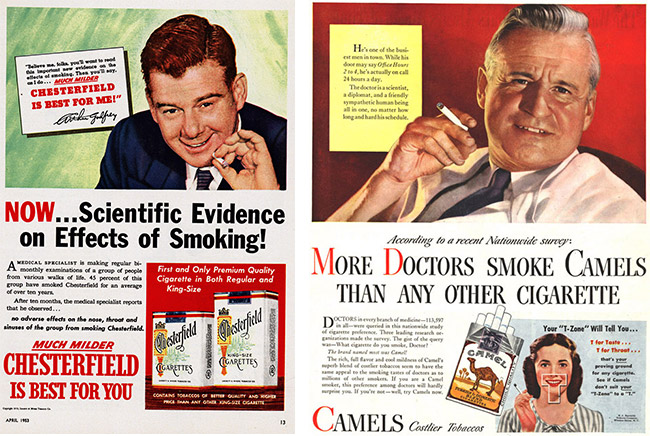
Camel’s campaign featuring doctor endorsements is probably the most familiar instance of false advertising, seen here in an ad from 1948. Yet almost every cigarette company twisted science to support its products, including Chesterfield’s 1953 ads, which rephrased expert findings to show that smoking had “no adverse effect.” Long after 1950, when Morton Levin published his definitive study linking smoking to lung cancer, experts continued to imply that there were other factors causing cancer and lung disease.
Though the industry has been seriously weakened over the past 20 years, primarily by government regulation, Big Tobacco is still issuing misleading health information in an attempt to reap a profit.
5. Feminine Hygiene: The Original Home Wrecker

Long before Lysol was reinvented as the caustic household cleaner we know today, the same substance was basically promoted for use as a feminine hygiene product. These Lysol ads from 1948 tout the internal use of poisonous Lysol as a marriage saver. To sum up the message: if you weren’t so dirty down there, he would love you more.
In a time when speaking about sex was even more frowned upon than today, a whole spectrum of sexual products, including vibrators and contraceptives, was marketed with campaigns focusing on their dubious health benefits for women.
6. Plastics, Plastics, Everywhere
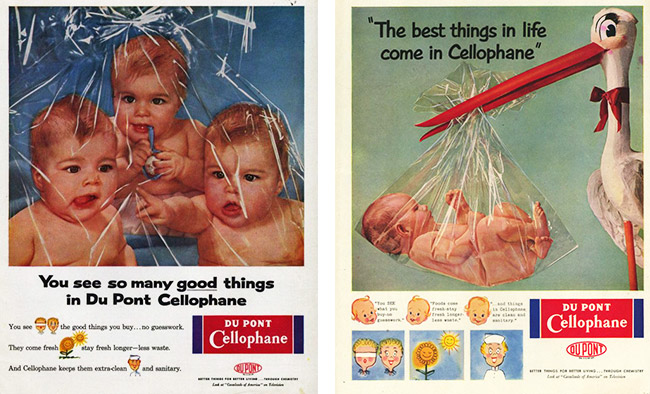
Suffocating babies in Cellophane! A bunch of infants tied up in clear cellophane packaging is pretty frightening to modern viewers, but at the time, these ads were just plain cute. When these Du Pont Cellophane ads came out in 1954, things like plastic grocery bags weren’t a ubiquitous part of American culture. Only after plastic bags became widespread during the 1970s did their strangulating qualities become frighteningly clear.
7. The Meat Mystery

In post-World War II America, eating more red meat seemed like a great way to keep yourself “in trim,” at least according to these two ads, from 1956 and 1946. Like other food fads, this campaign was orchestrated by the American Meat Institute, a lobbying group that is still working to improve public and political opinion toward its products. Maybe that’s why almost nobody in America knows that nutritionists generally recommend only 2-3 servings of red meat per week. And don’t get the experts started on sodium nitrite in processed meat.
We now know that eating too much meat increases the risk of heart disease and cancer. Yet industry trade groups are still creating food trends to spur sales or combat negative public stereotypes: Think of modern wonder-foods like agave nectar or chia seeds that seemed to appear from the heavens, as well as the bitterly argued corn syrup campaign.
8. Dieting? Try Sugar
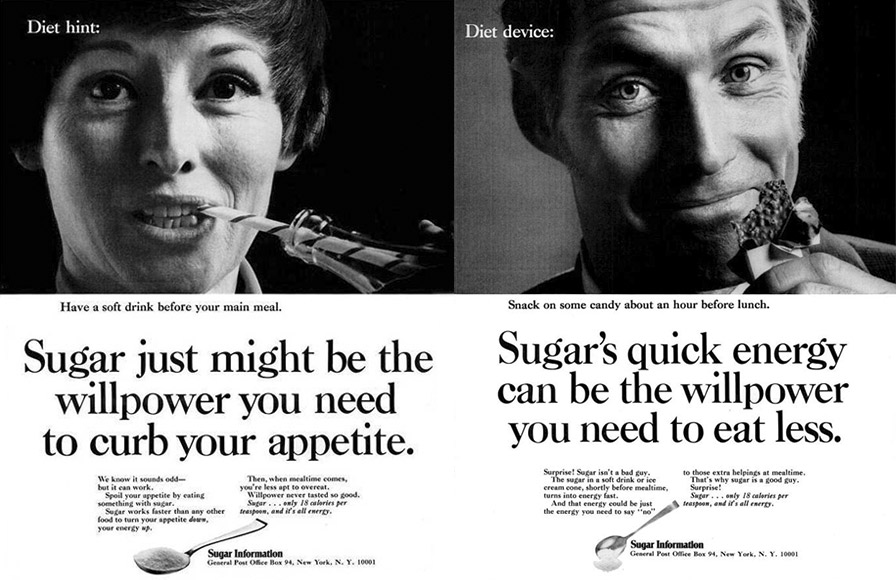
In a time before the current widespread obesity epidemic, sugar companies wanted shoppers to believe that a sweet treat would somehow inspire you to eat less. These ads from 1969 coach readers to “have a soft drink before your main meal” or “snack on some candy an hour before lunch.” Their strange logic isn’t even backed by a company name, though the campaign does include a helpful mailing address for “Sugar Information.” Talk about creepy.
Now refined sugar is presented as the dieter’s enemy, and is thought to make you want to eat more rather than less.
9. Shock Your Way to Physical Perfection

In 1922, “Violet Rays” were said to cure pretty much anything that ailed you. This Vi-Rex device plugged into a light socket so users could give themselves home shock-treatments, which would supposedly make you “vital, compelling, and magnetic.” Various recalls and lawsuits erupted throughout the U.S., forcing the FDA to finally prohibit their manufacture. The last batch of Violet Ray products was seized in 1951.
Just Google “light therapy” to find a range of new infrared devices whose claims to prevent everything from aging to anxiety sound pretty darn familiar.
10. DDT For You and Me
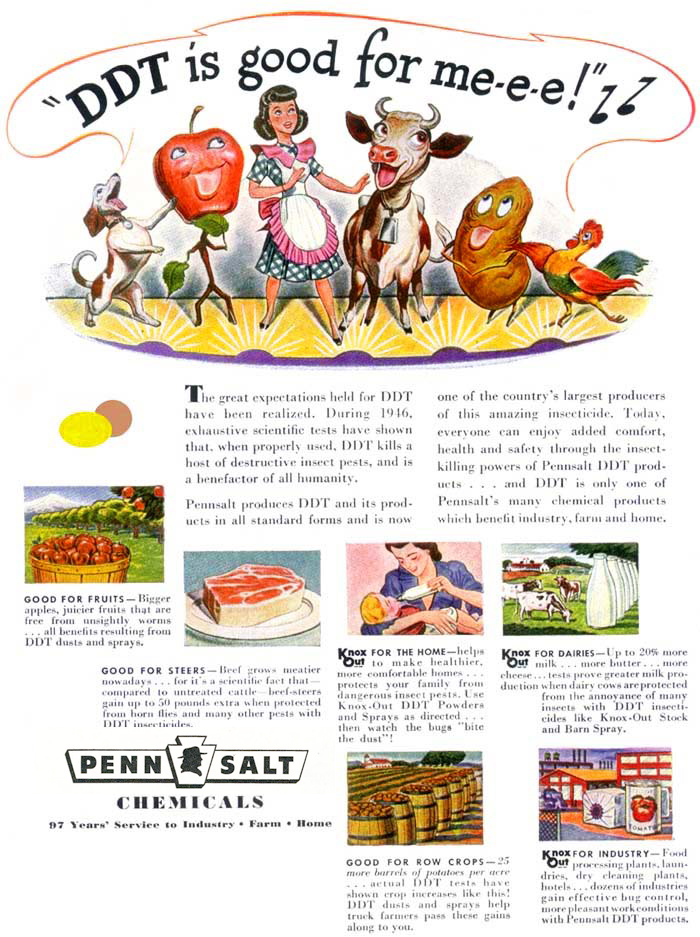
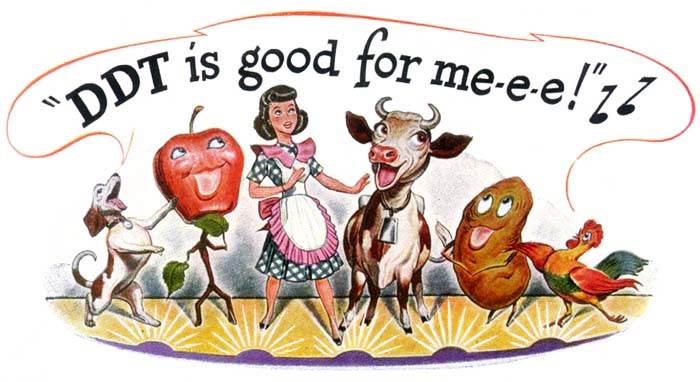
This ad for “Penn Salt Chemicals” from 1947 shows a range of dangerous applications for now-illegal DDT, from agricultural sprays to household pesticides. Particularly disturbing is the image of a mother and infant, above the caption stating that DDT “helps make healthier, more comfortable homes.” Not quite.
While effective in eliminating dangerous mosquitoes that carry malaria, DDT also has a variety of hazardous effects: Especially among young children, the chemical has been shown to damage the nervous, immune, endocrine, and neurological systems, not to mention its devastating influence on the natural environment. The spread of DDT across mid-century America is mirrored today by the success of Monsanto (one of the companies that originally manufactured DDT) in placing its genetically modified products on store shelves before researchers have a full understanding of their larger ecological impacts.

 When the Wild Imagination of Dr. Seuss Fueled Big Oil
 Girlie Pens, Again? Why Ordinary Things Go Pink
 When the Wild Imagination of Dr. Seuss Fueled Big Oil
 An Un-Conventional Thirst: Collecting 7Up's Most Beautiful, Hallucinatory Billboards
 AdvertisingFrom colorful Victorian trade cards of the 1870s to the Super Bowl commerci…
 Mari Tepper: Laying it on the Line
 Nice Ice: Valerie Hammond on the Genteel Charm of Vintage Canadian Costume Jewelry
 How Jim Heimann Got Crazy for California Architecture
 Modernist Man: Jock Peters May Be the Most Influential Architect You've Never Heard Of
 Meet Cute: Were Kokeshi Dolls the Models for Hello Kitty, Pokemon, and Be@rbrick?
 When the King of Comedy Posters Set His Surreal Sights on the World of Rock 'n' Roll
 How One Artist Makes New Art From Old Coloring Books and Found Photos
 Say Cheese! How Bad Photography Has Changed Our Definition of Good Pictures
 Middle Earthenware: One Family's Quest to Reclaim Its Place in British Pottery History
 Fancy Fowl: How an Evil Sea Captain and a Beloved Queen Made the World Crave KFC
One day I believe that we will look back and shake our heads in disbelief at the meat, dairy and egg industries and all the brainwashing and lies they spread. Those milk moustaches? Well the countries who drink the most cows milk have the highest rates of osteoporosis! There are many studies, but as a first step, The China Study is a comprehensive one published in book form. Not only are those industries unhealthy but they are cruel to animals and environmentally destructive. No wonder people like Bill Clinton and Al Gore are going plant-based.
The best part of this was reading all the comments and how everyone is sure they are right in their comment, but most of them are opposing another in some fashion.
Also, I love the links that are included, providing backup to the claims in the comments. I’m not picking on any particular link but seeing as how everyone disagrees with each other, I’m sure for every link one person provides that someone else can probably find two more links disproving it. As it goes, you can’t believe everything read. (My favourites though are the Wikipedia links as backup to claims.)
Nothing is true unless we believe it is. We all have our own truths and we all read, hear, and see different things that provide us our truths. We are not always all going to agree on everything, that’s just how it is.
WAIT! I just realized… I think there is one thing everyone agrees on – well no one commented otherwise as disagreeing with the author… lead is bad. Now, go forth, start mutual friendships based on that – and remember to not take everything so seriously.
I should say, just so no one thinks otherwise, of course I don’t agree with everything the author has to say… if God didn’t want us to eat cows, he wouldn’t have made them so tasty. :)
The problem with American diets is not red meats, etc. but gluttony. Everything in moderation(except DDT, cocaine, heroin, GMO’s, lead, and other common sense items) I believe that there are genetic and hormonal factors involved in obesity not just diet and exercise. As far as GMO’s go well I would like to see a study done comparing the introduction of GMO to our food supply and cancer rates. People should look at the daily recommended amounts of nutrients and eat accordingly. Also grains are high in carbohydrates, carbohydrates are made up of simple sugars, and we wonder why the obesity epidemic is on the rise.
My dad was an agricultural engineer who regularly used DDT and Chlordane at work and at home. He was one of many employees who died of cancer. Cancer does not run in his family. My mom also got a different type of cancer and all their pets died of cancer, as did their next door neighbor.
DDT threatened bird populations, the bird ate DDT infected bugs and it made
Their eggs so brittle that they cracked when they tried to hatch them. Many bird species are still recovering from near exticntion due to DDT.
I sincerely hope that it won’t be too much longer before ads for GARDISIL (all vaccines, actually) are included in a “look back” of this sort.
The violet wand is still in use today and has a HUGE following. It’s used for muscle therapy as well as used for fetish play. Don’t knock it till ya try it!! ( ; – )
http://en.wikipedia.org/wiki/Cellophane
so it 100% biodegredable – it;s not a pastic )
A surprising (not really) group of people coming out for sugar, fat DDT, genetic mutation of foods and a lot of other things we know are extraordinarily dangerous. Even a couple swearing smoking wasn’t that bad for us. They’ve been showing up around the web. They get paid by advertisers from various corporations to post this kind of drivel. It’s to try to defuse the amazing amount of damage they perpetrate on the country. The people posting in favor of these poisons believe having a job, even if it pays poorly, is better than none. I don’t mind if these people are trying to get along. I really don’t like them lying and shilling for corporations that would gladly kill us off for profits.
I used to give raptor demonstrations/talks and one point I was sure to make is that we are to be forgiven for this stuff! That generation was acting on their best information. Did they know all the harmful effects? No. Did DDT save farmers from the cotton boll weevil and children from malaria? Yes. Of course we’ve wised up. We were handed the information TO wise up, so it would have been tragic and unethical not to. But don’t call this article, “What Were We Thinking?” !
***To my knowledge, the U.S. is the only country to ban DDT. Mexico still uses it and it is carried through evaporation into the U.S. where it falls to earth with rain and snow. The Great Lakes is full of DDT!!! On the plus side, DDT was highly successful in killing mosquitoes carrying malaria.
I was good friends with Morton Levin’s daughter. She was in her 80’s when she told me her dad quit smoking cold turkey. When her mom asked,”Why aren’t you smoking anymore?” He replied,”The rats died.”
DDT has never been proven to make eggs brittle, just as GMO’s have never been proven to cause harm. The people who believe otherwise are the same people who have been trying to cram “global warming” down our throats. Find another religion already, that one isn’t working out for you.
DDT certainly WILL make your home healthier and more comfortable if you have bedbugs. I’m not singing DDT’s praises, but banning it is THE reason bedbugs are making a comeback.
All vaccines? Really? I bet if small pix was released as bioterror you’d be first in line demanding that vaccine. Educate yourself about how many lives have been saved due to vaccines.
I have not seen the one and only word in any of these posts that could probably save everything…..MODERATION. (thank you)
I have a feeling in 20 years, those ads saying ”high fructose corn syrup is an all natural sweetner and healthy and good for you” will show up in one of these articles.
“We now know that eating too much meat increases the risk of heart disease and cancer.”
Incorrect. Research suggests exactly the opposite. But nutrition “science” is so complex and so polluted by dogma and politics that we will never have a very clear picture of the “ideal diet.” But a heavy meat and animal fat diet??? It’s pretty much a slam dunk that a diet such as that is beneficial… with no link to heart disease and statistically insignificant link to various cancers (Forks over Knives invented plenty of correlations where none existed and the China Study (as are most studies surrounding nutrition) is plagued with issues… and in fact pretty much exonerates animal fats and proteans).
I´m not a scientist, but I can say by experience that ALMOST everything is good and bad at the same time. It all depends in how we use things. Meat,for instance, doesn’t kill people unless they eat very fatty ones every single day. I’m Argentine and we all eat red meat a few times a week if we can afford it. My maternal granny is 101 and she ate the same type of foods all her life: red meat AND its fat, eggs, bread and butter, vegetables- only if they are fried with garlic,onion and peppers,potatoes in all its variants( fried included) and tons of sugar in her coffee and tea with full-cream milk. She’s lean and healthy as her sister who is already 103. Their 4 siblings weren’t very old as them when they died if you wonder it might be genetic.
Maybe the reason is they don’t eat everyday the same food or in big portions and they never eat processed food. My granny never eats mashed potatoes unless it’s made from real potatoes. Everything is homemade. And her bones are so strong she never broke one in all the times she fell from the ladder while painting her house (she doesn’t do that anymore, by the way).
Other things, as cigarrettes, are really bad but they still don’t kill everyone who does them. Why? Maybe because, as a doctor says, ‘doesn’t fall ill who wants but who can’. We aren’t a simple machine that receives fuel and works. We are a compound of little things and scientists don’t know our body completely yet. They are full of theories and hypothesis but only a handful or less are already a fact. But I’m pretty sure it’s not what we eat , breath or drink by itself but how we live in general. A person that never gets up from a chair, doesn’t go out to feel the sun and air,doesn’t even walk around the block once a day, is more likely to live less and worse,fatter and weaker.
Shortly after WWII my grandfather started a business in Redbluff, CA where he would go from farm to farm spraying DDT on cattle because of the Botfly problem (they would lay eggs under the skin of cows- yuck). He did that for years, of course with no mask or protective gear.
He lived to 85 and when he did pass it was because of many reasons, but mainly problems with his lungs due to, what else… SMOKING! Even though he had quit smoking back in the 1980’s.
It’s just interesting that he didn’t have any cancer or any apparent side-effects from the DDT… Just something to ponder.
The Lysol for feminine hygiene really creeps me out…. I can’t imagine using that as a douche….. that had to be really bad down there….. yikes! And these poor women, after reading these ads, were probably buying this stuff by the gallon in hopes of improving their marriages.
The effect of DDT in eliminating malaria in the USA has been grossly overestimated. What actually eliminated malaria in the USA was the wholesale destruction of our wetlands.
I remember running behind the DDT truck in the Cloud! We thought it was alot of Fun!!
Hind sight is always 20 20.
Also when the DDT spray truck used to come down the street in the summer back in the 1950s us kids used to run out and play in the fog.
At the time no one thought of it as dangerous.
I am still here today and feel just fine so I guess DDT did not get every one.
I was born in 1946, so these ads were around while I was growing up. I still find them rather shocking! And I’m certain that the things that we believe today that are bad or good for us will be found in the future to be just so much BS. We didn’t eat a lot of meat back then because it wasn’t high on our parents’ financial priority list. We ate a lot of fat. My whole life, at 5’8″, I weighed around 125-135 lbs. When the low-fat/no-fat craze hit I was annoyed because in order to make things taste good after removing the fat, other things are added. I used to drink fresh milk right after my great-uncle milked the cows. So very good, that nice warm milk full of fat!! I’ve only found a couple of full-fat yogurts & the rest of that case is filled with no-fat.
I’ve discovered over the years that sugar will make me gain weight & fat will help me lose it. I don’t eat much meat, & no red meat at all, due to the inflammatory side effects that make my arthritis pain worse. I also don’t eat a lot of grains. When I want mac n cheese I use some sort of vegetable, like spaghetti squash, & of course full fat cheese. I am unbelievably healthy with lower blood pressure, not heart disease, my lungs function beautifully, etc. As long as this continues, I will continue the way that I eat & live. Also, I don’t take vitamin supplements; I buy fresh foods instead.
And the truth is that there is plenty of anecdotal evidence that people survived the side effects of these poisons without apparent damage. And lots of people live many decades having used cigarettes, etc. their entire lives. As was pointed out above, we are not machines. We are each a unique & complex human being who will be affected differently from our neighbors. The thing is to try different things & find out what is healthiest for you.
Just a note about Nestle: a person pointed out that “in all fairness they have also brought us baby formula”. You know what they did with it in Africa? Gave it away to mother freely for about 6 months and then would start charging them for it. Why? Because in that time the mother’s breasts would have dried up and would no longer be producing enough milk for their children. Scumbags.
No, besides the additives in food (sugars and salts where not needed but added for ‘flavor’), people are fatter now because we have more and do less to work it off. From household chores to the labor industries we’ve traded for tech and desk job related, plus longer hours watching tv sports than playing actual sports, our sedentary lifestyles are a bit different than our grandparents birth decades.
As for chemical damages, some pesticides and artificial additives didn’t affect the generation that ingested them, but the following ones in increased birth defects and genetic issues. Yes, those folks who ingested radioactive snake oils or wore physically damaging clothing/accessories bore immediate harm, but the chemical things could manifest further down the family line.
In Florida in the 1940s and 50s, Drive-ln movie theaters gave each car a hand sprayer filled with DDT, to kill mosquitos. We’d roll up the car windows and spray each others bare skin with DDT. We also found much joy riding our bikes behind the trucks that sprayed vast, thick clouds of DDT up and down our residential streets. I LOVED the smell of it! Now I’m 76, in good health, as are so many friends who grew up in that era. I realize that DDT is toxic, but I think there are environmental situations involving humans that were never studied.
Wow, love a lively debate and that people wish to take control of their own health and well being by informing themselves. A fascinating read both the article and the comments.
What I would like to add is each persons biochemistry is individual. While we share the same organs and biology, our life experience in every way individualises our health experience with some input from our genetics and predispositions.
Our world, due to industrialisation throughout has altered the toxicity of our planet forever. For example, all the tuna caught off LA recently tested positive for radiation from the reactor meltdown in Japan. Much the same effects (and other damaging environmental ones that directly impact the quality of all life including our own) occurred in Europe as a result of Chernobyl. Our world is connected.
The bigger the animal, the bigger the toxic load. As such when making food choices, we need to check where and how our food is grown or managed. Then we have to choose how much to take in and what form. Fruit, vegetables, nuts and beans are smaller and therefore (dependent on how its grown) should be the least toxic. Meat would be a greater amount and we need to make an informed choice again, regarding how the animals are treated and how much we need versus how much we want.
Whole foods (excluding grains – as we are not grass fed animals – which is the basis of grains, genetically modified grass) fruit, vegetables, nuts, seeds, clean unprocessed dairy and beans. Naturally raised animal products. (This assumes an exclusion of corn and soy and processed marketed foods that no longer resemble – food, as far as your body chemistry is concerned and its the thing that determines your health, not your taste buds or an advertisement.)
Your body is actually a highly developed machine that requires certain types of fuel. If you were to look into the vitamins and minerals (its fuels) needed for good health – fresh live foods prevail, and green leafy vegetables are a stand out.
Many of the products mentioned are not essential for health and as discussed are detrimental. Economics should not be determining how healthy we are but our current system does. Its a slow process of change but with a greater awareness, its changing. At the time of many of the ads, Doctor’s word was gospel. People now look to second opinions and alternative practices of the past, including a nutritional approach when faced with disease or ill health.
We can’t turn back time but we can move forward taking personal responsibility for the vehicle within which we travel through this life – our own bodies. And with our purchasing choices, we can change our world.
Just because you’re alive doesn’t mean DDT is safe. Number 1 DDT is a toxin which affects certain people more than others (for instance people with the very common MTHFR genetic defect). Secondly, I would be VERY surprised if you don’t have some health issues some of which may or may not have been caused by DDT. Ever had cancer, lupus, MS, diabetes, alopecia, autism, depression, anxiety, panic, eczema, acid reflux, gall bladder disease? I’m so tired of people saying “I’m alive”. Most people I know who say that are far from healthy and yet they defend the toxins responsible for their health woes. wake up!
Very clever, trying to connect kids drinking sugary drinks in the 50s to today’s childhood obesity. The 50s is my generation. (This isn’t just another “I’m alive” comment, read the whole thing.)
Everybody was drinking Coke and 7-Up and eating at A&W, Dog & Suds and McDonald’s — where coconut oil was routinely used. People cooked with it all the time. Where were all the fat people? Sure there have always been some, because that’s partly something that runs in families. But if there’s an obesity epidemic today, why?
The “fat epidemic” is partly a matter of cultural and government focus — what is considered “overweight” now used to be average (there was no Size 0) — and partly real. It started in the 80s when the corn and soybean companies decided we were buying too much coconut and palm oil — most of it from Southeast Asia — and started an ad campaign about “dangerous foreign oils” or “tropical oils”. You can collect these ads too. Proctor & Gamble (Crisco) probably had dozens of them. There were actually Senate hearings — doctors like C. Everett Koop trying to set the record straight. This BS goes clear back to 1920-22 when the hog and dairy industries tried to pull the same thing and failed. This time, the industries won. That’s when we got the hydrogenated vegetable oils and when people’s weight began to go up, the subsequent “fat is bad” thing. Then you got the additives (and their side effects) to make things taste better. Replacing sugar with corn syrup is more fallout from the corn industry.
What you want are medium and short chain fats. They’re much easier to digest and don’t suppress your metabolism.
Disclaimer: I wasn’t paid to write the above, and I’m not doing “coconut oil = total miracle superfood” (although I do like the stuff). I just look things up to be an informed consumer.
I’ve read all of the comments and agree with most.
Moderation is key with everything in life.
Anything man made or artificial is not going to be good for the planet or body.
There is a lot more to obesity than just diet. Genetics play a role as well as bring active and exercising. In today’s world people are far too busy being entertained with all of the technology while sitting on their asses. Movies, Internet, texting, ebaying, facebooking, mp3 playing, playstation, cable,….. back in the day kids ran the neighborhood til dark and people made do with what they had like walking and bicycles.
What I see everyday at work waiting on the general public is a society so addicted to attention that they can’t even put their phone down long enough to politely place an order or stuff their face with food. That’s scary and offensive.
Um, “light therapy” nowadays refers mostly to lamps (that emit 10k lux and little-to-no UV rays) used in seasonal affective disorder therapy. Not much to do with pseudo-science, I’m afraid.
1- It’s a logic failure to associate a soda ad for babies from the ’50s with child obesity today. Namely because child obesity was fairly rare until the 1990s is more due to a lack of exercise, than diet.
2- DDT, OK ask people living in Sub-Saharan Africa about the evils of DDT, because malaria is back and killing children and reducing adult life expectancy. In actuality, it was the DOSAGE, not DDT itself that was causing health problems. Typically it was heavily sprayed/coated (because older 1940s era bugbombs worked that way) rather than using a MUCH smaller amount.
People still believe “Silent Spring” the phony warning put out by a non-scientist with nutty death-fantasies, there are quite a number of actual, real, honest to good ness scientists who blame Rachel Carlson for being indirectly responsible for more deaths than the non-deadly DDT http://www.21stcenturysciencetech.com/articles/summ02/Carson.html Someone posted a link to “PAN: Pesticide Action Network” which purports itself as a “thinktank”, I can purport myself as Marilyn Monroe re-incarnated in the flesh if I want to. PAN suggests that those who claim DDT is “alright” are the same numbnuts that claim there is no “climate change” and that “smoking causes no harm”! What?? Nonsense. Just a cursory glance at the PAN site is enough to get one’s “UN-speak” radar beeping.
DDT was, and is, a wonder drug. Although I did not pore over this entire post written here, I wonder if it failed to mention the casual high people got off of DDT sprays? Yes, people did, they likened it to laughing gas (I have not researched as to whether it is a compound in DDT or the accellerants used in the spraying however). Like I said, I wince when I hear anyone making a reference to Silent Spring even today, it was bad science- er, NO science, just conjecture and fantasy- then, and even worse now
No one “shocked themselves to health” with Violet Rays, it was just a light, no part of the body was to be in contact with the lamp, bulb, or any part of the device.
It’s easy. Our grandparents WORKED (not sitting), WALKED (why would anyone walk today, we have an air conditioned car), and WORE themselves out.
We SIT, we WATCH, we WHINE about having to work. We never need to leave the car to drive thru the zillions of fast food joints. We supersize all the foods and we get HOSTILE and OFFENDED when a truth teller says we are FAT (not Big and Beautiful). We are lazier than any previous generation, have more time to play than any previous generation, but we spend more time and money to sit in front of a TV than anyone in history. And like just about every other sad commentary on our FATNESS and health, we no longer take responsibility for any of our own messes, it’s always someone else’s fault because we are a VICTIMIZED society (taught at our INSTITUTIONS of higher learning).
In my youth seeing a FAT person was a rarity, now it’s the American norm.
We are FAT, LAZY SLOBS but the blame lies elsewhere!
My Grandfather raised corn. He’d hire us kids to “paint” the tassels of corn with powdered DDT (a pail and a paint brush… just dab a little on the top of each ear).
I did this for YEARS.. (starting probably when I was 6 or 7). Not sure what was more covered… the corn or us kids….
Ill effects???? ehhhh, dont think so… (but I’ll bet there wasn’t a mosquito that bit me lived more than a few minutes afterwards…. even too this day)
The Lysol section is completely misleading. Post-sex douching was the most popular form of birth control, and Lysol was the most popular of douche. “Germs” are sperm. “The Other You” is pregnant. Sue’s “neglect” of Tom is that she refuses sex during her fertile period.
Doctors were pretty much in agreement that douching with Lysol was a terrible idea, but they also weren’t offering women better birth control options.
I’m just here doing some English homework and I find this disgusting!! Lysol to clean down there no thanks, babies in cellophane and smoking absolutely not!
thanx for sharing
Pity you have point 7 almost completely wrong. As a doctor who became vegetarian for 35 years and ended up back as mostly carnivore in the past 11 years I had to eat a lot of humble pie as to how wrong I had it.
We’ve learned nothing. I’ve recently seen mouthwash packaged in aluminum beverage cans and gelatin treats in look-alike packaging to childern’s school lunch treats containing alcohol in my food store. Accidents waiting to happen.
This is the price we pay for capitalism and excessive greed. Caveat emptor – on everything. BTW – redlight therapy is an accepted form of therapy and is not harmful – it isn’t radiation. And, it isn’t lead nor DDT.