


Posted 15 years ago
TMLAFF
(1 item)
This Nat'l Bank Note is graded 40PPQ by PMG and was issued by the First Nat'l Bank of New Bethlehem, Pa, Charter No. 4978 (Pop < 2000) and has a Ser #1! I purchased this note as a collector not as a retailer. However, it's value is elusive and probably best determined by more seasoned collectors rather than a dealer (for resale).



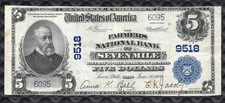
This note sold at public auction in August of 2011 for $3,450. I think it is fair to say the fair value was established then within $250 depending on the day.
correction: August 2010
Thanks,, James. I'm aware of the (sale) history of this note. However, I would not use an auction sale price any more than a dealer's appraisal for estimating the market value of an item. There's another 1882 $10 Brownback, same grade but uncertified, from a similar sized town in Pa (Montgomery), Ser #1, same FR-#, advertised for $29,500. I think the seller is fishing for Moby Dick in a small pond but the bottom line is, it's worth whatever someone's willing to pay :)
Not to be rude, but an auction result for the exact same item combined with dealers' appraisals is exactly what I would use to establish market value.
If you ever decide to sell yor car, don't ask the person that wants to buy it to tell you what it's worth! I'm sure your methodology would generate a fair price and quick sale, though. At best, I would search the archives of different auction houses, e-bay, etc. to establish an 'estimated value' based on several sale prices
Not to press the issue, but to help better understand collectors, let me ask this question:
You know that this exact same note sold at a huge public auction where every possible dealer and collector would see it. This happened less than 12 months ago. Why would you think the market value is anything but what it sold for at auction? People put notes in auctions so that they can achieve the market value. I can't think of a more perfect way to determine the market value to both collectors and dealers.
I have to agree with James on this-- unless the item was incorrectly catalogued or there were issues with taking bids at the auction, I'd say the market value has been established.
Agreed, Jason. I've bought and sold currency at 2X or more of the purchase price. You might get a representative value from several auction sales of identical currency as stated. You won't find an 1882 $10 brownback, certified to the same grade, same Fr No., etc. for anything close to $3450. Now, one exception is kids . . . I couldn't auction or sell mine for anything near to what I've invested in them!
I think the real issue here is that Terry was uninformed and paid $5,000 to a seller on ebay to buy this note, and now he is trying to justify that he didn't pay too much.
I agree that you can buy for something $50 at a major auction and maybe find someone who really needs it who will pay $100 later on in a retail setting. And you can also buy something for $3,500 at a safety deposit box auction, estate sale, or generally poorly advertised auction - and you could sell that to a collector for $7,000. However, you will have a tough time flipping something out of a major auction where every dealer and collector knew about the auction.
Interest will usually wane when there are several sales of the EXACT same item.
Part of the attraction of the Heritage Auction was that the note had not been on the market for 12 years and was advertised as such.
Currently ebay is THE market place for antiques and collectables. And, in my opinion, ebay auctions sales determine "fair market value" for most of the antiques and collectables that are bought and sold today.
Take a look at Collector's Weekly-- whenever someone wants a "value" most here cite ebay auctions as a good indicator. Appraisers readily use ebay sales as well in their valuations.
With that being said, there are bargains on ebay every day, where items don't sell for "fair market value". Many of these under market value sales are due to poor descriptions. By dropping the obvious high and low aberrations, a mean value of most items can be quickly determined-- which I would call the "fair market value"
Scott
I agree with Kevin in regards to eBay. I spent close to a year selling there and what I made was nothing more than pocket change. Granted, I wasn't putting up rare or high priced items but, having spent many days on their "sellers forums" I learned one thing that they kept repeating over and over and over again and that bit of advice was..."Don't put anything up for auction on eBAy that you wouldn't mind losing." The climate on that site is so stacked in favor of the buyers that it's become ridiculous. Many times, all the buyer has to do is file a SNAD complaint (significantly not as described) and they will get a full refund. Oftentimes, after receiving their refund, they keep the item as well. Then there are those scam artists that will have the exact same item as yours but only not in as great a condition, bid and win your item, and then switch them and send you their item that is in terrible condition. eBay is more of a headache than what it's worth in my opinion. I nearly fell out of my chair when, while on their "seller's forums", someone admitted to selling a $12,000 watch. Lo and behold, the check bounced and the buyer wasn't answering any of their e-mails. What a surprise. I'm very relieved that I jumped ship when I did and that no one bid on the real expensive items that I had posted when I was just starting out on eBay. I guess that I'm very fortunate in that regard.
I agree with both of you on SELLING on ebay.
Prices are down but it is still the market place to quickly sell an antique or collectable. And with a good representative quantity of most antiques and collectables, I still consider it to be the antiques and collectables market and representative of the "market value" of most items.
Ebay has changed the market place. Many "one of a kind" and "rare" items are no longer thought of in those terms:
"If I can find 20 of grandpas GAR medals on ebay at any given time, then it must not be as rare as I was led to believe and consequently not worth as much as I thought."
If I am selling GAR medals and I actually want to move them, my prices better be competitive with ebay. If they aren't, buyers will buy them on ebay and not from me. Most buyers that I deal with (I set up at Civil War shows) are familiar with ebay pricing and use it to gauge what they should pay for an item. Sure there are truly rare, one of a kind items that cannot be compared with an ebay item for pricing, but MOST antiques and collectables don't fall into that category.
If I can find 10 sales of a particular item on ebay completed auctions, I would call that range the "market value" of an item. I would consider a "local sale" at a higher price or lower price a deviation from market value. If it so happens that the local sale is higher than the ebay range, then that is great for the seller; however, it hasn't changed the market value. If there are 10 local sales of the same item (and the information is readily available), then I would say that market value has changed.
Better than finding 10 brownbacks on ebay-- I can find this EXACT note that sold at a well advertised, national currency auction within the last year for $3500. It apparently sold several months later for $5000. I would put the market value in the $3500- $5000 range. If the second buyer was unaware of the first sale at $3500, then I would shift the market value closer to the $3500.
I didn't say ebay sets the price for ALL antiques and collectables.
Using your $10 camera as an example: You find many on ebay selling for $10, you buy one for $10 and sell it for $25. That is great for you, but your one sale hasn't changed the market value. Market value is still $10 with a notable deviation. If you sell 10 of them of for $25, then market value has shifted.
As far as the as the snickers bars, I would say we need more data. Price doesn't determine market value-- sales price determines market value. Thousands of these snickers are sold each day and market value probably falls in the $.75 range. Additionally, I would call those that purchased several of the $1 bars uneducated consumers (or an impulse or convenience driven consumer), just as I would say the buyer of your $25 camera was not an educated buyer (or was driven by impulse). Again these are deviations and don't mean the market value has changed.
I'm not looking for support or justification (this brownback is not for sale) . . just information. If I found an 1882, $10, PMG EF40, ser #1A (sheet No. 1), same Fr, etc, etc, NBN that sold for $1000, I would have to consider that information. One other consideration is that notes issued from smaller banks/geographical areas also command a higher premium. The note I discussed in Post #3 meets all this criteria and is advertised for $29,500. I'm not using this value as an indicator since it might sell for $100! The fact is, you won't find more than one (maybe two) similar notes ANYWHERE on the internet and that's why I was seeking more information.
Wow, this is one of the longest posts I have ever read on here. Interesting...
All this talk about Snickers bars is getting me very hungry. ;-)
I've got a 2011 Snickers Bar with only one bite out of it for $50 . . . uh, two bites . . .