Collectors of U.S. paper money have a rich array of notes and certificates to choose from. Most people begin with the Colonial paper issued between 1690 in Massachusetts and 1788 in New York. Paul Revere engraved some of the Massachusetts Bay Colony notes — an image of a codfish graces one side of his bills.
Continental Congress notes were printed between 1775 and 1779 to underwrite the Revolutionary War. Continentals, as they are known, were produced by Hall & Sellers, who used the former press of none other than Benjamin Franklin to create the precursor to contemporary U.S. currency. The bearer was promised a set amount (four dollars was the most common denomination) in “Spanish milled dollars” (one Spanish dollar being equal to one “piece of eight”).
This promise assumed that enough taxes could be collected upon victory in 1781, which did not happen as the Founders had hoped. At one point, holders of Continentals were getting two and a half cents on the dollar for their paper. Collectors do much better today.
In the early part of the 19th century, currency was a hodgepodge. Bridge builders and
railroad tycoons were routinely given banking privileges, and even the Ohio Mormons had their own currency, signed by church leader Joseph Smith.
The Civil War revived the government’s interest in paper money when the Confederate States of America issued notes in 1861. A $50 bill from Montgomery, Alabama depicts slaves hoeing cotton. Other cotton-themed Confederate notes show the Southern crop being loaded onto a steamboat. The U.S. government responded to the Confederate States’ show of financial force with seven and a half by three and a quarter inch Demand Notes that same year; U.S. Notes followed in 1862, and National Bank Notes in 1863. These are the original greenbacks, so called because of the hue on their non-face sides.
One of the many fallouts of the Civil War was the hoarding of
coins. With so many coins out of circulation, the government...
Collectors of U.S. paper money have a rich array of notes and certificates to choose from. Most people begin with the Colonial paper issued between 1690 in Massachusetts and 1788 in New York. Paul Revere engraved some of the Massachusetts Bay Colony notes — an image of a codfish graces one side of his bills.
Continental Congress notes were printed between 1775 and 1779 to underwrite the Revolutionary War. Continentals, as they are known, were produced by Hall & Sellers, who used the former press of none other than Benjamin Franklin to create the precursor to contemporary U.S. currency. The bearer was promised a set amount (four dollars was the most common denomination) in “Spanish milled dollars” (one Spanish dollar being equal to one “piece of eight”).
This promise assumed that enough taxes could be collected upon victory in 1781, which did not happen as the Founders had hoped. At one point, holders of Continentals were getting two and a half cents on the dollar for their paper. Collectors do much better today.
In the early part of the 19th century, currency was a hodgepodge. Bridge builders and
railroad tycoons were routinely given banking privileges, and even the Ohio Mormons had their own currency, signed by church leader Joseph Smith.
The Civil War revived the government’s interest in paper money when the Confederate States of America issued notes in 1861. A $50 bill from Montgomery, Alabama depicts slaves hoeing cotton. Other cotton-themed Confederate notes show the Southern crop being loaded onto a steamboat. The U.S. government responded to the Confederate States’ show of financial force with seven and a half by three and a quarter inch Demand Notes that same year; U.S. Notes followed in 1862, and National Bank Notes in 1863. These are the original greenbacks, so called because of the hue on their non-face sides.
One of the many fallouts of the Civil War was the hoarding of
coins. With so many coins out of circulation, the government introduced Postage Currency in 1862 and Fractional Currency in 1863. As its name suggests, Postage Currency was tiny, so an enterprising entrepreneur named John Gault customized a button machine to encase the fragile
stamps in brass and clear mica.
The mica face let the bearer see the denomination of the stamp (5, 10, 25, or 50 cents). The brass back served as a vehicle for
advertisements. Thus, pitches for Ayer’s Cathartic Pills and Ayer’s Sarsaparilla, which promised “to purify the blood,” lived in economic harmony with the stern images of Thomas Jefferson and George Washington, whose portraits were on the face side of these early stamps.
Encased
stamps are very rare, but Fractional Currency is more widely available and popular with beginning numismatists. In a famous case, one of President Lincoln’s Treasury Department employees, Spencer M. Clark, put his own bearded mug on a piece of Fractional Currency, prompting Congress to pass a law banning images of living persons on notes.
After the war, National Bank Note use spread widely. The size of the note shrunk to six and 1/8 by two and 5/8 inches in 1928, and by the end of the National Bank Note era in 1935, most of the 14,000 banks in the country had their own notes. People collect them for condition ('crisp uncirculated' is an almost perfect note; 'good' is not prized by serious collectors because they are usually dirty and may have holes or tears), but also for the personal connection they may have to a particular town or bank.
As with
Stock Certificates, some currency collectors are drawn to the vignettes and engravings — Franklin experimenting with lightning; Pocahontas being baptized.
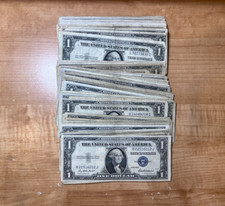
Concurrent with National Bank Notes, the government issued both Gold and Silver Certificates, which promised the bearer the note’s face value in either metal. The first Gold Certificates were issued on 1865 for transactions between banks; a general-circulation Gold Certificate came along in 1882. Gold Certificates were recalled as part of the Gold Reserve Act of 1933, and it wasn’t until 1964 that it was again legal for private citizens to own them. Silver certificates coincided with the surplus of silver in 1878 but they were discontinued in 1963.
Finally, even though just about every currency collector would like to find that rare bill whose serial number or other distinguishing feature is printed upside down, some bills were deliberately tweaked. For example, during World War II, special currency was issued to troops in North Africa so that if it was captured, the currency could be easily demonetized. Similarly, to protect the money supply in the event of a Japanese invasion of Hawaii, currency there was overprinted with the word “Hawaii” on it, front and back, to make to easy to remove the bills from the money supply in the event of the worst.