



Posted 11 days ago
 Patriotica
(55 items)
The earliest extant directional sign is carved in what appears to be marble mounted on a building on Rua do Salvador in Alfama, Portugal near Lisbon. It dates to 1686 directing carriages on this very narrow street to return the same way it came. It seems that the oldest street sign is also carved in stone above 34-36 Tavistock Street in London, which still shows the original name as “Yorke Street 1636.” These are exceptions, of course, as early road signage was mostly made of wood and maintained only sporadically.
Curiously enough, the first modern roadway signs that began showing up about the 1870s intended to provide some idea as to conditions of the road ahead for bicycle traffic. Yes, bicycles. Since it wasn’t easy to control the new fangled velocipede, as they were known, local bicycling groups competed to provide a sign of sorts to warn of the terrain ahead, probably ribbons on trees or hand-lettered wooden ones hammered on trees, poles, and fence posts along the way. It was all about safety, not necessarily direction.
Progress being what it is, though, the automobile soon became more the norm by the early 20th century, edging out the prevalence of the bicycle, although I can’t imagine that controlling early automobiles was any easier. Soon automobile clubs like the American Automobile Association (AAA) in 1902 replaced the bicycle signs to provide directional and safety signage along proprietary stretches of usually dirt roads.
The Italian Touring Club, a bicycle club originally, would be the first to create a coherent traffic sign system in 1895 strictly for the new-fangled automobile. Nowhere does it say what the signs looked like or were made from, but by 1909, at least nine European countries had standardized four different signs to include “bump,” “curve,” “intersection,” and “railroad crossing,” according to a Wikipedia entry on traffic signs. By 1935, the United States had its Manual on Uniform Traffic Control Devices for Streets and Highways (MUTCD), which standardized all traffic signage throughout the country that is still the official guidebook for signage today.
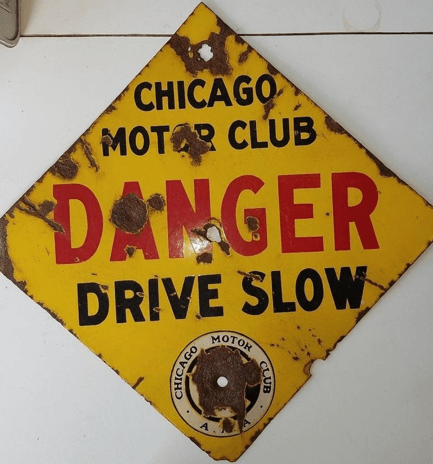
So what were the first modern signs made of? Cast iron and porcelain. Heavy and durable, these signs were first manufactured in Germany and became the norm from the early 20th century to about World War II. By then metal anything was melted down for the war effort and these early cast iron signs, like the “Danger” sign from Chicago (image 2), were routinely recycled for armaments like everything else. It’s also why these early signs are so coveted by collectors because there are relatively few of them.
One of the more curious road sign design features was the addition of a reflector added to the sign itself beginning about the mid-1920s. One of the first was a flat red reflector known as a Stimsonite that you still see today as a reflector on bicycles.
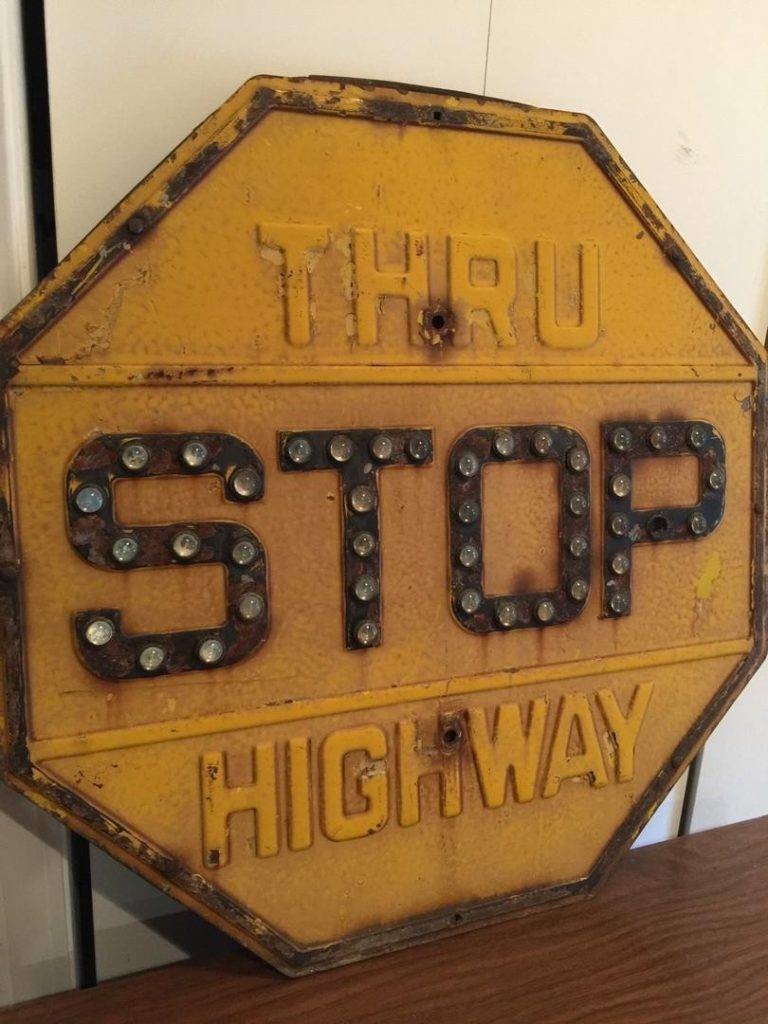
The more prominent reflector, though, was officially known as a cataphote. Developed by Percy Shaw, a road contractor from Halifax, West Yorkshire, in 1933, it was basically a specially crafted, rounded glass bead inserted into a flexible rubber housing originally intended to help light roads by the reflection of muted headlights during World War II blackouts. Later these cat’s eyes, as they became known, became an integral part of signage as a safety feature such as the yellow stop sign of the 1930s (image 3)*. By 1939, though, 3M corporation invented a reflector sheeting process that made the use of “cat’s eyes” as reflectors on signage no longer cost-effective. However, that’s what makes these signs more valuable to collectors.
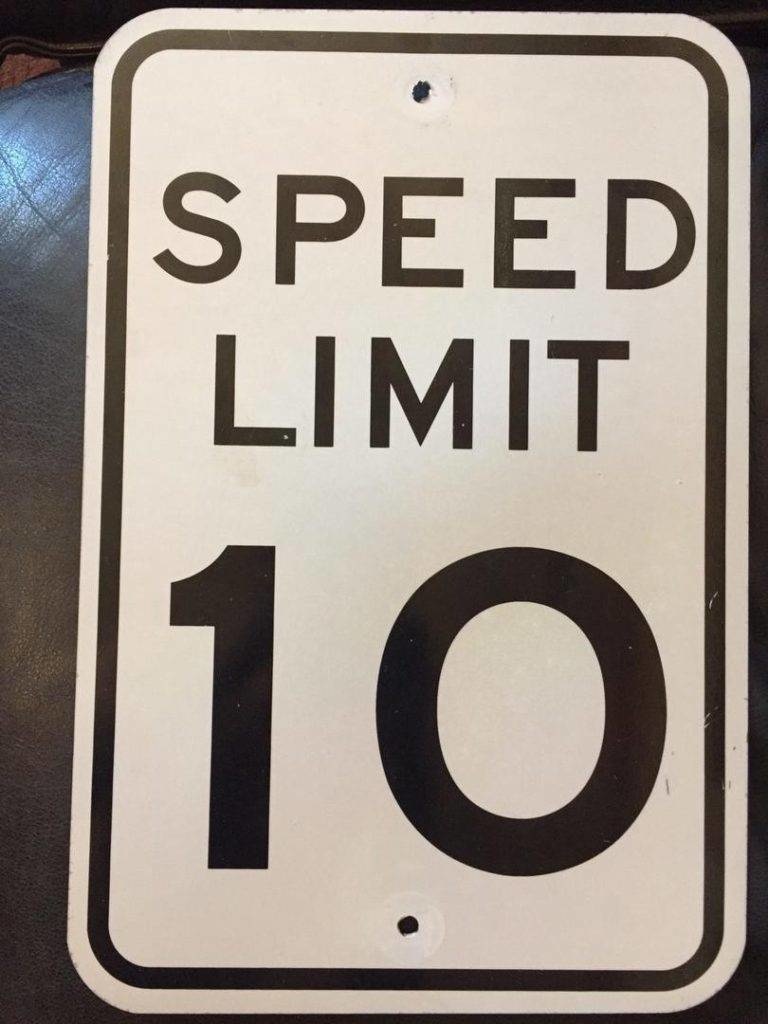
By the 1950s, signage moved away from the heavier iron and porcelain and instead used steel sheeting. Later, a more lightweight and more cost-effective aluminum sheeting became the norm such as the speed limit sign (image 4)**. Use of silkscreen printing for the sign itself eventually replaced paint and stencils originally used in the sign making process.
Finally, we are seeing more electronic, infrared, and LED signage that is easily reprogrammed in an instant to reflect actual safety conditions, particularly along highways. Will they be as collectible 100 years from now as the early cast iron and porcelain signs are now? Perhaps, if hologram signage becomes the norm.
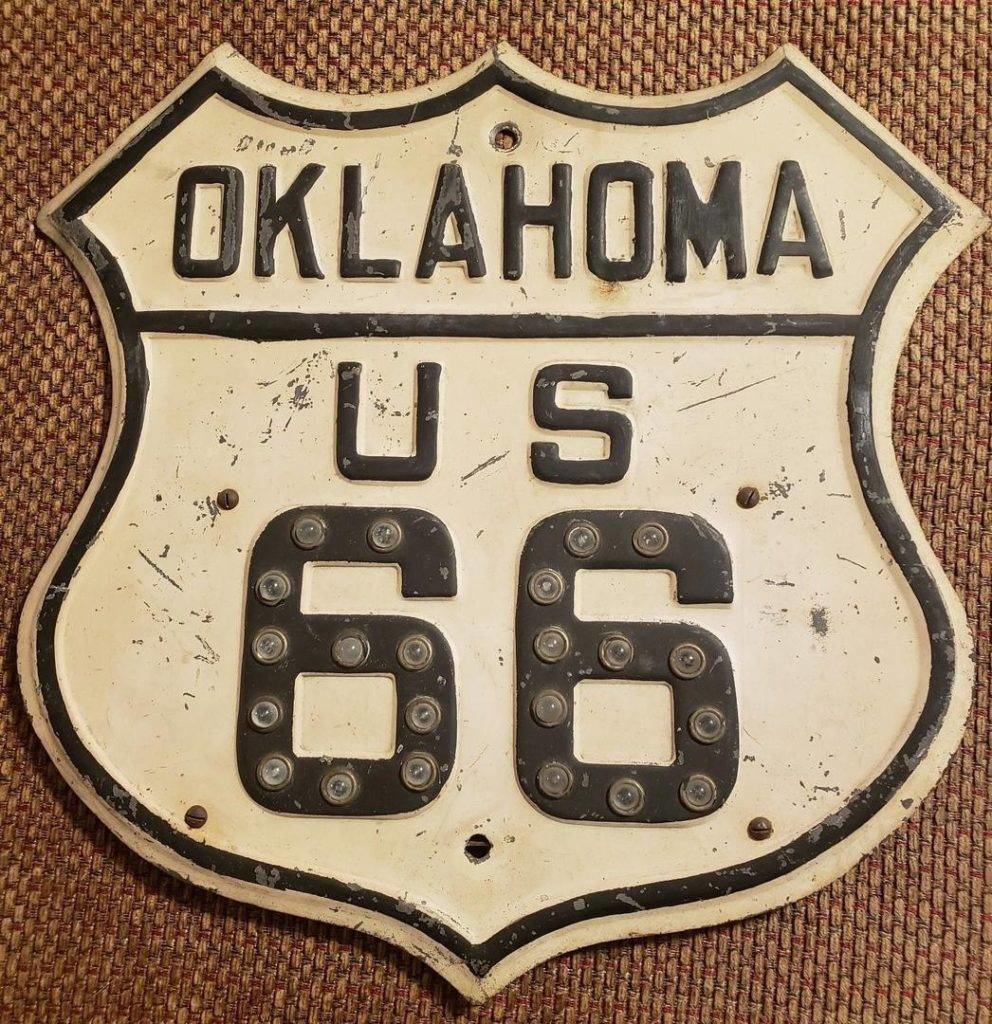
So, what are the most collectible road signs? The old U.S. Route 66 identification signs (image 1) are, especially the ones with the “cat’s eyes” like this one from Oklahoma. Known as the Main Street of America once upon a time, U.S. Route 66 ran from Chicago, Illinois to Santa Monica, California, beginning in 1926 but was replaced by the U.S. highway system beginning in the 1950s. While U.S. Route 66 is no longer a major road, the nostalgia remains in its collectible signs and a snappy song celebrating its 100th year in 2026 with celebrations in every small out of the way place.
Lost on how to collect traffic signs? Ask for roadside assistance from the American Sign Museum (americansignmuseum.org) in Cincinnati, Ohio, to learn more about the world of traffic and roadway signs around the world. You will be easily steered toward your next collectible signpost.
Notes:
* The first stop sign was installed in Detroit, Michigan in 1915.
**Municipal signs are being bolted to signposts to discourage theft of safety signs with penalties becoming criminal offenses if a missing sign results in injury or death. Visit trafficsign.us on how to buy traffic and safety signs legally.
This article was originally published at WorthPoint.com.



