Posted 12 years ago
 StLoretta
(22 items)
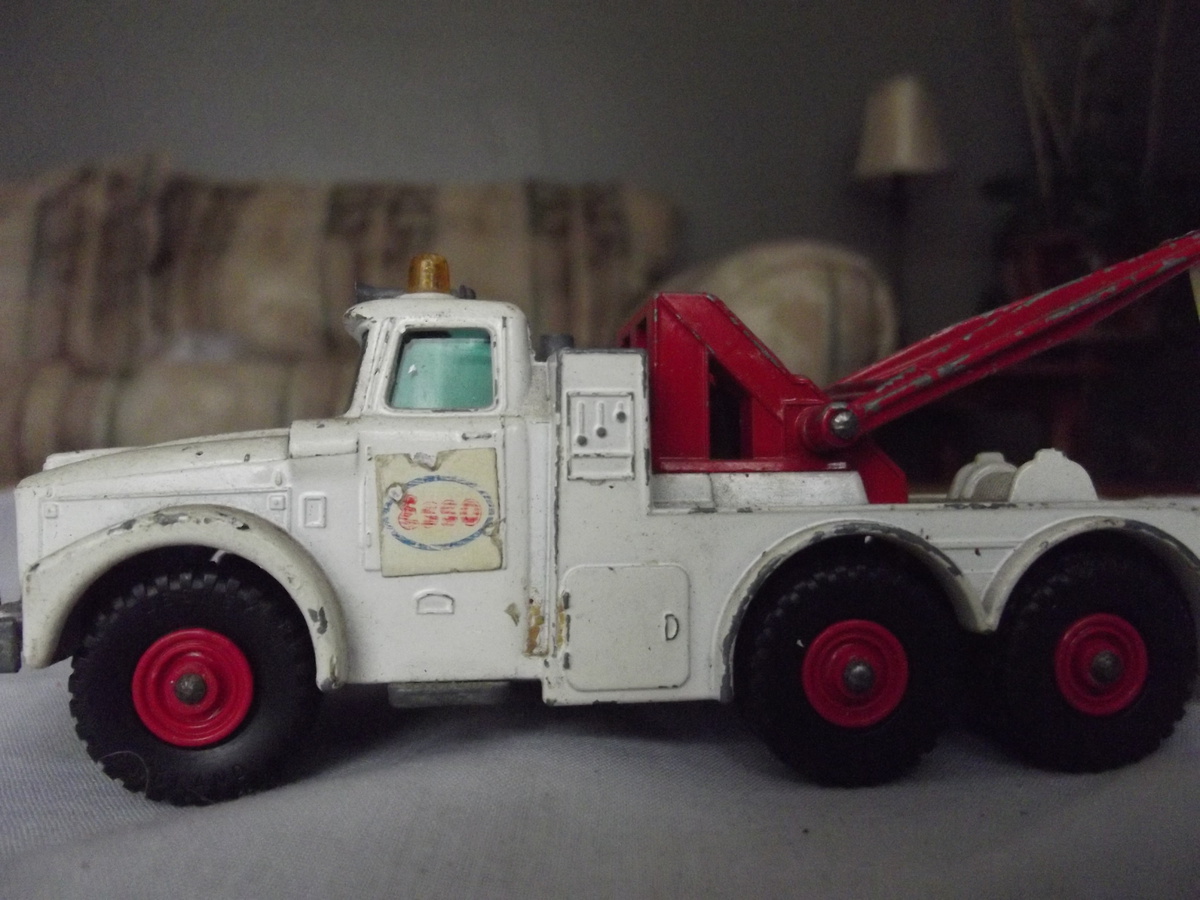
and Esso tow truck that I found with my yard sale finds...the truck is in played with shape...but still amazing...
Esso tow truck | ||
| Model Cars2666 of 3831 |  |  |


 Lata loves this.
 mikecassidy loves this.
 EJW-54 loves this.
 chevy59 loves this.
 trukn20 loves this.
 packrat-place loves this.
 walksoftly loves this.
 officialfuel loves this.
Create a Show & TellReport as inappropriate
Posted 12 years ago
StLoretta
(22 items)
and Esso tow truck that I found with my yard sale finds...the truck is in played with shape...but still amazing...

Help us close this case. Add your knowledge below.
Create an account or login in order to post a comment.



Here is a very excellent condition one .
http://www.ebay.com/itm/1969-Matchbox-King-Size-K-2-Scammell-Heavy-ESSO-Wreck-Tow-Truck-/390460844651?pt=Diecast_Vehicles&hash=item5ae947aa6b
Lesney Products & Co. Ltd. was a British manufacturing company responsible for the conception, manufacture, and distribution of die-cast toys under the "Matchbox" name.
Lesney was founded in 1947 as an industrial die-casting company by Leslie Smith (March 6, 1918 - May 26, 2005) and Rodney Smith. The two men were not related by blood; they had been school friends and served together in the Royal Navy during World War II. Shortly after they founded the company, Rodney Smith introduced to his partner a man named John "Jack" Odell, an engineer he had met in a previous job at D.C.M.T. (another die-casting company). Mr. Odell initially rented a space in the Lesney building to make his own die-casting products, but he joined the company as a partner in that same year.
Lesney originally started operations in a derelict pub in north London (The Rifleman), but later, as finances allowed, changed several location times before finally moving to a factory in Hackney which became synonymous with the company. In late 1947 they received a request for parts to a toy gun. As that proved to be a viable alternative to reducing their factory's output during periods in which they received fewer or smaller industrial orders, they started to make die cast model toys in the next year. However, seeing no future for the company, Rodney Smith left the company in 1951.
Yet, seen in hindsight, the first model toy they produced in 1948 — a die-cast road roller based clearly on a Dinky model (the industry leader in die-cast toy cars at that time) — proved also to be the first of perhaps three major milestones on the path to their eventual destiny. It established transportation as a viable and interesting theme; other similar models followed, including a cowboy-influenced covered wagon and a soap-box racer. Of course, the company continued to produce non-toy items; of those marketed directly by Lesney, one of the more popular ones was a bread-bait press, well liked by British anglers at the time.
The next crucial milestone was the production of a replica of the Royal State Coach in 1953, the year of the coronation of Queen Elizabeth II. Two versions were created, the first in a larger scale, followed by a smaller-scale model. It was this second model that sold over a million units, a massive success at the time. The profits from the sales provided valuable capital for further investments.
The final and decisive stepping stone in the pre-Matchbox era was a toy which Mr. Odell designed for his daughter: Her school only allowed children to bring toys that could fit inside a matchbox, so Mr. Odell crafted a scaled-down version of the Lesney green and red road roller. Based on the aforementioned size restriction, the idea was born to sell the model in a replica matchbox — thus also yielding the name of the series which would propel Lesney to worldwide, mass-market success. The road roller ultimately became the first of the Matchbox 1-75 miniature range; a dump truck and a cement mixer completed the original three-model release.
In the early years of the series, Lesney used a partner company, "Moko" (itself also named after its founder, Moses Kohnstam), to market/distribute its toys. This distribution was documented on the boxes themselves, on which the text "A Moko Lesney product" appeared. However, by the end of the decade, Lesney was able to buy Moko, marketing its products under its own name from that point on. A period of great expansion, tremendous profit, and recognition followed: In 1966, Lesney received their first (of several) Queen's Awards for Industry. By the mid-'60s, Matchbox was the largest brand of die-cast model vehicles in the world, and had diversified the line into multiple series. For further details on the history of the Matchbox series, see the article Matchbox (brand).
On July 11, 1982, after years of difficulties due to the economic climate in Britain at the time, Lesney went bankrupt and into receivership. Competing companies Mettoy (Corgi) and Meccano (Dinky) also suffered the same fate. The Matchbox brand as well as Lesney's tooling were bought by and became a division of Universal Holdings/Universal Toys, where the company re-formed as "Matchbox International Ltd." Tooling and production were moved to Macau. Jack Odell went on to form a new company, Lledo, where he produced models similar to early Matchbox Models of Yesteryear. Today, the Matchbox brand is owned by Mattel, creators of Hot Wheels.
This is one of my favorite Matchbox recovery (tow truck) vehicles. This one looks like it is in great shape.