




Posted 16 years ago
 JimLinderman
(203 items)
From the Folk Art and Photography Website DULL TOOL DIM BULB
(Where collection of TEN original cabinet card photographs are shown)
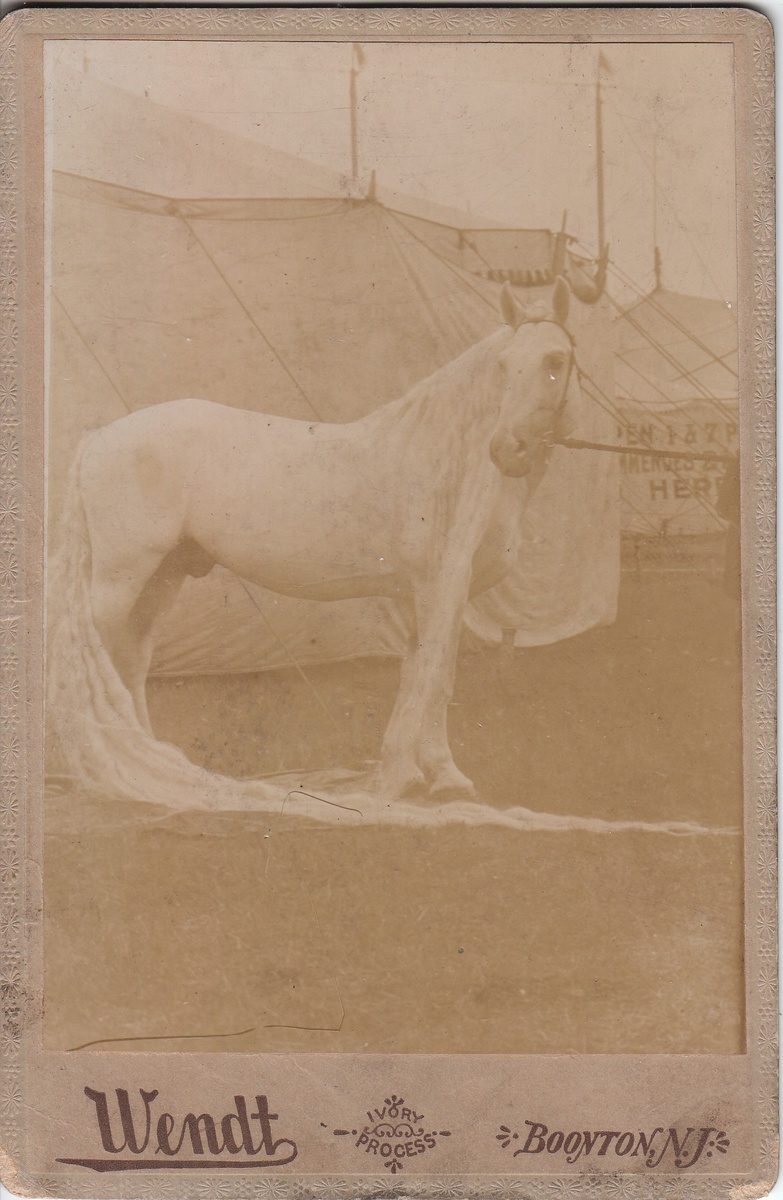
These pictures being taken during the the agrarian United States on the cusp of Industrial Society, one can appreciate the horse. It played a role in both, and it is no wonder it also played a role in the traveling circus.
Horses with long tales can swat flies easier, but the mane seems purely decorative. Depending on genetics, many horses can grow spectacular heads of hair, but normal wear, tear and snags usually keeps the mane at a manageable length. Show horses are often allowed to grow it longer. They will even have it braided and let loose before the show in an attempt to create perfect waves, but even their splendid "dos" pale compared to a wild horse, of which I recently heard there was some 30,000 roaming in the states today. A number increasing through abandonment...it is expensive to maintain a horse, often costing far more than the horse is worth.
Horse were also taught tricks. Fake tricks, but then all tricks are fake. When you see an educated horse clomping off a count, or solving complex mathematical problems, it is usually because the trainer has tipped Trigger off. It is a fairly easy trick to teach your horse to go get their food bucket. Even a dog can do it without training. Teaching your horse to shake his head yes or no is easy as well, and we're not even into Mr. Ed territory here yet. But for the math genius horse who knocks off numbers like an accountant? Usually he has been taught to respond to cues from the boss, not to operate a calculator in his head.
All Photographs Frank Wendt circa 1890-1910
All Original Photographs from the Jim Linderman Collection.
Excerpt above by Jim Linderman of DULL TOOL DIM BULB
from the forthcoming book "The Wondrous World of Wendt" and copyrighted!




Being a lifelong horse owner, exhibitor and lover, I found this picture incredible! I've been able to get tails to drag the ground by about a foot or so, but never could get a mane longer than the point of the shoulder. I KNOW how many hours of work and care it took to get that grown like that. Thanks for sharing these great photos.
Hi Jim, I just recently posted a photo of a little girl that I am sure I've seen on CW before. Mustangtony mentioned that I should check out your site but couldn't find a similar image. Could you check out the pic and see if it looks familiar?