





Posted 2 months ago
Mariaodey
(2 items)
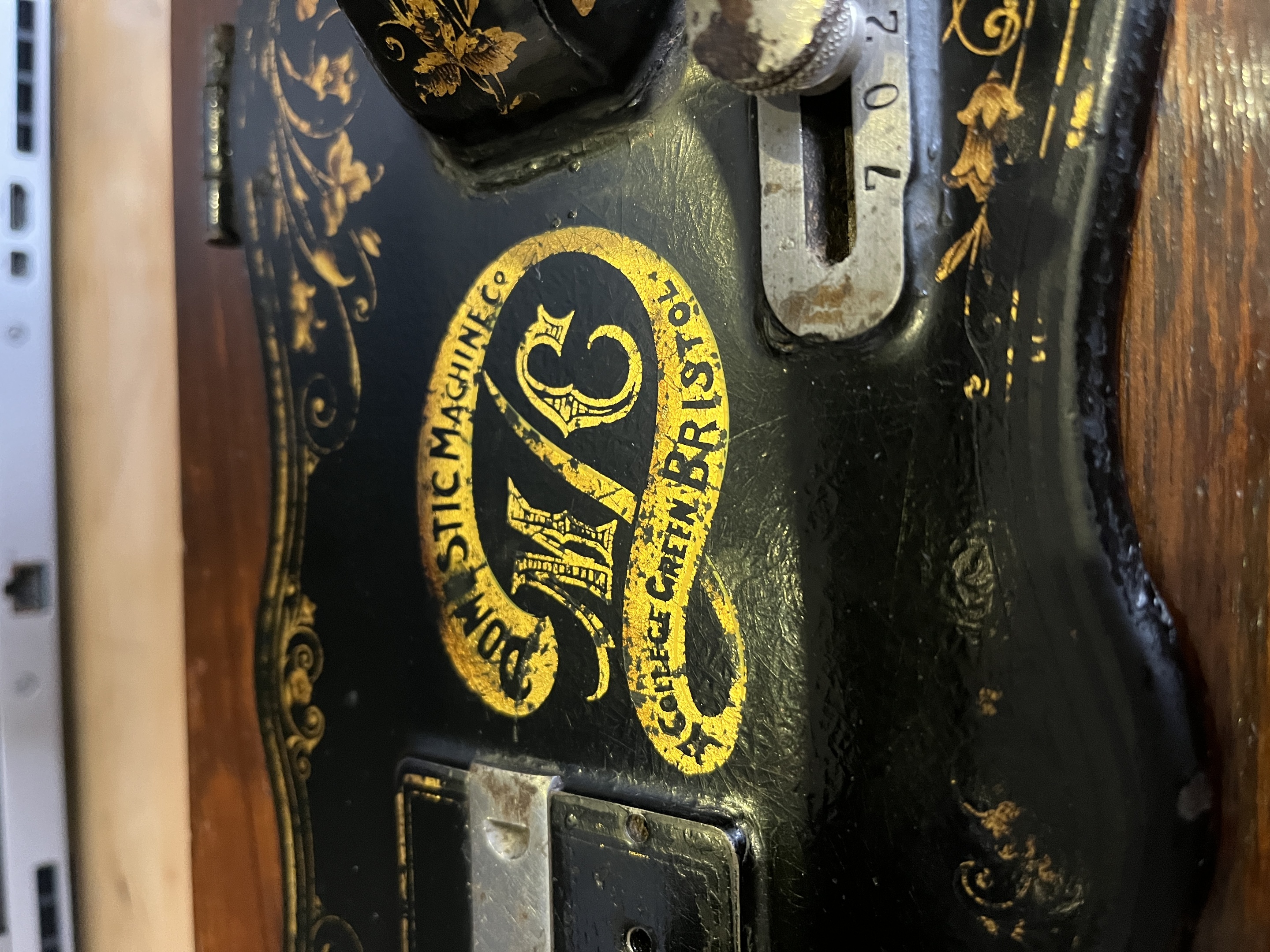
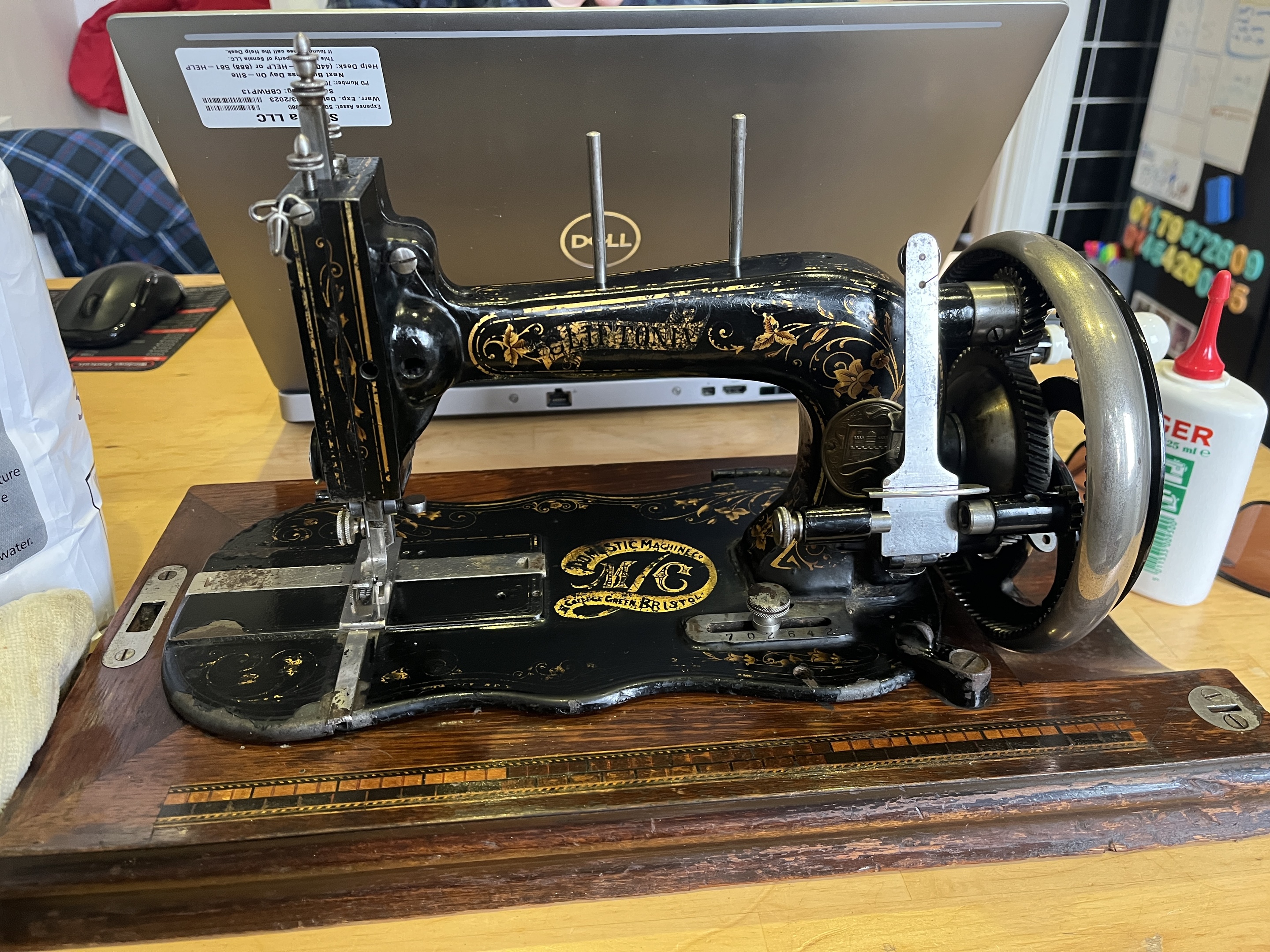
can anyone help me, i have just been given my great great grandmothers sewing machine, i believe it was made by Hengstenberg and distributed by Silberg. but i can't seem to find anything else. the decal calls the machine a Cliftonia. Any help great fully received.

Hi, again, Mariaodey. :-)
Thanks for the additional pictures.
I'm going to link your two posts together:
https://www.collectorsweekly.com/stories/327664-hengstenberg-cliftonia
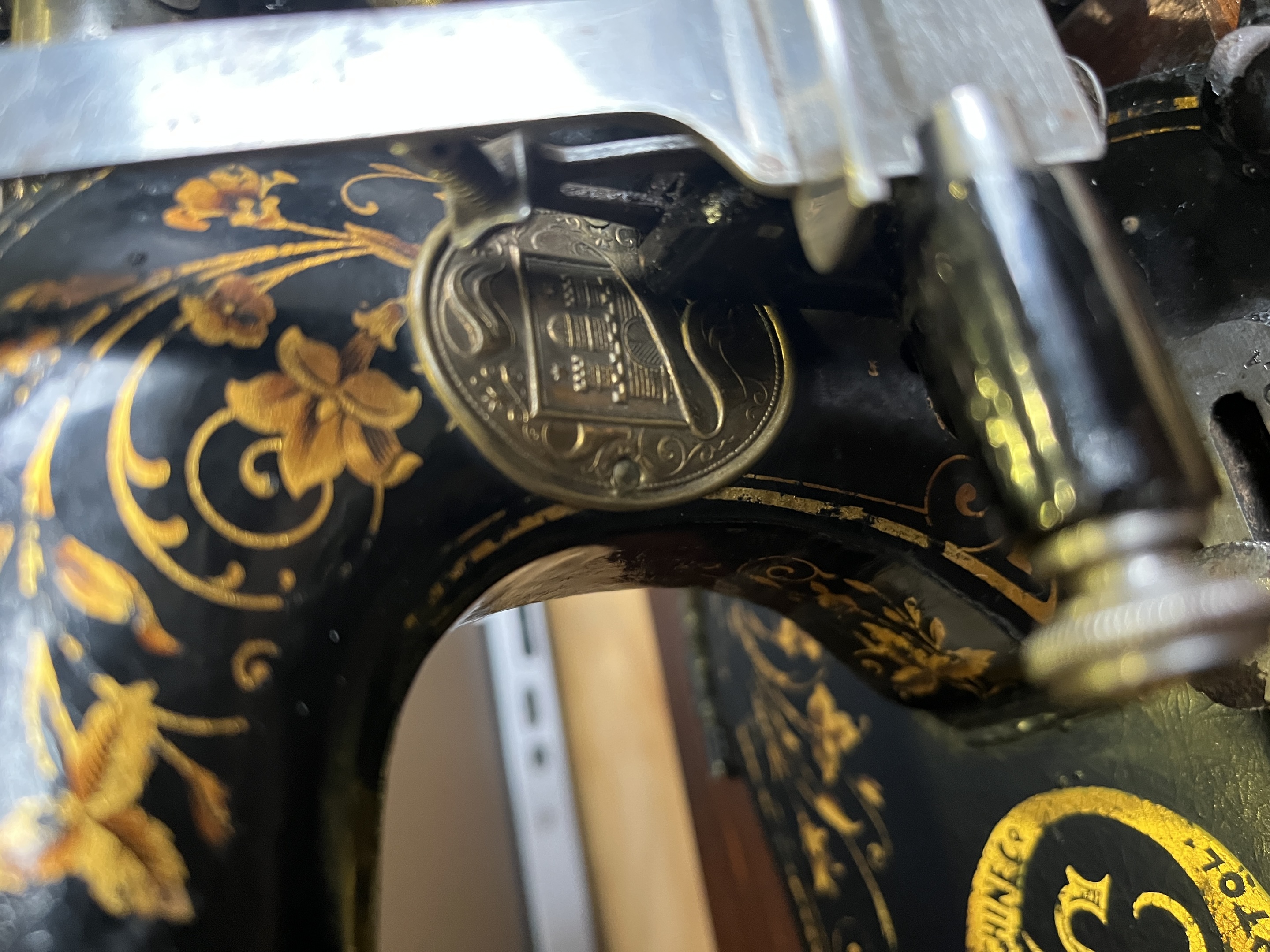
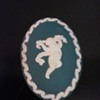
Yes, I thought that I'd spied the J. Silverberg ([mis]spelled around the web variously as Silberg, Silbeberg, etc.) medalllion badge on the pillar.
Here's another transverse shuttle with the J. Silverberg medallion:
https://possumjimandelizabeth.com/xhtml/collect_sewing_silberberg.html
Per this source, distributor/exporter J. Silberberg goes back to 1855:
https://ehive.com/collections/5495/objects/970575/sewing-machine
It's not identical to yours, but it is a fiddlebase.
So now we're still left with the mysteries of the "Domestic Machine Co.," and "Cliftonia."
It looks like DMC was based in College Green, Bristol, UK. It seems possible that "Cliftonia" is derived from "Clifton, Bristol, UK.
You might want to contact the Bristol Historical Association:
https://bristolha.org/contact-us/
I'm out of time at the moment, as holiday responsiblities and festivities beckon.
Mariaodey, I was in a bit of a hurry yesterday, and only latterly realized that I'd misplaced a comment.
This:
"It's not identical to yours, but it is a fiddlebase."
It should have been placed after the link to the possumijelizabeth dot com website, because that's the machine that has a fiddlebase. I'm sorry for any confusion that might have arisen from that.
I also wanted to tell you something important about the serial number. Per this source, distributor/exporter J. Silberberg also issued serial numbers, so that might confuse things:
*snip*
The serial number won't help - as it can be a Silberberg serial
*snip*
https://www.reddit.com/r/vintagesewing/comments/1d1sl42/need_help_identifing_a_vintage_hand_crank_sewing/
Also, the fiddle-shaped bed on your great great grandmother's sewing machine might suggest that it's fairly old, but not necessarily so, per Olaf at the victoriansweatshop forum:
*snip*
I think it is a quite late version of fiddle base machines, some manufacturers use the old base for a long time after most others went to a rectangular bed, especially for the Saxonia machines.
*snip*
https://www.victoriansweatshop.com/post/show_single_post?pid=1332300422&postcount=10&forum=501752
I tried to find more history on J. Silberberg and found these tidbits (translated using DeepL):
*snip*
German-Israeli community. Julius Silberberg with Safr. Bertha Heinemann. List of those who have become citizens.
January 8, 1855,
Julius Silberberg, agent.
*snip*
https://img.sub.uni-hamburg.de/kitodo/PPN52146935X_18550115/PDF/00000001.pdf
*snip*
Julius Silberberg and Julius Oppenheim founded the company Oppenheim & Silberberg on March 30, 1855 an import business dealing in American leather cloth. The partnership was dissolved in 1859. Silberberg then continued to run the company alone with his sons, importing Pumpa brand sewing machines. In 1937, the company was relocated to Amsterdam and dissolved in Hamburg.
*snip*
https://library.oapen.org/bitstream/id/2b5421e8-a928-407d-bd33-2d2064a2e432/external_content.pdf
Is it that Silberberg business a perfect match? No, but I found the year of the company founding an interesting coincidence.
I also found it interesting that the company was relocated to Amsterdam, and dissolved in Hamburg: a prudent move, given Silberberg's ethic identity, and considering the socio-political climate in 1930s Germany.
What I was trying to establish is historical timelines for the J. Silberberg, Hengstenberg & Co., and the Domestic Machine Co. businesses.
Unfortunately, I can't find anything about the latter, so that's why you should probably contact the Bristol Historical Association.
For all we know, the founder of the Domestic Machine Co. might well have grown up in Clifton, and the badge name Cliftonia might have been a matter of sentiment.
I think it's about time for me to link this post over on the victoriansweatshop forum, and see if the combined knowledge of that community can shed any more light on this machine.
OK, here's the link to the topic over on thevictoriansweatshop forum:
https://www.victoriansweatshop.com/post/cliftoniaj-silberberg-badged-hengstenberg-transverse-shuttle-13752163?pid=1343617114
Unknown Artist at the victorian sweatshop (he is German) thinks your machine might be an Altenburg/Vesta L. O. Dietrich, and of circa 1895 vintage.
Here is a sample of one of those:
https://www.ebay.com/itm/275210369866
About Dietrich/Vesta:
https://www.lrcrafts.it/vintage-dietrich-vesta-sewing-machine/#history
Olaf of the victoriansweatshop forum (he is Norwegian) thinks your sewing machine is a Winselmann Saxonia (a Saxonia is not a model; it a term meaning that the sewing machine is smaller than average, and for a portable, that makes sense).
I think I should tell you at this point (in case you didn't already know) that vintage sewing machine identification is not an exact science.
Hi again, Mariaodey. :-)
I found a sibling for your great great grandmother's sewing machine (it's a Winselmann fiddlebase hand-crank Saxonia transverse shuttle):
https://x.com/adumont/status/1754191785042051456
The OP estimates its vintage as 1890-1900.
Considering the history of Winselmann's sewing machine business, I think I'd tweak that to 1891-1900:
*snip*
In 1871, the firm 'Dietrich and Co' was established in Altenburg in Germany, by (Leopold Oscar) L.O. Dietrich, (Hermann) H. Köhler and (Gustav) G. Winselmann. They had worked together in the 'Clemens Müller' sewing machine factory in Dresden.
In 1873, Dietrich left the company, and started his own manufacturing of sewing machines in 1874, under the name 'L.O Dietrich'.
Kohler and Winselmann continued production under the name 'Köhler & Winselmann', after Dietrich left in 1873.
In 1891, Gustav Winselmann also left to start his own factory, known as ‘Gustav Winselmann'
Köhler continued the production as 'Hermann Köhler‘.
After WW2, the factories were situated in East Germany, DDR, and what was left, was gathered under the name WEB.
Olaf
*snip*
https://www.victoriansweatshop.com/post/show_single_post?pid=1343621182&postcount=6&forum=501752
https://www.singersewinginfo.co.uk/other_manufacturers/antiques/makers/winselmann/
The Winselmann sewing machine on Xitter doesn't have a J. Silberberg medallion badge on the pillar, nor any decals referencing the Domestic Machine Co. of College Green Bristol.
J. Silberberg & Co. seems to have persisted beyond its Hamburg origins and presence (1855-1937) in Amsterdam:
https://www.nationaalarchief.nl/onderzoeken/archief/2.09.16.13/invnr/171511
The transverse shuttle was patented by Elias Howe in 1846:
https://patents.google.com/patent/US4750A/en
It was popularized by Singer, and the latter made their widely copied model 12 roughly 1865-1903:
https://ismacs.net/singer_sewing_machine_company/model-list/classes-1-99.html
For information on the Domestic Machine Co. of College Green Bristol, I think you'll need to consult the Bristol Historical Association.
A few more tidbits:
Olaf with regard to your great great grandmother's Winselmann sewing machine:
"In 1902 the company became a Gmbh, and about the same time started to use the brand name Titan, which they earlier had used on some machine logos. I would place the dating close to 1900. Identifying the unmarked german TS machines can be pure hell, especially the early ones."
Unknown Artist on J. Silberberg & Co. (translated via DeepL):
"Peter Wilhelm => page 141
Silberberg, a small assembly factory until 1879, then a trading company"
Wilhelm's book:
https://www.isbns.net/isbn/9783932752872/
Also from Unknown Artist, another fiddlebase Winselmann Saxonia hand-crank:
https://treadlestreasures.blogspot.com/2011/05/winselmann-titan-saxonia-handcrank.html