







Posted 4 months ago
 Jazzres
(38 items)
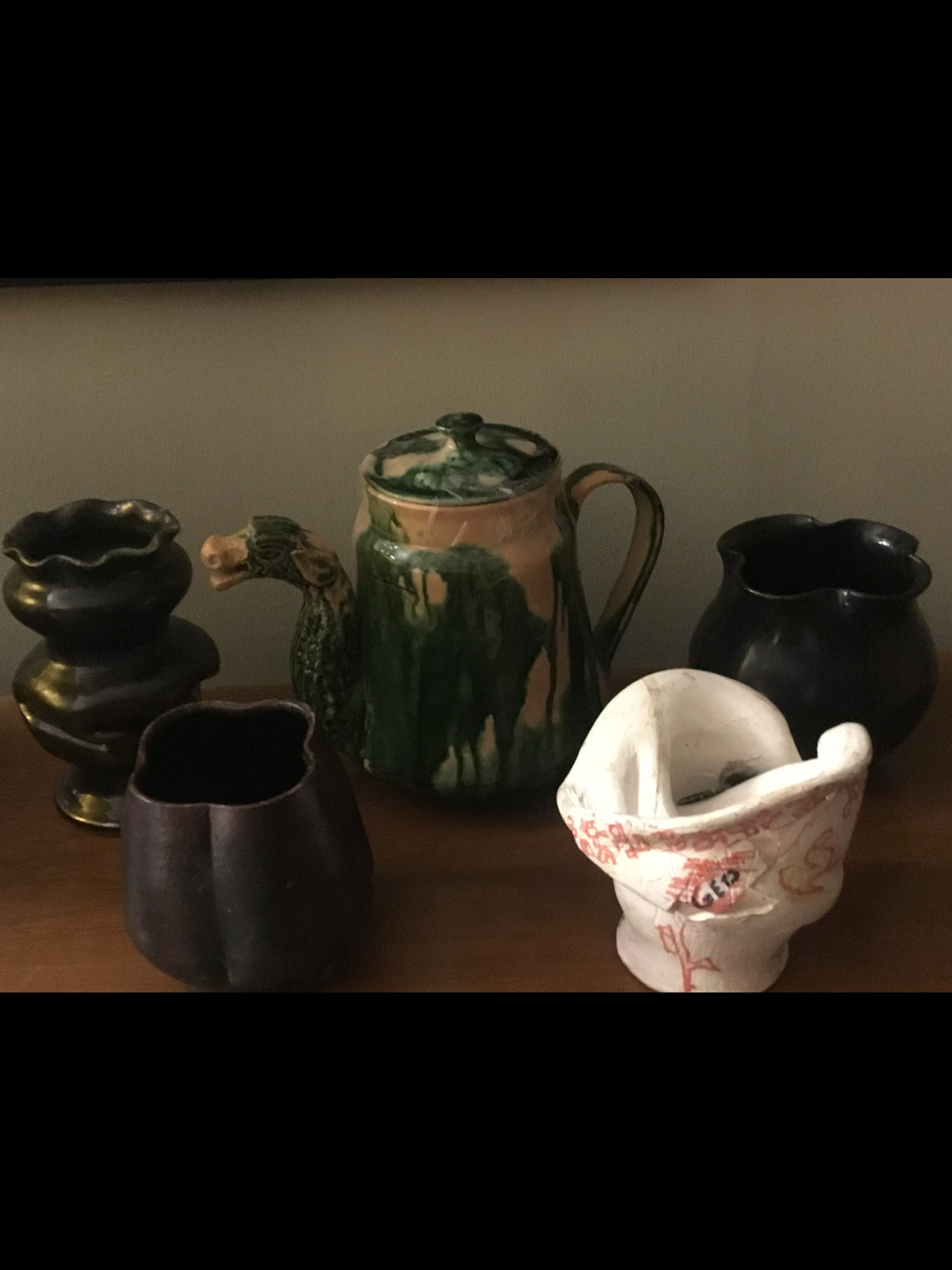
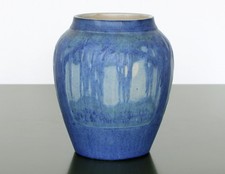
The last photo is my Ohr collection. The white bisque Ear vase was my first pot thrown at Kreuger pottery St. Louis. There is a vase by the Dryden potter of Hot Springs who worked in the style of Ohr. There are a couple potential Ohr vases, without signatures, and an unverified dragon pitcher similar to the applied snake pitchers of George Ohr.
I was happy to get a quick response from the Ohr Okeefe Museum in Biloxi.
Hi Bill,
Thank you for reaching out.
At this time, I do not have any documentation indicating that George E. Ohr owned or commissioned sterling silver flatware. The engraved "G E Ohr" appears to be a personal monogram, which was common on silver of this period.
That said, it is a beautiful example of American sterling from the era, and I completely understand why it caught your attention.
Best,
Casey Sullivan, MLIS
Collections Manag-OHR & Registrar
Grok A.i, was helpful with identification:
From a closer look at the hallmarks (“STERLING A&C PATENT”) and cross-referencing with silver mark databases:
• This mark belongs to A. & C. Feldenheimer, a prominent American jewelry and silver firm based in Portland, Oregon, operating from about 1899 to 1936 (though their roots go back to 1868 as A. Feldenheimer).
• They specialized in patented souvenir spoons, often with ornate designs like yours (beaded borders, floral/scroll finials). These were popular in the late 19th and early 20th centuries, aligning with Ohr’s active years (1880s–1910s).
• The “PATENT” refers to their design patents (e.g., from 1891–1892), and pieces were sometimes manufactured for them by bigger firms like Gorham or Durgin.
• Style-wise, it’s a classic demitasse spoon (small, about 4–5 inches, for coffee/tea), with Victorian/Edwardian influences—common for American-made sterling at the turn of the century. Not English (as I initially thought), but U.S.-made for the domestic market.
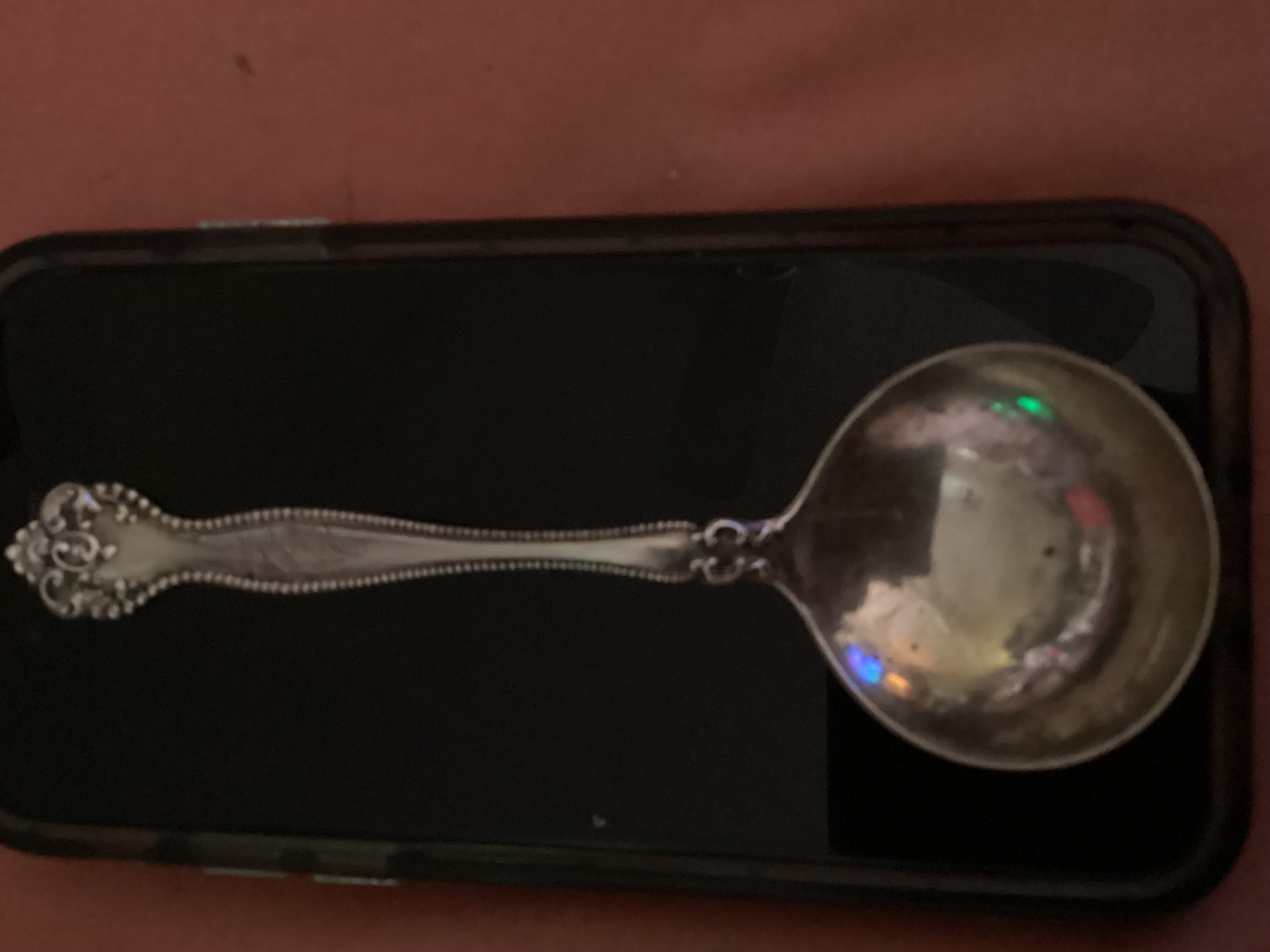
• Handle style: Beaded (or “pearl-bordered”) border along the edges, with a fancy, ornate finial (the decorative top) featuring scrolls and possibly floral/rococo-inspired detailing. This is a classic Victorian or early 20th-century ornate pattern, popular around 1880–1920.
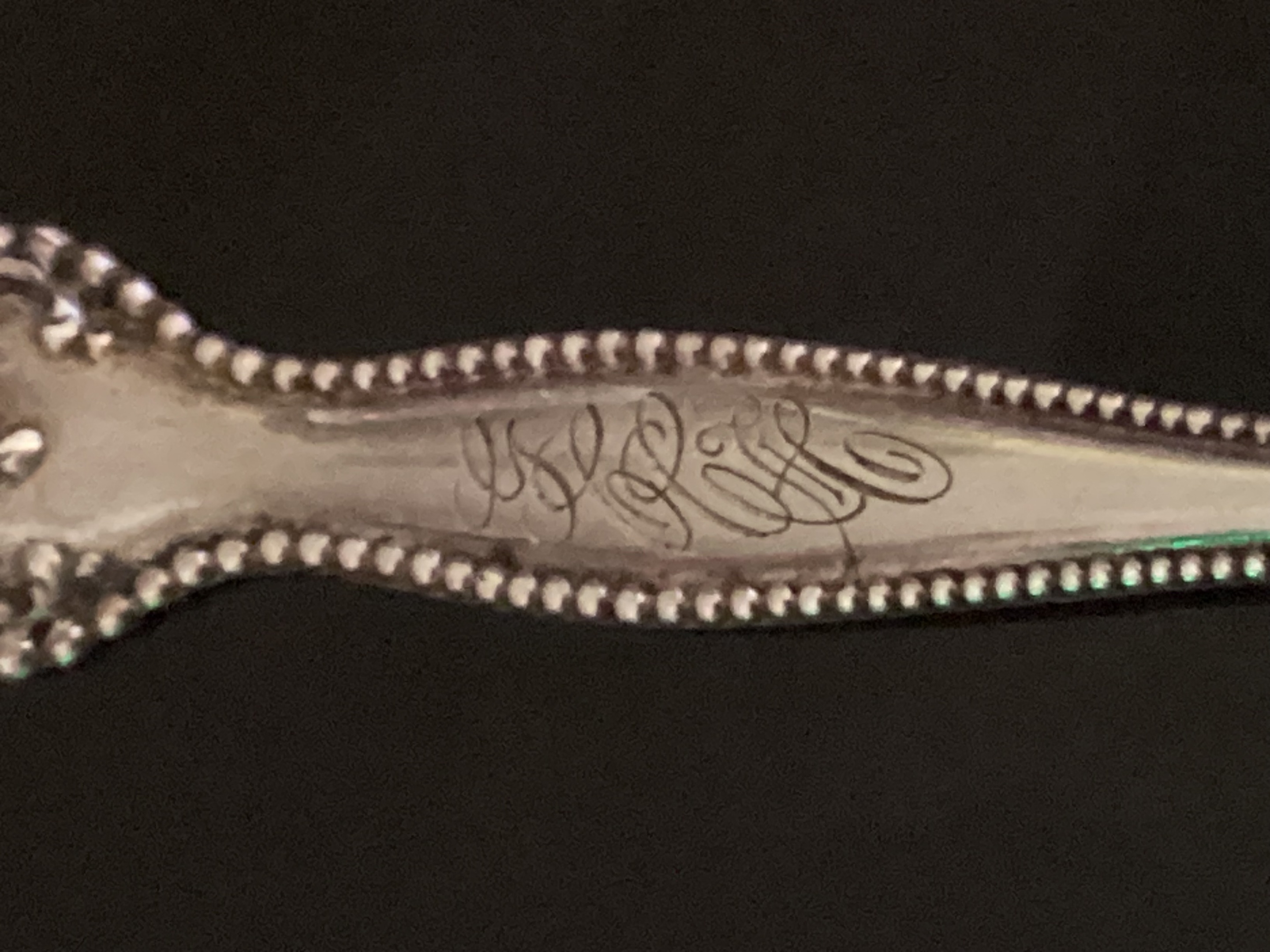
• Monogram: Engraved “G E Ohr” (or stylized as intertwined/script “GEOHR”) in a flowing, period cursive script on the front of the handle. This is a personal monogram, likely from the original owner (common on flatware from that era to mark family silver). It doesn’t appear to tie directly to George E. Ohr the potter (no known silver from him), but the letters match his typical signature style coincidentally—probably just a name like “Geo. something Ohr” or a family variant.
• Hallmarks/marks (on the back near the bowl):
• “STERLING” — Confirms it’s genuine sterling silver (92.5% pure).
• “A&C” (intertwined or in a shield-like cartouche) — This is the maker’s mark.
• “PATENT” — Indicates a patented design or feature (likely the handle patte



Ha my Father was born in Biloxi Mississippi
I can tell you he was a character
Jazzres, Beautiful spoon.
Just for grins I pumped the full length picture of the spoon into Replacements. It came back with something called Raleigh (Sterling 1900) by Alvin:
https://www.replacements.com/silver-alvin-raleigh-sterling-1900/c/1518
I downloaded an image of the demitasse from that collection so that I could rotate it and compare the decor side by side with that on yours.
The bowl is shaped differently, of course, but that decor looks pretty dead on to me.
The Alvin Manufacturing Company:
https://www.smpub.com/ubb/Forum13/HTML/001263.html
So, dunno, maybe A & C Feldenheimer also did some business with the Alvin Manufacturing Company?
Jazzrez, Just one more tidbit: I found an auction listing for some Alvin Raleigh sterling pieces, and it contains a smallish spoon with the round bowl like yours:
https://live.dumoart.com/online-auctions/dumouchelles/alvin-beiderhase-co-usa-raleigh-sterling-silver-flatware-ca-1900-59-pcs-18-of-differing-makers-6412461
The text description:
"Alvin-Beiderhase Co. (USA) 'Raleigh' Sterling Silver Flatware, Ca. 1900, 59 Pcs. + 18 of Differing Makers"
"Monogrammed with 'S'. Includes: (8) Dinner forks, L 7.25", 15.4 Toz. (16) Teaspoons, 5.75", 12.1 Toz. (8) Dessert forks, L 6", 7.5 Toz.(8) Soup spoons, L 4.75", 4.8 Toz. (3) Serving spoons, L 8.25", 4.8 Toz. (8) Seafood forks, L 5.5", 3.9 Toz. (8) Dinner knives, L 9.5". Lot also includes: (13) Butter spreaders of various makers and patterns, average L 5.75", 8.6 Toz. (5) hors d'oeuvre forks by William Rogers, L 5.75", 2.4 Toz. Provenance: Property from a Midland, MI private collector"
The only thing I can see in that description that might match is "Soup spoons, L 4.75", 4.8 Toz."
I don't know why a soup spoon would be so short, but a round bowl would certainly make sense.
Probably for short people
Probably for short people
Jazzres:
Dunno whether you care, but I fell down into a rabbit hole over this spoon.
Google AI Overview thought your spoon was an Alvin Raleigh salt spoon:
This item is a Raleigh Alvin Sterling Silver master salt spoon, patented in 1900.
Pattern: Raleigh by Alvin.
Composition: Sterling Silver.
Type: Master salt spoon, typically used for serving salt from a cellar.
Dimensions: Approximately 3.75 inches in length.
However, per Replacements, the Alvin Raleigh salt spoon is pretty short:
Length: 2 3/4 in
https://www.replacements.com/silver-alvin-raleigh-sterling-1900-individual-salt-spoon/p/38479651
And the Alvin Raleigh round bowl soup spoon is a bit too long, I think:
Length: 5 1/2 in
https://www.replacements.com/silver-alvin-raleigh-sterling-1900-round-bowl-soup-spoon-cream-soup/p/38470731
At any rate, neither of them look like they have the same proportions with regard to bowl size versus handle length.
One reference asserted that Albert Feldenheimer designed a silver service for the battleship Oregon:
http://files.usgwarchives.net/or/multnomah/bios/feldenhe961gbs.txt
However, all I could find of table flatware made by "A. Feldenheimer" for the Oregon was a souvenir spoon:
Sterling USS Battleship Oregon Souvenir Spoon A Feldenheimer Engraved RARE
https://www.ebay.com.au/itm/177898521368
Apropos of nothing in particular, I found a medallion made by A & C Feldenheimer:
Manufacturers & Land Products Show Portland, Oregon, 1915, A & C Feldenheimer
https://digital.wolfsonian.org/WOLF015821?search_api_fulltext=feldenheimer
Interestingly, I did find a spoon with similar proportions to yours for the USS Oregon, but it was made by International Silver Co:
Spoon USS Oregon Silverware USN US Navy International Silver Co. 44C10
https://www.ebay.com/itm/326821247472
I found no trace of any patents for Feldenheimer, but maybe I'm not holding my mouth right.
I did find a couple of trademarks for Feldenheimer, one of an image of Mt. Hood:
19,404. April 28, 1891. Spoons, Forks, and other Flat Ware. Albert Feldenheimer, Portland, Oregon.
https://archive.org/details/DigestOfTradeMarks1893/page/n58/mode/1up
And one of a fish:
20,640. January 26, 1892. Flat Ware and Jewelry. Albert Feldenheimer, Portland, Oregon.
https://archive.org/details/DigestOfTradeMarks1893/page/n96/mode/1up
Indeed, I did find a Wayback Machine archive of a publication that shows A. Feldenheimer souvenir spoons with similar imagery:
Souvenir spoons. Containing descriptions and illustrations of the principle designs produced in the United States
by James, George B., jr. [from old catalog]
Publication date 1891
"OREGON SALMON." "MT HOOD."
"A. FELDENHEIMER"
https://archive.org/details/souvenirspoonsco00jame/page/187/mode/1up
The only trace I found of a patent for Alvin Manufacturing Co. was one that they bought, and then sued the inventor for using it himself(!):
https://app.midpage.ai/document/alvin-mfg-co-v-scharling-9301897
https://patents.google.com/patent/US472230A/en
However, Alvin later on got sued for patent infringement by Whiting:
https://case-law.vlex.com/vid/whiting-mfg-co-v-893205750
https://patents.google.com/patent/USD54452S/en
Of course, the George Washington Law Review thinks that design patents aren't really patents, and the concept of design patent law is a monster:
https://www.gwlr.org/wp-content/uploads/2024/08/92-Geo.-Wash.-L.-Rev.-811.pdf
For what it's worth, Replacements dot com lists over 300 patterns for Alvin, but only one (a souvenir spoon) for Feldenheimer:
https://www.replacements.com/silver-alvin/b/003-800036
https://www.replacements.com/silver-a-c-feldenheimer/b/003-10487068
What exactly was the purpose of this spoon originally?
Just dunno, but the vintage is 1899 or later if the hallmark is "A &C Feldenheimer" instead of "A Feldenheimer."
I think I'm going to rest now. };-)
As long as it’s not eternal rest ,we would all miss you
A'ight, don't ask me how I failed to notice this the other day, but the Alvin Raleigh (Sterling, 1900) pattern has a round bowl bouillon spoon that's 4 7/8 in in length:
https://www.replacements.com/silver-alvin-raleigh-sterling-1900-round-bowl-soup-spoon-bouillon/p/108271
Sure looks like a twin to me.
I haven't been able to find any concrete trail of collaboration between Alvin and A & C Feldenheimer; however, as already noted, the latter did collaborate with other silverware firms, including Gorham.
Gorham ended up owning Alvin along with all of their assets, dies, and patterns:
In 1919 the name changed to Alvin Silver Co until 1928 when assets, dies and patterns were purchased by Gorham Corporation operating in Providence plant as a separated division of Gorham under the name of Alvin Corporation.
https://www.silvercollection.it/USASILALVIN.html
Here's an etsy listing for a Gorham Alvin souvenir spoon in the Raleigh pattern:
Gorham Alvin Sterling Souvenir Demitasse Coffee Spoon-Raleigh-features Longfellows Home-Portland ME-Vintage 1900
https://www.etsy.com/listing/607531368/gorham-alvin-sterling-souvenir-demitasse
Anyway, I think your spoon is a bouillon spoon. If you wanna use it to stir your espresso, I'm not gonna stop you. };-)
Yep, I'm beating this to death. };-)
I wanted to do a serious side-by-side comparison, so I downloaded copies of both your spoon, and the Replacements dot com Alvin Raleigh bouillon spoon.
I cropped them, removed the background, resized them, etc., but no matter what I did, I couldn't get them to look exactly alike in terms of proportions.
I tried the same exercise with regard to the Alvin Raleigh cream soup spoon, but again, no joy.
The Alvin Raleigh bouillon spoon was closer than the cream soup spoon, but neither one of them is exactly the same. The handle is longer, and the bowl is smaller.
The actual decor is the same; it's the overall proportions of the spoons that are different.
I still don't think your spoon is an espresso spoon, because to my mind, the bowl is too large for the job. Indeed, why should the bowl of an espresso spoon be larger than the bowl of a soup spoon?
https://rauantiques.com/blogs/canvases-carats-and-curiosities/flatware-history
https://www.smithsonianmag.com/arts-culture/the-long-history-of-the-espresso-machine-126012814/
So this is still a bit of a mystery. To me, anyway.
Jazzres, Nope, I couldn't leave it alone.
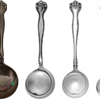
I made a post with a side by side comparison of your A & C Feldenheimer spoon with three different round-bowled spoons from the Alvin Raleigh pattern:
https://www.collectorsweekly.com/stories/328399-the-mystery-spoon
If you don't like it, just say the word, and I'll delete the post.
Jazzres, this is neither here nor there, but I found another Feldenheimer spoon that has an apparent patent year on it:
"This exquisite 925 solid sterling silver spoon is 5 3/4 inches long by just over 1 3/16 inch wide. It weighs 20.3 grams. It is etched PORTLAND on the bowl. The back of the handle is stamped STERLING PAT. 1883 A. FELDENHEIMER."
https://www.etsy.com/listing/960364294/estate-souvenir-spoon-portland-antique
So it's another souvenir motif spoon; however, the year is 1883, hence the firm name is "A. FELDENHEIMER," rather than "A. & C. FELDENHEIMER."
Incidentally, with regard to this:
"A. & C. Feldenheimer, a prominent American jewelry and silver firm based in Portland, Oregon, operating from about 1899 to 1936 (though their roots go back to 1868 as A. Feldenheimer)."
I found a lot of A. & C. Feldenheimer ads in the archives for The Sunday Oregonian, and a lot of them seem cite that 1868 date for the establishment of their business, e.g.:
https://oregonnews.uoregon.edu/lccn/sn83045782/1918-12-22/ed-1/seq-4/#words=Feldenheimer
However, that's a bit disingenuous. The year 1868 is the date the Stone jewelry store was established by B. L. Stone. A. Feldenheimer worked there, and took over in 1884:
http://files.usgwarchives.net/or/multnomah/bios/feldenhe961gbs.txt