




Posted 26 days ago
 Patriotica
(55 items)
Medal of Honor
“The President may award…in the name of Congress, a medal of honor…to a person who…distinguished himself conspicuously by gallantry and intrepidity at the risk of his life above and beyond the call of duty.”
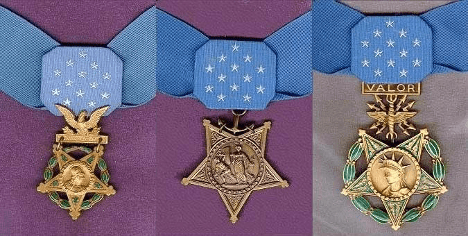
While the Medal of Honor is awarded in the name of Congress by the president of the United States, it is officially known only as the Medal of Honor (MOH), not the Congressional Medal of Honor (image 1). To date, there have been about 3,538 Medals of Honor awarded since its introduction in 1861. The Army, Navy (Marines and Coast Guard), and Air Force all have their own specific medals, but they all feature the light blue, grosgrain ribbon and three chevrons of 13 white stars
According to Federal Statute 18 USC 704, section 704, “…the unauthorized wearing, manufacturing, or sale of the Medal of Honor is punishable by a fine of up to $100,000 and imprisonment of up to one year.” That doesn’t mean that they aren’t available for sale. A company called H.L.I. Lordship Industries based in Long Island, New York, had a federal contract to produce the MOH, but possibly sold up to 900 to collectors in the early 1990s, according to Stars and Stripes. Few have been recovered.
To be clear, it is illegal to sell, buy, trade, broker, traffic, manufacture, barter, advertise, or otherwise exchange anything of value for a Medal of Honor which includes all ribbons and the flag presented to the recipient. For those who possess a legally awarded MOH, it can remain in the family even if the original holder is deceased. However, if it is to pass outside the family, it must be returned to the US Department of Defense. Other materials such as programs, signage, books, and other items not part of the official award are exempt.
National Disasters: Challenger, Columbia, and 9/11
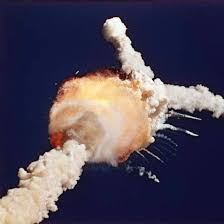
More than an operational disaster, the destruction of the Space Shuttle Challenger during takeoff on January 28, 1986, with all the crew lost, including civilian school teacher Christa McAuliffe, was a tragedy of national importance. The destruction of the Space Shuttle Columbia during reentry on February 1, 2003, also resulted in the death of all seven crew members which spread debris over Texas, Louisiana, and Arkansas for hundreds of miles. The most tragic was the loss of nearly 3,000 with the destruction of the Twin Towers in New York City by passenger airliners on September 11, 2001, and at the Pentagon and in a field in Pennsylvania.
They are all national disasters, but they also have another thing in common, debris. Under Federal Statute 18 USC, 641, any piece of debris, no matter how small, from any national disaster, is considered to be a national memorial, and any attempt to keep, transfer, sell, trade, or otherwise profit from it is considered theft of government property. Families with relics from national disasters, no matter how unintentional, should return the item to the proper federal authorities.
Ivory
By 1989 the elephant population had been cut by almost half because the ivory tusks were used for all kinds of consumer products like billiard balls, jewelry, folk medicine, and artwork. Most elephants were killed illegally. An international effort to protect elephants began with CITES (Convention on International Trade in Endangered Species of Wild Fauna and Flora), a treaty signed in 1975 to help prevent the export of illegal elephant ivory and later to include other ivory such as walrus, narwhal, rhino and even ancient mammoth ivory that is uncovered.
For example, antique set carved ox bone or ivory billiard balls such as this set of 19th-century ox bone snooker balls (image 2) that sold for $586 in 2012 are still legal since they predate the CITES international treaty of 1989, but only if they can be authenticated.
The ban on ivory sales isn’t as effective as it could be, but elephant herds have rebounded greatly since its implementation. Today, buying and selling ivory is illegal on auction sites, and only ivory that can be traced before 1989 is free from confiscation but still can’t be sold or auctioned without international certification.
Eagle Feathers
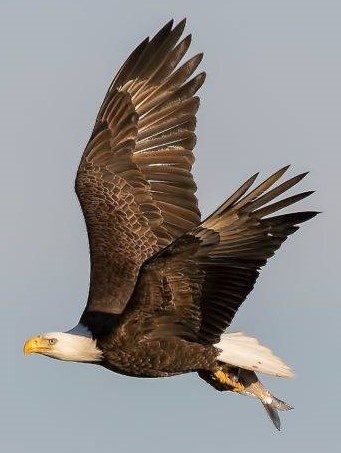
The bald eagle is more than the national symbol of the United States of America. It is also a highly religious figure for the Native American communities as well. To protect the bald eagle populations, the Migratory Bird Act of 1918 became “…unlawful without a waiver to pursue, hunt, take, capture, kill, or sell…” nearly 800 species of birds that include nests, eggs, feathers, or any part whether living or dead.
The Migratory Bird Act of 1918 protects about 800 species of birds in whole or in part, whether living or deceased from the illegal sale of feathers, nests, and eggs with the exception of eagle feathers used in ceremonies within federally recognized Native American ceremonies.
Eagle feathers became exempt only through what is called the Eagle Feather Law where they are allowed to be possessed and used during Native American ceremonies, but only when authorized and procured through the National Eagle Repository.
If you find an eagle in distress, deceased, or in parts that include nests, eggs, or individual feathers, a certified staff member of the US Department of the Interior must take full possession for proper disposition under federal law. Fines up to $250,000 can be assessed for possession, sale, buy, barter, or trade of any eagle part.
Protect and Defend
It is in all of our interest to help protect and defend the endangered and help preserve our national memories for future generations to appreciate and pass along themselves. That is what makes our collective national identity uniquely our own. Don’t become a trafficker. Protect and defend instead.
From an article originally published on WorthPoint.com
A local auction company in Washington State just got fined $12K for a listing of an ivory piece. Apparently legal to own, not to sell.
That's curious that the company would get fined just for listing an ivory piece, but was it tested to be sure it wasn't covered under the CITES act? I guess its fine first, authenticate later.