
As a little girl, Samantha Knowles didn’t stop to consider why most of her dolls—her American Girl dolls, her Cabbage Patch Kids, her Barbie dolls—were black like her. But black dolls were not common in her upstate New York hometown, whose population remains overwhelmingly white. So when Knowles was 8 years old, and one of her friends innocently asked “Why do you have black dolls?”, she didn’t know quite what to say.
“When you see a doll, it’s such a wonderful reminder of your beauty. Somebody took the time to make a doll in your likeness.”
But that question stuck with her, and in college, she started to consider how she would answer as an adult. Finally, as an undergraduate film student at Dartmouth, she connected with a small but passionate group of black doll enthusiasts who gather at black doll shows around the country, and for her senior honors thesis, Knowles, now 22, completed a documentary called “Why Do You Have Black Dolls?” to articulate the answer.
What the Brooklyn filmmaker didn’t know was that her mother felt so strongly that her daughters, Samantha and Jillian, have dolls of their own race, that she would stand in line at stores or make special orders to make sure they got one of the few black versions. “My parents made sure to get us a lot of black dolls in a wide variety of hues and shapes,” Samantha Knowles says. “We didn’t have exclusively black dolls, but we had mostly black dolls. After I started working on the film, I had a lot of conversations with my mom, and she would say, ‘Oh, you don’t know what I had to go through to get some of those dolls!’”

Top: Jillian Knowles, Samantha’s younger sister, sits with their doll collection from childhood in a still from “Why Do You Have Black Dolls?” Above: Three Baby Nancys, the first doll produced by Shindana Toy Company, dedicated to making ethnically correct black dolls, in 1968. Photo by Debbie Behan Garrett.
Many black doll enthusiasts, like Debbie Behan Garrett, the author of Black Dolls: A Comprehensive Guide to Celebrating, Collecting, and Experiencing the Passion, feels the same way as Knowles’ mother.
“I’m emphatic about a black child having a doll that reflects who she is,” Garrett says. “When a young child is playing with a doll, she is mimicking being a mother, and in her young, impressionable years, I want that child to understand that there’s nothing wrong with being black. If black children are force-fed that white is better, or if that’s all that they are exposed to, then they might start to think, ‘What is wrong with me?’”
“Why Do You Have Black Dolls?” debuted in October at the Reel Sisters of the Diaspora Film Festival in New York City, where it won the Reel Sisters Spirit Award. It has also been selected for the Martha’s Vineyard African-American Film Festival and the Hollywood Black Film Festival in Beverly Hills. In the film, doll maker Debra Wright says when little girls see her dolls, they’ll exclaim happily, “Look at her hair! It’s just like mine.”

Debbie Behan Garrett poses with a group of vintage to modern dolls.
In fact, Knowles says that Wright gave a quote that best sums up her answer to the question posed by the film: “I think women know that they’re beautiful,” Wright says. “But when you see a doll, it’s such a wonderful reminder of that beauty—because somebody took the time to make a doll in your likeness.”
Among Knowles interviewees were Barbara Whiteman, a longtime black doll collector who runs the 25-year-old Philadelphia Doll Museum where she has a rotating display of 300 of her collection of 1,000 black dolls. On Saturday, Feb. 23, 2013, Knowles’ documentary screens as a part of the Black History Month programming at the National Black Doll Museum in Mansfield, Massachusetts. Five black-doll collecting sisters Debra Britt, Felicia Walker, Celeste Cotton, Tamara Mattison, and Kareema Thomas opened that museum in the summer of 2012 to teach black history and showcase their collection of 6,200 dolls.

Laura Larue and Lou-Ellen are artist dolls made by black artist Gloria Young Rone, from her Massas Servants doll creations. Photo by Debbie Behan Garret.
The only black girl at her school in 1950s Dorchester, Massachusetts, Debra Britt grew up carrying the vinyl white Baby Bye-Lo doll. “I didn’t have a lot of self-esteem with it.” Britt says. “I had big issues because I was black and fat, and kids were teasing me. And I had to ride a bus with nobody on it. When I would get to school, the other kids shook my bus every day and called me names.”
Britt’s grandmother stepped in and started dip-dying store-bought dolls brown for her granddaughter, and she also taught Britt how to make African wrap dolls from a gourd, an apple, and vines. These dolls were also made by slaves on plantations in the South, who would have their children put in a pebble to represent each fear or worry and relieve them of the burdens. “My grandmother kept saying, ‘You don’t know where you’re coming from and you need to.’” Britt says. “And so she made this African wrap doll and gave me the history.”

Two girls visited the National Black Doll Museum in Mansfield, Massachusetts, in August 2012 to show off the wrap dolls they made. Via the National Black Doll Museum Facebook page.
Garrett, who runs the Black Doll Collecting blog and also recently published The Doll Blogs: When Dolls Speak, I Listen, went without black dolls as a girl in the segregated South in the 1950s and 1960s. “Black dolls were just not readily available,” says Garrett, who’s also written in the “New York Times” about how she started collecting in the early 1990s to replace the black dolls she never had as a child. “And those that were available, my mother felt were not true representations of black people. So all of my dolls were white. What saved me from having low self-esteem was the fact I lived in a mixed-class community. Doctors, lawyers, educators, and just everyday people, like the store owners, were black.”
“Some black dolls were painted as though they were angry. That was subtle racism in doll manufacture.”
Dolls—handmade to look like the children who love them or the deities their parents worshipped—have been found all over the world, in all cultures, all races, since ancient times. In early America, everyone, including slaves, made their own dolls. A controversial homemade doll that’s often found in the South is the “topsy-turvy doll,” which had, instead of legs, another head that could be hidden under the doll’s skirt. One head and set of arms would be white; the others would be black. Early doll manufacturers Albert Bruckner and E.I. Horsman later produced a topsy-turvy doll as a novelty toy, Garrett says.
The topsy-turvies existed, Britt says, because the slave masters actually didn’t want the slave children to have dolls that looked like themselves, which would give them a sense of empowerment. “When the slave master was gone, the kids would have the black side, but when the slave master was around, they would have the white side,” she says.

Collectors Weekly Show & Tell poster stepback_antiques has this topsy-turvy doll from the 1870s in his collection.
Slaves living and working in the main plantation house were more likely to have access to high-quality scraps for doll-making, but slaves working the field would have to be more creative when it came to materials. They would make dolls from whatever they had, whether it be the bones of a chicken, a nut, a cornhusk, an empty gourd, a mop, a broom, or a black nipple from a baby bottle, after the baby had grown, Britt says.
The first manufactured dolls in the mid-1800s were produced in Germany and France, countries that dominated the porcelain and bisque doll industry in the Western world for decades. Even early American dolls would have heads and hands produced in Germany. Unsurprisingly, the aristocratic white European ideal of beauty monopolized the doll world, while the occasional black dolls portrayed the “exotic beauty” of dancers or opera characters. Even after the slaves were freed in the United States the 1860s, most black families could not afford European porcelain dolls, which were luxury items only available to the very wealthy.

A 1920s Mammy doll, made from a black rubber bottle nipple. Via Stonegate Antiques.
The objects featuring racist caricatures that we now call “blackamore” or “black Americana” grew out of post-Civil War black-face minstrel shows where African Americans were depicted as watermelon-chomping simpletons with exaggerated features like googly eyes and big red-lipped grins. These caricatures carried over to children’s books like the British “Golliwogg” series featuring black-face humanoids, which were also made into rag dolls.
The matronly Mammies or Aunt Jemimas, the passive Uncle Tom, the aggressive Savage Brute, the sexually available Jezebel, the nagging Sapphire, and pickaninny children like Little Black Sambo and Topsy were all stereotypical characters that appeared as composition, celluloid, and rubber dolls in the early 20th century. Effanbee and Horsman, for example, made Mammies pushing baby carriages for decades. The Nancy Ann Storybook Doll Company made characters from Uncle Tom’s Cabin, while Reliable Doll Company was one of many that produced a Topsy, characterized by three knots of hair.

Paper dolls of Aunt Jemima and her family were printed on pancake mix boxes starting in 1895.
Minstrel caricatures were also prominent in advertising: Cream of Wheat adopted the male Rastus character in 1893, and that same year, the Aunt Jemima brand of pancake mix was trademarked. For some poor black families in 1895, the paper dolls printed inside the pancake-mix cardboard box, featuring Aunt Jemima and her whole family, were the only black dolls they could afford.
But even in the 1910s, early civil rights activists like Marcus Garvey and R.H. Boyd were pushing back against these stereotypes, Britt says. Boyd started his National Negro Doll Company in 1911, importing elegant black porcelain dolls from European dollmakers and selling them in the United States before his firm went out of business in 1915. Between 1919 and 1922, Garvey launched his Black Star Line, a steamship company that helped found several other black-owned businesses, including a black doll manufacturer.
Part of the reason that Boyd’s company failed might have been that most black people didn’t have the money for fancy china dolls. But perhaps black families wouldn’t have wanted them. While Pat Hatch and Roben Campbell have discovered plenty of soft-cloth folk art black dolls made from the 1870s to the 1930s, Garrett knows that during that time that some black parents handmade their children white dolls instead.

The Walking African Girl, made by Pedigree of
England in 1950s. Photo by Debbie Behan Garrett.
“Because of the false belief that anything white was better than anything black, some early dolls that black parents and children made from household items were often in the image of white people,” Garrett says. “I didn’t personally make any dolls as a child, but I have heard of those who used a Coke bottle as the doll’s body and undyed rope as hair. The undyed rope represented blonde hair.
“In the early movies and television, there were not very many positive images of black people,” she continues. “White characters always had positive roles: There was Shirley Temple, ‘Leave It to Beaver,’ and Opie on ‘The Andy Griffith Show,’ to name a few. Black people had Buckwheat in ‘The Little Rascals’ and other characters that were not positive images for young children. The negative characterization of black people not only affected black children. It was a way to embed in the minds of young white children that all black people were like the ones seen in the media.”

This antique European porcelain doll depicts a black woman with green eyes.
The end of World War II in 1945 brought about a boom in U.S. manufacturing featuring new plastics developed during the war. Suddenly, vinyl and hard plastic dolls were cheap and easy to churn out of the factory. These manufactured dolls were so affordable that middle and lower class people didn’t have to hand-make their dolls anymore.
The mass-production of plastic dolls was so streamlined that, for manufacturers, making special molds of dolls with African American features seemed like an unnecessary cost. That’s why most of the vinyl and hard plastic dolls were white. The black dolls that were sold by companies like Horsman or Terri Lee were most often white dolls painted brown or dipped in brown dye, Garrett explains. “You couldn’t look at the doll and classify it as a true representation of a black person,” she says. “Because it was just a brown counterpart of the white doll.”

Patty-Jo was a black version of the popular hard plastic doll Terri Lee made by the Terri Lee Doll Company between 1947 and 1949.
It was more difficult to make a caricature out of a doll that was originally meant to be white, but Garrett believes that at least one manufacturer painted the black doll’s features in a way that telegraphed prejudice. “The black version’s eyebrows were painted to look a little sinister,” she says. “They were thicker and arched up where the eyebrows on the white dolls were normally curved. The black dolls were painted as though they were angry. That was subtle racism in doll manufacture.”
“If black children are force-fed that white is better, then they might start to think, ‘What is wrong with me?’”
Research shows this bias about dolls is real. In 1939 and 1940, black psychologists Kenneth and Mamie Clark conducted a study wherein they presented black children with two dolls—almost identical, except one was white with blond hair and one was brown with black hair. The researchers asked the kids which doll was nice, which doll was pretty, which doll was smart, which doll would they rather play with, etc., and the kids overwhelmingly chose the white doll as the one with positive attributes. When student filmmaker Kiri Davis conducted a similar doll study in 2005 and when CNN asked black children about cartoons with varying skin colors in 2010, they both got almost identical results. But a 2009 replica of the original doll survey by ABC’s “Good Morning America” came up with more black children favoring black dolls.
The one exception to the white-dolls-painted-brown rule in the 1950s was the Sara Lee doll, which was created by a white woman named Sara Lee Creech, who took 500 photographs of black children to get her doll’s face just right. Ideal Toy Company sold her vinyl doll between 1951 and 1953; and these are next to impossible to find now.

A 1971 Live Action Christie. Barbie’s black friend, Christie, made her debut in 1968. She was probably made from a mold of Barbie’s white friend Midge. Photo by Debbie Behan Garrett.
The most famous vinyl doll, Barbie, who sashayed onto the world stage in 1959, got a cousin named Francie in 1966, Britt explains. In 1967, Mattel issued a Francie doll as a black woman, but customers rejected her, possibly because of the assumed family connection, even though “Colored Francie’s” box didn’t call her Barbie’s cousin. In 1968, Mattel produced another black fashion doll, Christie, probably made from an altered mold of Barbie’s less-glamorous white friend, Midge, who was accepted as Barbie’s pal. In 1969, Mattel introduced Julia, inspired by the TV show, “Julia,” in which Diahann Carroll played a widowed black nurse. It wasn’t until 1979 that Mattel felt assured enough to issue an official Barbie with black skin.
But more significantly, Mattel was alarmed by the Watts race riots of August 1965, which led to 34 deaths, fires, and the destruction of $40 million worth of property in South Central Los Angeles, uncomfortably close to Mattel headquarters, Britt says. To extend an olive branch to the nearby black community, Mattel contributed to a project known as Operation Bootstrap, Inc., which sponsored the founding of several new black-owned companies in the neighborhood.

Starting in 1968, Shindana Toy Company, a project out of Operation Bootstrap, made dolls like Malaika, with black facial features and Swahili names.
“Mattel was afraid people were actually going to come up into their business and burn it down,” Britt says. “And so Mattel sat down at the table with the people of the community and said, ‘What can we do to help alleviate some of the problems in the community?’ And the people said, ‘We need jobs, and we want our own business.’”
“My mom would say, ‘Oh, you don’t know what I had to go through to get some of those dolls!’”
As a result of the meetings with Mattel, community leaders Louis S. Smith II and Robert Hall, a member of the Congress of Racial Equality, and launched Shindana Toys in 1968, the one of the first toy companies that focused on making ethnically correct black dolls. (“Shindana” is the Swahili word for “competitor” or “to compete.”)
“Shindana was one of the first toy companies that regularly came out with dolls that actually had black features,” Britt says. “The dolls’ noses were a little bit wider, and they had shorter, nappier hair, or afros on them. The complexions were darker than most dolls that people had seen. It was also the first time an American doll company had ever used African names, like Baby Zuri, Malaika, Tamu. Before, the dolls were always Cathy, Nancy, Betty, or whatever. ”

In the 1970s and ’80s, Sasha Dolls, created by Swiss artist Sasha Morgenthaler, included black dolls in the line. Photo by Debbie Behan Garrett.
Shindana produced baby dolls, talking dolls, cloth dolls, fashion dolls, and action figures inspired by black celebrities such as Flip Wilson, Jimme “J.J.” Walker, Marla Gibbs, Redd Foxx, Diana Ross, and Michael Jackson. The box of Shindana’s Career Girl Wanda fashion doll contained pictures of black women in Wanda’s various jobs such as nurse, skydiver, tennis player, and singer. These dolls were heralded by magazines like “Ebony,” “Jet,” and “Essence.”
“They put forth remarkable efforts to promote African American pride,” Garrett says. “I was sorry to hear that they had gone out of business by the time that I was trying to build my daughter’s collection of positive playthings. I did manage to add several Shindana dolls to my adult collection.”

Black doll maker Beatrice Wright Brewington started producing dolls in the late 1960s that resembled her own kids. Photo by Debbie Behan Garrett.
Around the same time as Shindana, a female African American entrepreneur and educator named Beatrice Wright Brewington started the B. Wright Toy Company in New York, which put out another line of dolls that accurately represented black people and other races called “Ethnic People Dolls.” The most popular today are the 19-inch toddler dolls Christine and Christopher, who have rooted hair and sleep eyes, modeled after Wright’s own children. Following in the footsteps of Shindana and B. Wright, companies like Remco started producing lines of black dolls, like its “Brown Eye” series, in the late ’60s and early ’70s.
Both Shindana and B. Wright, which sold its molds to Totsy Toys, went out of business by the mid-1980s, but other companies like Keisha Dolls and Golden Ribbon stepped into the gap. Another black female entrepreneur, journalist, and educator, Yla Eason, whose 3-year-old son had informed her that he couldn’t be a superhero like He-Man, started Olmec Toys in New York in 1985. Olmec made baby dolls, action figures like Sun-Man and Butterfly Woman, and fashion dolls like Naomi and Imani before it went out of business by the end of the 1990s. But Olmec had inspired Mattel and Tyco to come out with their own black fashion dolls like Kenya. In the 1980s and ’90s, Robert Tonner, Cabbage Patch Kids, Magic Attic, and American Girl also included black dolls in their lines.

Debra Britt will bring this Big Beautiful Doll, featuring fabulous fashions designed by Britt and her sisters, to schools to show the children that size 16 women are beautiful. From the National Black History Museum Facebook page.
Still, since the 1990s, options for parents who want to buy their children black dolls have been woefully slim. There have been some noble efforts, including the Big Beautiful Dolls, the first full-figured fashion dolls, created by Georgette Taylor and Audrey Bell in 1999; black designer Byron Lars’ African American Barbies for the Barbie Collector Series from 1997-2010; and Stacey McBride-Irby’s “So In Style (S.I.S.)” line for Mattel, launched in 2009. McBride-Irby went on to launch The One World Doll Project, multicultural fashion and play dolls. As far back as 2003, Salome Yilma led the founding of EthiDolls, which are made in the images of historical African women leaders and come with a true-to-life storybook. But as much as Britt and Garrett love these dolls, they’re emphatic that there simply aren’t enough.
“The black dolls manufactured today have gotten lighter in complexion, and I think the toy companies are trying to create a one-size-fits-all as far as reaching the African American market, the Hispanic market, and the biracial market,” Garrett says. “I’m not sure how well this is working. It’s rare for me to see a Hispanic child with a brown doll. They usually have a blonde doll with blue eyes.”

A display at the National Black Doll Museum. Via the museum’s Facebook page.
Britt says the National Black Doll Museum wasn’t anything she ever set out to do. While she started collecting black dolls at age 14 and her whole family already had some form of the collecting bug, it wasn’t until the 1997 that doll-collecting became a bonding hobby for her and her four sisters—Felicia Walker, Celeste Cotton, Tamara Mattison, and Kareema Thomas—and their mother, when her youngest sister, Thomas, had a stroke after giving birth to her daughter at age 25.
“The doctor was saying she’s got to move and you got to get her talking,” Britt says. “In the hospital, we were showing her an Essence magazine, which featured the first black Barbie designed by Byron Lars, called ‘In the Limelight.’ She kept saying she really wanted to have that doll. And we said, ‘We’ll take you to go find this doll and buy it for you, but you’re going to have to get up.’
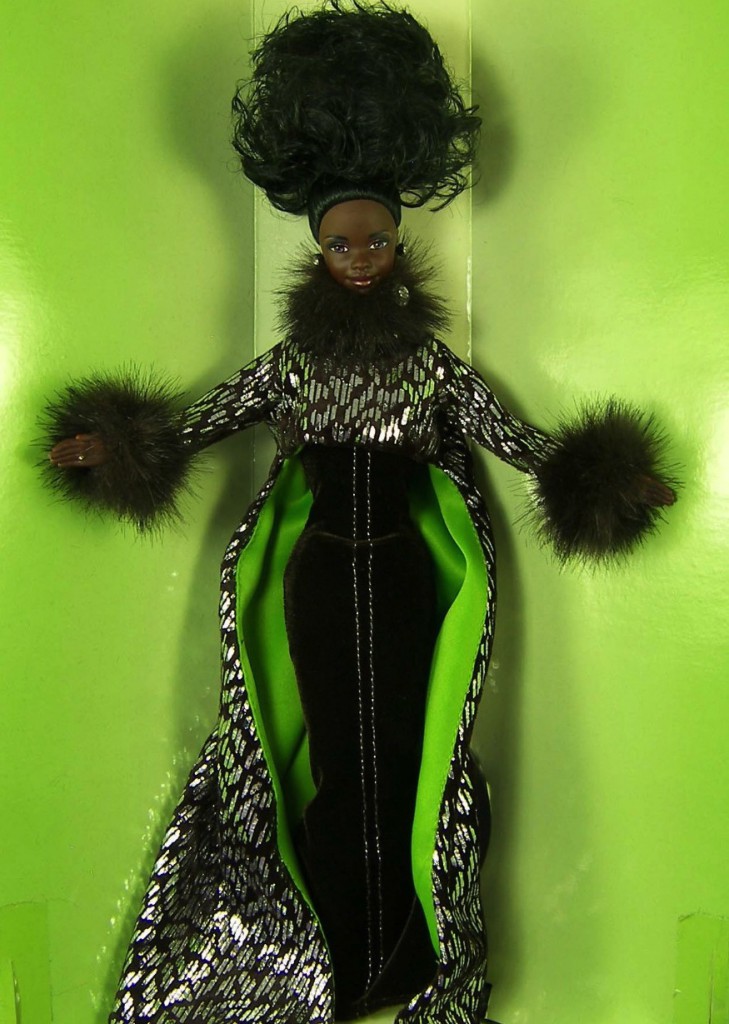
This Barbie Collector edition doll, called “In the Limelight” the first featuring clothing by black designer Byron Lars, got Debra Britt’s sister Kareema Thomas out of her hospital bed to hunt for dolls in 1997.
“That’s what started us going doll collecting,” she continues. “Daily, we went out looking for dolls—in all the toy stores, flea markets, wherever we could go—because we just wanted her to get up. And we all started gravitating toward different things, which is how our collection really started getting crazy.”’
Once Britt’s sister had fully recovered, she wasn’t sure what to do with all the dolls she had accumulated. In early 2004, she called 15 nearby libraries to see if she could put her dolls in their display cases in February. The next year, she had even more libraries and teachers calling her and asking her not only for the dolls but an educational Black History Month presentation for their classrooms. That’s how the touring Doll E. Daze education project, led by Britt and her sister Felicia Walker, got started. Britt started teaching children how to make dolls in their own images, using her grandmother’s African wrap dolls technique on a Coke bottle.

A girl poses with the African wrap doll she made at a class at the National Black Doll Museum. From the museum’s Facebook page.
“At the libraries and schools, I found some girls who were a little heavy looking at dolls and saying, ‘I could never be this beautiful,’” Britt says. “And I would tell them, ‘You’re absolutely beautiful. Just because you’re a little curvy doesn’t mean that you can’t be like this and just because you’re a little dark don’t mean that you’re not beautiful.’”
Eight years later, the National Black Doll Museum was borne out of Britt’s family wanting to share their collection of 6,200 and the history that goes with them with the Mansfield community. But the museum is not just a bunch of dolls in glass cases. It is truly an eye-opening experience. The first exhibition visitors are hit with is called “The Ugly Truth” featuring slave-made dolls like nipple dolls as well as Golliwoggs and other brutal caricatures of “darkies” in dolls, toys, and advertisements.

Three artist dolls: Rashahn and Lil Bitty Kayla by Lorna Miller-Sands; and doll with painted cloth face by Rita Williams at Crafty Sisters. Photo by Debbie Behan Garrett.
“‘The Ugly Truth’ talks about the inhumane treatment of humans by humans,” Britt says. “That display talks about all of the hurtful things that have been done to African Americans, and it actually talks about some of the things that were hurled at me: People calling me a ‘bush boogie,’ a ‘porch monkey,’ and a ‘coon.’ It talks about the n-word, and people saying, ‘Sticks and stones will break your bones and names will never hurt you.’ I always say that’s not true. Name-calling lasts a lifetime.”
The museum’s collection includes 50 different styles of traditional African dolls including Maasai warriors, lifesize Dogon dancers, and dolls from the Ndebele tribe. The dolls take you through both black history in the United States and the history of black doll manufacturing. There are Buffalo Soldiers and Tuskegee Airmen as well as civil-right leaders like Martin Luther King Jr. and Malcolm X. Other galleries honor musicians and performers like Josephine Baker, Louis Armstrong, Michael Jackson, Biggie Smalls; a wide range of sports figures; aviation pioneers and astronauts; politicians like President Obama; and celebrities like Raven Symone, Will Smith, and Laurence Fishburne.

A 12-inch action figure representing a 10th
U.S. Cavalry First Sergeant Buffalo Solider. Photo by Debbie Behan Garrett.
In this way, Britt’s museum employs dolls to educate visitors about both the painful and inspirational moments in black American history, which hold lessons for Americans of any race. The message is similar to that of “Why Do You Have Black Dolls?”: Dolls tell us who we are.
“People just think of dolls as a plaything, and really, they’re not,” Britt says. “You can do so much more with dolls than just play.”
Learn more about black dolls at Debbie Behan Garrett’s Black Doll Collecting blog, Barbara Whiteman’s Philadelphia Doll Museum, and Debra Britt’s Doll E. Daze site and the National Black Doll Museum Facebook page. You can also watch the trailer for “Why Do You Have Black Dolls?” below.
 Why Aren't Stories Like '12 Years a Slave' Told at Southern Plantation Museums?
 The Beautiful Chaos of Improvisational Quilts
 Why Aren't Stories Like '12 Years a Slave' Told at Southern Plantation Museums?
 The Zen of Ken, or Life as Barbie's Boyfriend
 Black MemorabiliaBlack memorabilia, sometimes called Black Americana, describes objects and …
 DollsPeople have made dolls for thousands of years for use as religious objects,…
 Mari Tepper: Laying it on the Line
 Nice Ice: Valerie Hammond on the Genteel Charm of Vintage Canadian Costume Jewelry
 How Jim Heimann Got Crazy for California Architecture
 Modernist Man: Jock Peters May Be the Most Influential Architect You've Never Heard Of
 Meet Cute: Were Kokeshi Dolls the Models for Hello Kitty, Pokemon, and Be@rbrick?
 When the King of Comedy Posters Set His Surreal Sights on the World of Rock 'n' Roll
 How One Artist Makes New Art From Old Coloring Books and Found Photos
 Say Cheese! How Bad Photography Has Changed Our Definition of Good Pictures
 Middle Earthenware: One Family's Quest to Reclaim Its Place in British Pottery History
 Fancy Fowl: How an Evil Sea Captain and a Beloved Queen Made the World Crave KFC
I have a white Santa and Mrs. Claus, I want to paint their faces and hands black. What kind of paint should I use. I went to Michael’s Craft Store, and they really didn’t have anyone in the store who could help me.
P.S.
I ‘m hoping you can.
Black is more than beautiful.
Thanks,
I remember in the late 70s and early 80s when I was old enough to buy my own dolls. I was so embarassed to buy black dolls, because I was white, and hoped nobody that was black saw me doing so, LOL. It was bad enough that I was “too old for dolls” but I was really bored with blond dolls, and wanted more variety. I know we have race issues in America, but not in my heart. I like to think more people are like me than aren’t. ::hugs:: to all you beautiful ladies out there!
For B.B.
If your Santa is vinyl or plastic, acrylic craft paint will work. Seal the paint with a matte varnish after the paint dries.
Great Thanks for insight
Has anyone see this Little Orphan Annie Doll? Pretty amazing!http://www.ebay.com/itm/261737802392?ssPageName=STRK:MESELX:IT&_trksid=p3984.m1555.l2649
I bought my son a black baby doll when he was a baby and he grew up without any prejudice, not because of the doll but because we taught him to see people as individuals. He was in a childrens’ theater in Coconut Grove (Miami) FL directed by Corky Dozier. There were a diverse group of kids socially and racially and they were mre than just friends – they were like a family and have kept in touch. Now 43, his 5 year old daughter has the black doll.
I’m from Philly I now live in Miami Florida I want to say how beautiful everything looks on the site I do understand how important preserving African American dolls are too. I lost a large African American doll from the 60’s it stood about 3ft and if you’d hold her hand her leg would come out like she was walking. I am looking too buy her again if the doll can be located I feel awful losing Cathy she was my first doll and the only memories I have of my dad are connected to this doll if you have any information concerning any similar dolls please contact me asap. I feel proud to see others holding on to these beautiful treasures. Thanks again C.C.
Okay so basically I’m looking for a doll designer. Someone who’s generally better at making African and African American dolls (dolls with darker skin). Please let me know. Someone in Atlanta is be preferred, but anyone who fits the requirements is fine.
Luckily, as a white South African, my children get to go to school with many different races and it is amazing to see how far we have come! They do projects together, share their lunches, hug each other and are genuinely loving and good friends. This was not done or acceptable when I was a child. I have noticed that children who attend the white-only Afrikaans schools are uncomfortable around other races so it is ultimately about exposure and getting comfortable with one another. If it takes a doll to start the process then that is great but there is nothing like the real thing!
I have two dolls that are African-American and cannot find anything about them. One is called Shanna and it is a Petite Porcelain by Barbara Lee. It is about 8 inches tall and the certificate says it is # 390 but does not say how many in the edition. The other is the September in the Doll of the Month Collection, according to the box. It is also porcelain, and the dress has little apples on it, and the doll has a basket with apples over the arm. It is just under 12″ tall and is on a stand. The box does not say who the maker is. I would like to find out about them.
My daughter had a beautiful baby African American doll, given to her by her grandmother when she was small. She loved this doll and had it up into her 20’s. It got put up into a bathroom cupboard on a top shelf where she couldn’t see it, she moved and the doll got left in the home she moved from! She was just heartsick when she remembered the doll had been left behind, and it was too late to go back and get it! I have no idea of the year or maker of this sweet doll!
I would like to know if there is any african american doll clubs out there that she unique how to’s paint faces with blending techniques. Hair styles for dolls movable head, legs arms
I adore Dolls and Debbie’s site. She’s our African American Dolly Go-To Guru for Doll Artist & Identification! I enjoyed reading everyone comments and wanted to help Jose G. The link below is for doll clubs across the nation. Enjoy!
http://www.clothdollconnection.com/ClothDollClubs.html
All The Best
Tanya Montegut
Dolls BY MonTQ
This is wonderful! I live in PA and have been collecting black dolls for 25 years, and have 100…so far.
Great article! I am white, and my experience definitely shows the power of dolls to change perceptions. When I first moved to Memphis during the 1970s as a five year old, and became friends with black children at school for the first time, I was just like those children in the famous “doll test” who picked the white doll. I knew what “beautiful” was supposed to mean, but every person who had ever been called that in my experience was white, and black people looked different from what I had been taught was beautiful. Then my grandmother bought me a Sojourner Truth doll, part of a series about legendary American women. All of the dolls were youthful and idealized, but Sojourner also had distinctly African features and dark skin and I just thought she was the most beautiful doll. I remember just staring at that doll thinking how pretty she was. At that time, my best friend at school was black, and even though I loved her skin – we used to like to put our hands together and look at how different they were – I never thought about describing her with the WORD beautiful before my grandmother got me that doll. She was only a doll, but she really did teach me to see a wider world of people as beautiful. I also remember the Miss Universe pageant which was first won by a black woman in 1977. Here was a black woman on the television set and everyone agreed she was the most beautiful woman in the world!
I agree with those above who suggest that the Angel Tree giver should have picked a black doll regardless. White little girls can benefit from having dolls of all colors, just as much as black little girls! I know my whole attitude and experience transformed because my grandmother bought me a black doll.
When I was a child I lived in the remote Yorkshire Dales my father had family in London. On returning from a trip to London he Brought me back a small maybe 8″ – 10 ” petite black doll.
It had curly black hair close to the head straight unmoveable legs with movable arms & a pretty white sleeveless flared dress with small navy spots on. I was seven or eight at the time I’m now 68 but iv never forgotten that doll that I adored. My friends or I had never seen anything like it. They all loved it & wanted one! I believe in the end the arms came off & it was put in a box to await repair after we moved to London it was never found & iv been looking for a replica ever since!
Thanks for the inspirational article on Black Dolls. I have for years cherished rescued and saved both my collection as well as the used family dolls from my grand children, nieces and other family members. I have dolls like the 3 ft. doll, Topsy-Turvy, Fat Albert, Black Raggedy Ann and Andy and others referenced in your response comments. Recently I started to unpack the years of boxed dolls and remembered the smiles and great times each of the girls had with their Black Babies. I am retired and have downsized making it necessary to find a means to minimize the varied cultural collections I have held on too. I am unable to just donate to an organization not in appreciation of the cultural heritage referenced in your publications. I live in a retirement community in Arizona and after reading your article decided to see if there are collectors or organizations who can assist in vintage Black Dolls, black history and cultural collectible items. A recommendation, referral or web site will truly be appreciated. Thanks again for your uplifting articles.
I have a doll named Amasandra I had her for 67 years.
Hi! This article is very interesting!!!! As a small child, I was infatuated with an aunt jemima (mammy) doll my grandmother had.. (I am white) when I was able 7 she said I could have it! And I was over the moon!! My grandma died about a year later. I have lost many items over the years (now 31) but I have held onto that doll. I have tried many many times to see if there is another one anywhere so I can figure out the origin and date and also for comparable value. I have had no luck at all! Wondering if I took a picture of it, someone would know something about it. Thank you!!
I have a doll by childhood classic dolls,a black cloth doll with a chicken on her right arm.dressed in blue shorts and red top ,yellow hat.
An outstanding article on the historic and psychological aspects of doll making and selling in America.
Great article i will share this article at my 1st Black Doll Showcase on 9/22/2018
I have a old black doll from my aunt the doll is three feet tall.
I was wondering if I could get some info on her.
I am 60 and I use to play with one just like this one and I was about four.
can you tell me where I go for research?
Hi there! Desperately seeking porcelain head for my beautiful African doll. She was 21″, with 5″ head and 6.5″ neck circumference. Her beautiful head broke and she deserves to be whole. Does anyone on this site know where I can find a head?
Thanks
Pamela
Dear Samantha,
I enjoyed your website. I think you’re great! Are you on facebook? I collect AA dolls. I love My Twinn also. My first doll was a Black Betsy Wetsy when I was 4 years old. Please share some more of your dolls with me when you have time and vice-versa.
I started making dolls 36 years ago out of brown chiana fabric. lainie
I played with all types of dolls coming up as a child. I really don’t think it is anything wrong with knowing what your race is however, I feel society focus to much on race. Why can’t we teach our children that all the dolls are beautiful no matter what color they are and have all companies to stop putting on the packages what the race of the doll is. We all are beautiful no matter what color we are.
I am 68 now, and white. I have always collected African American and Asian dolls. When I moved and reduced my collections I gave extensive beautiful collection to my African American/Native American daughter-in-law from my truck. She casually handed them out to neighborhood kids. Some were very expensive, all were greatly prized by me. Now, years later the same daughter-in-law covets my Tonner Esme dolls in my home made fashions. Wish she noticed the others sooner. Especially one beautiful soft bodied Furga, we called her “Nonni” but the neighborhood kids who were gifted with these dolks, ripped their clothes off and seemed to have no regard for them. My heart was broken. Almost as sad as my mother selling my first issue Barbie doll with all the original pieces, earrings, shoes,etc and homemade clothes also for $.25 when I left for college.
My parents are from Texas and Alabama. They were born during the Jim crow era but moved to Chicago. My sisters and brothers always had black dolls during a time when they were hard to find. I grew up always loving my skin and my black dolls. I grew up in the suburbs of Chicago and saw racism first hand. My family was my strength and I always had a beautiful companion. My black dolls. They are beautiful and unique. So are we.
I have several black dolls , I use to collect dolls .They mostly have been in storage. Now that I have to move to a one bedroom apartment, I do not just want to give them away I really want them to be in a place where they can be appreciated, example I do have a Diahann Carroll in the box with the nursing outfit, also a Diana Ross doll and several athlete dolls, Colin Powell I really do want them to get in good hands
I just bought an African American Horsman doll from the l920’s. His counterpart, an Effanbee doll is called Cotton Joe. Both dolls look similar but the Horsman name is on the back of mine. Would you have a picture of this doll so I can see his face? I have to restore him and some of the internet pictures show him as having a centered eye and other pictures show he has teeth. This one is a small one, about 11″. Any help would be appreciated.
Andrea
as a child growing up in australia there was only one black child at school .so i only saw him but at home there were lots of black dolls my mother purchased for my sister . i remember looking at her priced black doll sitting on her dresser big brown eyes and gold hoop ear rings red spotted dress and panties .since then other black dolls have joind the family black babies home made black raggedy andy .im white love my black dolls many child hood memorys im 53 and still have them
I was given a baby doll when I was around 7 or 9 can not remember. I loved that doll I had her until I was 15, I am 60 now, and I am searching for my baby doll. She was a little black baby around 8 to 10″ tall, she was made of soft rubber from hair to toe
I have been searching for years. I named her Chocy Drop and called her Chocy I would ? to fund her. I know they had told make more than one. If there was any poss way of seeing all black babies made in 67 to70 I know I would find my Chocy.
To other white women commenting: Maybe just let this page be for the celebration of Black dolls empowering Black girls and women, and leave the space uncluttered for firsthand experiences from their points of view which are most important and relevant here. We don’t need to detail our own life stories everywhere we go. Or instantly start defending how open-minded we are with anecdotes of acceptance or awakening. Or always expect help in our own highly specific concerns or dilemmas, such as trying to track down a rare doll. Maybe we could stop and ask ourselves, as white women on the internet and in life, do we really need the attention right now in this particular space, or can we just be quiet and listen and not think of ourselves all the time. The world has revolved around our experiences and needs for long enough. We don’t have to barge into every conversation about someone else’s. Consider having an “internal monologue”– personal reflection without redirecting the attention to us. Kindly, L.
We have a 14″ black doll. porcelain head ,wood lower hands to just below elbow, attached to wood shoulder by wire & lower legs that have painted red boots. Musical squeeze box. It does play a couple of notes when squeezed.
Head marked 1902. The 0 is very faint. 10/0 under. Brown glass eyes. Curly black Afro wig. The curls are very precise and close to the head. Very soft. It might be mohair. Open mouth, four teeth.
Dressed in faded red pants to the knees, over jacket with tails, red & beige bow tie.
Would like to know the year and value of this doll.
Thank you for your help. Donna
I have some black dolls, black salt and pepper shakers and black woman savings banks that I inherited from a former teacher. I don’t know what to do with them. Any suggestions?
Thank you very much for your insight.
We need to move the lines so that the dolls look like all of us. My daughter had different dolls so she knew that people are both the same and different.
As soon as I started making dolls, I have colored dolls. And I keep making dolls that look like us every day.
Natasha
I am looking for an exact replica of a black rubber/vinyl doll approximately 24inches tall with rooted black hair wearing a red gingham dress bought in1959/60 from a Devon store bought by my mother for my daughter don’t know the make
I am also white, and being a little girl in Russia in the late eighties and early ninentees I desperately wanted a black Barbie. I was tired of the blonde blue eyed dolls as well. I only got my hands on my first ever black fashion doll when I moved to South Africa in 1997.
Things have changed tremendously since. I really believe that it’s important for children to have all kinds of dolls.
I’m african american, and I find this very educational. Without remembering the bad parts of history, we repeat it.
Lately I’ve looked at Smart Doll and similar dolls. I once saw Smart Doll do a good job at portraying black females compared to much anime / manga. (I think most of the time, anime / manga is portraying darker asians, not african americans or africans)