
According to The Metropolitan Museum of Art, which is the source of the 1884-1886 evening dress shown above, “The bustle was at its greatest extension by 1885.” No kidding. The back of this dress, with its ginormous, protruding posterior, is almost horizontal, in contrast to the rounded silhouettes of the Hoop Era that had come before. “It was a popular conceit that the cantilevers of these bustles could support an entire tea service,” an uncredited author at the Met remarks. From here, it looks like you could land a Grumman F-14 Tomcat on the back of that thing.
By 1887, though, the bountiful bustle had flattened out somewhat, as seen in the rehearsal snapshot below of actress Kristin Brownstone, who is playing the part of Mrs. Kendal in the City Lights Theater Company’s production of “The Elephant Man,” through April 17, 2016. Over the past few months, I have learned more than I ever thought I would about this particular piece of women’s clothing from the late Victorian Era because my wife, Pat Tyler, made this costume for City Lights from scratch. Since her sewing room doubles as our living room, I got to watch it take shape.
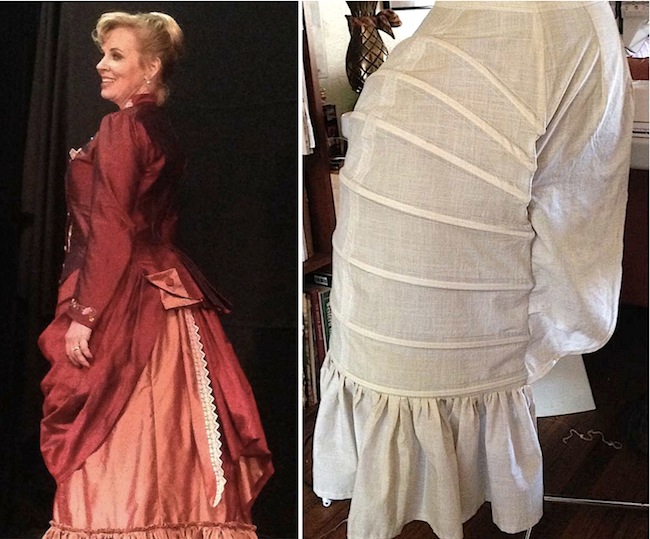
Left: Kristin Brownstone as Mrs. Kendal in a costume by Pat Tyler for “The Elephant Man.” Right: The bustle itself, from a pattern by Truly Victorian.
Beyond the obvious appeal of the lustrous silks used in the dress (modern synthetic materials would not have been historically accurate), I was struck by the dress’s engineering. Under all those layers—from the overdrape to the underskirt to the petticoat—is a marvelous device known as a lobster bustle, which gets its name from its resemblance to the tail of the tasty crustacean. “If you laid the bustle down on a flat surface,” says Tyler, “it would resemble a tunnel, with the road bed being a flat piece of fabric sewn to the sides. The stays inside the bustle are made out of powder-coated steel. Since the flat piece—the road bed—is narrow, the wider tunnel piece arches when the boning is inserted.”
That gives the dress its shape, but because each piece of boning is parallel to the next, with nothing but cotton in between, the dress allows the wearer more mobility than you might think. In particular, it makes it relatively easy to sit down, as the short video below shows. This is something I’d always wondered about, but then again, conversations about such things are common in our living room.
 From Whale Jaws to Corsets: How Sailors' Love Tokens Got Into Women's Underwear
 Everything You Know About Corsets Is False
 From Whale Jaws to Corsets: How Sailors' Love Tokens Got Into Women's Underwear
 Leading the Charge Against Casual Style, Armed With Antique Clothes and a Bike
 Victorian Era ClothingThe Victorian period ran from 1837 to 1901 and is named for Queen Victoria,…
 Mari Tepper: Laying it on the Line
 Nice Ice: Valerie Hammond on the Genteel Charm of Vintage Canadian Costume Jewelry
 How Jim Heimann Got Crazy for California Architecture
 Modernist Man: Jock Peters May Be the Most Influential Architect You've Never Heard Of
 Meet Cute: Were Kokeshi Dolls the Models for Hello Kitty, Pokemon, and Be@rbrick?
 When the King of Comedy Posters Set His Surreal Sights on the World of Rock 'n' Roll
 How One Artist Makes New Art From Old Coloring Books and Found Photos
 Say Cheese! How Bad Photography Has Changed Our Definition of Good Pictures
 Middle Earthenware: One Family's Quest to Reclaim Its Place in British Pottery History
 Fancy Fowl: How an Evil Sea Captain and a Beloved Queen Made the World Crave KFC
Leave a Comment or Ask a Question
If you want to identify an item, try posting it in our Show & Tell gallery.