









Posted 1 year ago
 antiquerose
(1472 items)
~ Hi CW Gang ~
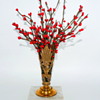
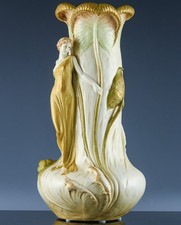
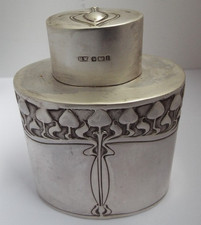
UNKNOWN pair of Vases -Art Nouveau METAL VASES // URNS - POST # 2 -- help with marks . Art Nouveau. Can you help me with the marks, as I WANT YOUR INPUT too. The more the merrily!! Are they silver OR silver plated?? Age?? Any ideas on it
Thanks for LOOKING // LOVING !!
~ Rose ~
==================



As I did find this link with info, but i would still like your input of the marks https://www.ascasonline.org/windowfebbra105.html
antiquerose, That ascasonline dot org site is quite helpful. :-)
*snip*
In 1909/1910, two new WMF ostrich marks were introduced. They bear the image of a running ostrich inserted in a rhombus with a two-line inscription WMF/G, which in turn is placed inside a fully (or partly) dashed arch, see photos below. These two marks were used during a long period of time. According to [1,3], the first of these two small-size marks was applied on WMF goods, exported to France. In my opinion, after 1914 the export to France was stopped due to obvious reasons and after that this mark was applied to the goods made from non-ferrous metals and their alloys, like copper, brass, nickel, etc. The silver-plated products with such a mark are very rare. Contrary to that, the production of non-ferrous WMF products with this mark continued until 1930. The second ostrich mark was introduced in 1910 for the internal market and was used for silver-plated products until 1925. This supposition is justified by the dated WMF objects collected by me and possessing such a mark; they are dated 1910, 1914, 1916, 1920 and 1925.
*snip*
The two-letter inscription "MB" means a combined use of both brass (M) and Britannia metal (B) as base metals.
*snip*
The fraction "I/O" means the normal thickness of silver deposited on the surface of the base metal.
*snip*
The two-letter inscription "OX" ("oxydiert" in German, "oxidized" in English) means artificial darkening of the silver surface to a grey colour.
*snip*
Your ostrich mark looks like the second one from 1910 for the internal market.
The "MB" mark means the base metal is brass and Britannia.
The "I/O" mark denotes the normal thickness of the silverplate.
The "OX" mark means that the sliverplate was oxidized to give it a grey color.
@keramikos - Thank you so much ~ HUGS~ , I wanted a second opinion or if anyone knew more about them. So what date do you think they are ?? That is a Super link one should bookmark for any further reference needed there or here
antiquerose, You're welcome; however, you did the critical work in finding that ascasonline dot org link. :-)
If you read that section on the ostrich hallmarks carefully, you'll see this (I'm providing a snippet of my earlier snippet):
*snip*
The second ostrich mark was introduced in 1910 for the internal market and was used for silver-plated products until 1925.
*snip*
So unless somebody else points out some other distinguishing characteristic, 1910-1925 is probably about as close as you're going to get.