





Posted 20 days ago
 Patriotica
(55 items)
We spend our US dollar bills every day. You might want to know that maybe you’re actually spending more than a dollar when you do.
Just so you know, collecting paper currency is a branch of numismatics called notaphily. Like any collectible category, collecting banknotes and national currencies can be subdivided by historical significance, rarity, by era, by size, error printings, by amount, special artwork, and so on. Most pieces of value are hard to find and are usually found in a dealer’s shop or at auction. But there are collectible currencies, particularly the US dollar bill, that you can find in your pocket every day.
Color-Coded
On any current US $1 dollar bill, you see a letter inside a dark circle on our left of George Washington. This is the Federal Reserve District Seal, one of twelve Federal Reserve Banks that ordered the dollar bill printed for its circulation (A through L). On our right of George Washington is the Federal Reserve Bank (FRB) seal superimposed over the word “One.” It has been a green seal for a circulating Federal Reserve Note since 1928.
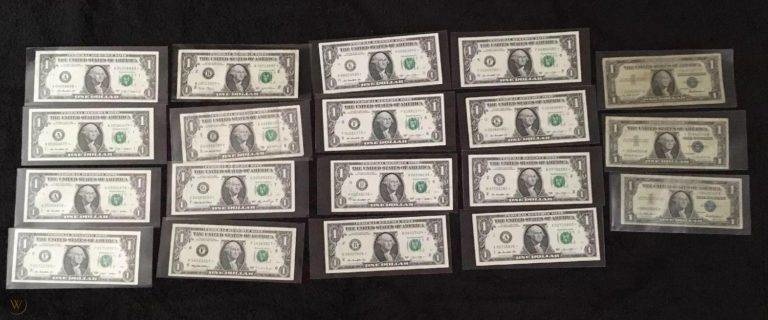
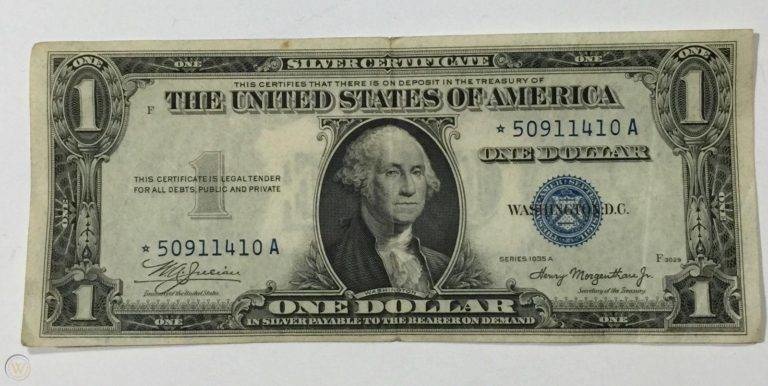
However, over time, this Federal Reserve Bank seal has been in different colors denoting a significant difference in its circulation. For example, a Federal Reserve Note has had its seal circulate in blue signifying a silver certificate printed from 1928 to 1964 (image 4). With so many millions still in circulation, a value of $2 to $4 is reserved only for those in the most pristine of condition. Otherwise, they are worth little more than face value.
A red FRB seal is present on a Demand Note circulating from 1928 to 1971 (image 1). This form of US currency can be traced to 1862 to help pay for Union expenses during the Civil War. Today, they are particularly rare but are still occasionally found in circulation.
In 1934 and 1935, a brown FRB seal was overprinted on a $1 silver certificate with the word “Hawaii” on the reverse in order for the bill to be demonetized if Japan occupied the territory during World War II ($5, $10, and $20 bills were also overprinted). Similar silver certificates were overprinted with a yellow FRB seal for use by US troops fighting in Europe and North Africa.
Unless any of these certificates are in higher grades or of smaller printings, such as the 1935 $5 bill, many $1 color-coded bills (except the blue silver certificate) can have a value of $10 to $15 depending on condition, enough at least for a nice lunch at work.
Star Note
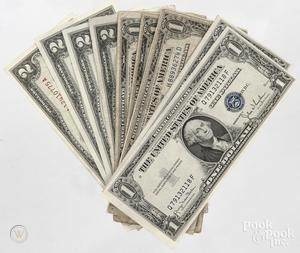
Quick, check the obverse or George Washington side of any $1 bill. See the two sets of serial numbers that begin and end with a letter–the numbers you play Liar’s Poker with? Well, as it happens, when an error occurs with these numbers during printing (offside, upside down, etc.), the bill is pulled to prevent it from being circulated. However, to keep an accurate count of the number of bills being printed, the government agency replaces it with another, but with a new serial number. Except, in the case of the US Bureau of Printing and Engraving, a star (*) is added at the end of the numbers instead of a letter (other countries have a similar system). This is called a replacement note or a star note to collectors. This lot of star note dollar bills (image 2) sold for $43.99 in 2017.
Star notes are relatively scarce. Depending on condition, $1 star notes can have a value from $2 to $15 or so. And star notes circulate among all denominations, not just the $1 bill.
Web Bill
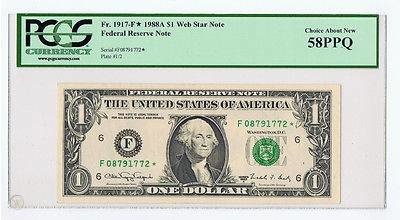
Always looking for cost savings in the production of currency, the US Bureau of Printing and Engraving decided to try an offset “web printing process” that involved the printing of currency on continuous rolls rather than the established intaglio flat sheet printing process. It was a short-lived experiment limited only to certain notes printed in 1988A series, 1993, and 1995. Yet, because of the limited runs, these “web notes” as they are called by collectors, are the most collected currency.
The way to spot a web note from a sheet note is by its face plate numbers. On the obverse (George Washington side), the face plate number on a web note is just to the right of the green “One” (the sheet fed bill has one there and one just to the right of the top far left number 1). On the reverse, the web note has a face plate number to the right of “In God We Trust”; the sheet fed number is to the lower right of the word “One.”
The 1988A series is the most collectible, particularly those from the New York and Atlanta Federal Reserve Banks with uncirculated bills being auctioned from $600 to $1200 each. Web notes from the other series can sell similarly to the other types of notes mentioned above at $10 to $25, depending on condition. This “F Star” 1988-a experimental web press dollar bill (image 3) sold for $1499.99 in 2014.
Finally
It isn’t just the $1 dollar bill that has these particular traits. All denominations from $1 to $100 have one or several of them at one time with values commensurate with their denomination. Check with USPaperMoney.info or the Bureau of Printing and Engraving online for more specific information. Other countries have similar production traits for their currency as well.
So, it turns out that there are collectibles in your wallet. Looking closer at what you are paying for a good cup of Joe might just be traded for a high-end lunch, or more – if you just take the time to look.
This article was adapted from the original published at WorthPoint.com.



So you are an information Collector
Do you Type , Snip or use Speak to Type print
You have a wide Useful range of info.
Quite cerebral & wordy, but not showing or telling about your personal collectibles
From 2007 to 2022, I was a feature writer for WorthPoint.com and these are adapted from those articles.
Some articles originated from a personal collection such as flags, presidential, political and others, but others are just information that collectors of all types can use. I'm also hoping different types of collectibles will inspire new collectors.
I don't speak to type, use AI or otherwise cut and paste from other sources. These are generated from personal research and I can type about 100 wpm so getting thoughts down is done in almost real time.
Thanks for your comments.
Thanks Newfld,,,
Great post! Thanks for sharing all your in depth knowledge.