




Posted 11 years ago
 kelkat
(17 items)
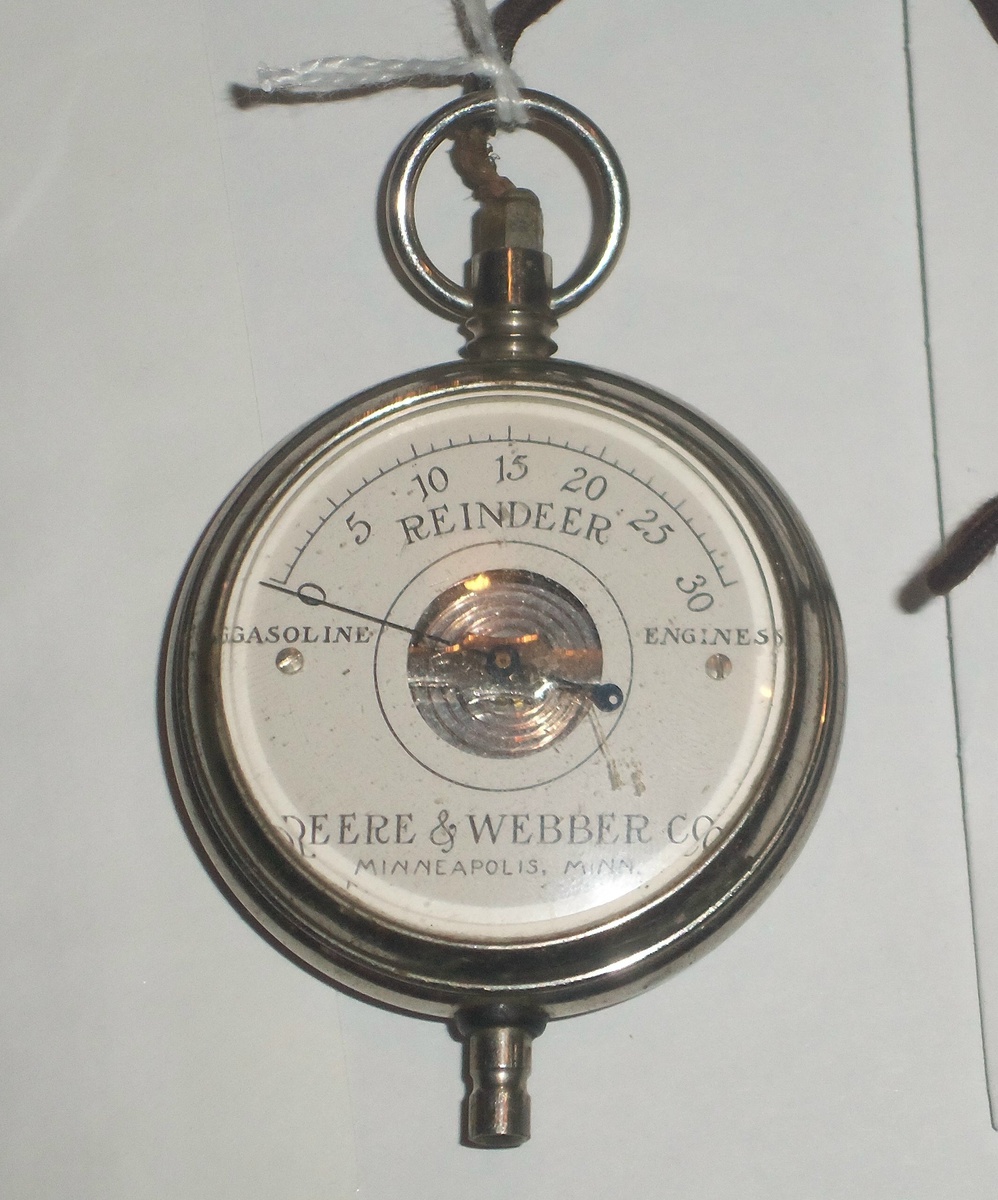
This is my new addition! But I have no idea what it's used for. It says REINDEER DEERE & WEBBER CO MINNEAPOLIS MN GASOLINE ENGINES. It looks like a tester of some sort, it has an atteched wire with an end cap. Any help would be much appreciated! I still love it regardless:)
Thanks for looking.




You say "wire with an end cap". Is it wire or a tube, as in copper. If so, probably a pressure gauge. Possible fuel pressure.
Or maybe to test vacum....?
Could be Roy. Easy way to know, lightly blow & see which was the needle moves.
true ..blunder ...tell him to get on it ...lol
lol, yeah my description was uninformative at best. It has copper wiring under the casing, does that make sense?:)
\
I repeat, is it wire or tubing?
wire inside cloth like material, its not incased in rubber or plastic. sorry total girl here
OK, you just explained a lot. In this case, suck on the end of the wire/tube & see if the needle moves & which direction.
there is no opening, its solid tip.
amp gage ...?
or Im leaning a battery tester ...look at the bottom of the dial thebottom peace has rubber around it to keep it from gronding out ......?
grounding out
Maybe, it looks like it could be some type of volt meter or amp meter. I just wonder what its used for it has a unique ends.
That's strange as I can see a bellows for activating the needle in the centre of the gauge so it has to work on pressure or vacuum. The hole on a tube for these will be very small. Looks like it has been bent enough where it might be crimped off. The hole might not be much bigger than a large sewing needle. The protrusion on the bottom of the gauge is probably a button to release pressure/vacuum. Let me hit Bing & see if i can find the blud-clot ting. Just looked & it could be real old. I failed to connect Webber when I 1st looked & they developer in to making carburetors so it probably is more likely to be vacuum than fuel pressure. That copper "wire" must be a tube with a hole in it(of course it wouldn't be a tube if it didn't have a hole).
I could be wrong, but that looks like a typical bellows behind the centre of the dial & that doesn't "connect" with elec. to me. Buttons to release pressure such as at the bottom would usually have a rubber/plastic seal around the hole. Cloth without anything else is not used for insulation on elec. wires.
We still haven't been told if the button(?) at the bottom pushes in or not. A protrusion like that would not be used for a ground. I see nothing to indicate elec. here.
It definately is not a vaccum anything, the stranded wire is soldered into the top of the gauge. I'm guessing its for checking spark, or to test rectifiers, I seen something about a moisture content meter in the 1918 catolage
Thanks for the tip, I found the information about the Root & van dervoort. Its a good place to start, thanks again
Yeah, my ck'ing even gets into the Fairbanks-Morse engines. Could even be used on eng's going back to 1928. Kelkat, vacuum lines could be sealed by solder as well as flare or compression ferrel. Other than the woven cloth around the wire/tube, I see nothing indicating electrical. There is no known elec. connectors here to my knowledge & experience.
Go with what you want, but that is definitely a Bourdon tube in the gauge.
Tried that, nothing happens:)
Battery ammeter gauge
http://www.stevenjohnson.com/pics/manhattanbatmeeter1.jpg
Westchester Appliance Co.Ammeter Patented DEC. 22, 1903
http://www.ebay.com/itm/Antique-1903-Westchester-Ammeter-Amp-Meter-Electronic-Amprage-Test-/221205110979
And walks come thru again! Did you spend every waking hr. for 4 months to solve this?
No, it was just something to do well I had my coffee! :-)
I havent been on forever! Thank you sooo very much! I cant wait to pass this on! Forever grateful for your time and efforts, your great!
Glad to help!
:) glad your still on! Sorry for delay;)
That looks awesome, too bad the recoil doesn't still work to pull the wire back in. Must be a broken spring. PLEASE let me know if you decide to sell. DLF91 at Hotmail.com