





Posted 2 years ago
michaelr.g.1
(41 items)
A Weary Willie is a name that originated in the American lexicon during the post-Civil War depression years to describe homeless veterans who became drifters after the war ended in 1865. The term was later popularized during the economic panic years from 1893 to 1897 when widespread foreclosures forced many homeless Americans onto the nation’s roads and railways in search of a better life. The Weary Willie type of wanderers are known for avoiding work in favor of asking for handouts, traveling endlessly from town to town, typically by hopping rides inside empty railroad freight cars. Weary Willies are very similar to tramps and bums who also avoid work whenever possible, but they are not to be confused with the similar looking "Hoboes" who typically embrace the Protestant work ethic while bouncing from place to place in search of short-term jobs to earn their keep.
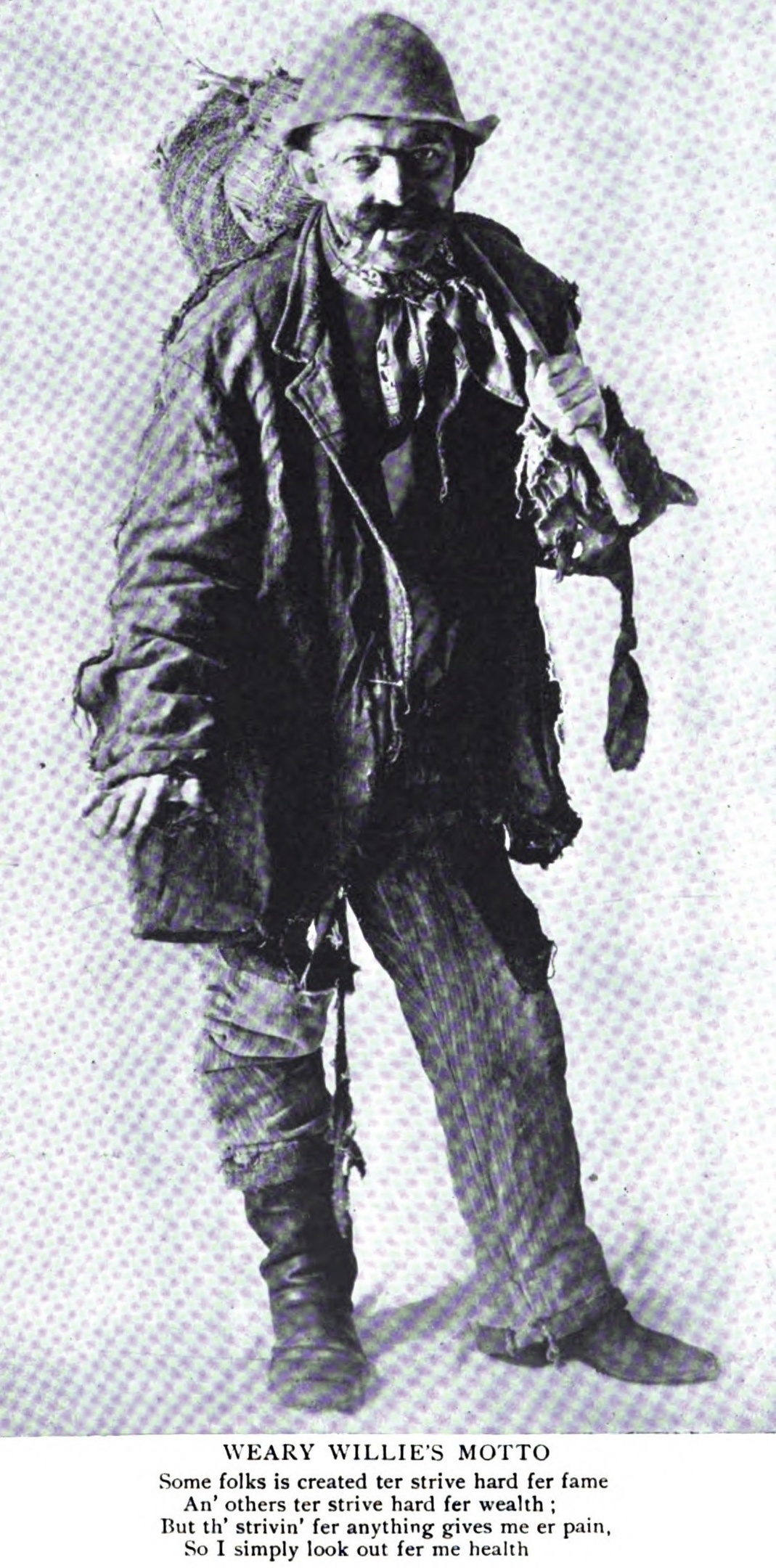
Pictured above, I have identified one of the earliest depictions of the Weary Willie stereotype by photographer A. B. Phelan, published in an August 1895 issue of Judge Magazine. The picture entitled "Weary Willie’s Motto" predates publications like the 1896 Chips comic strip featuring Weary Willie and Tired Tim. This post-Civil War stereotype of Weary Willie was also the inspiration for a world-famous sad-faced hobo clown by the same name portrayed by Emmett Leo Kelly. The official National Weary Willie Day of remembrance falls on December 9th recognizing the art of clowning and Kelly’s hobo clown legacy (born Dec. 9th, 1898 – died March 28, 1979).
WEARY WILLIE’S MOTTO
Some folks is created ter strive hard fer fame
An’ others ter strive hard fer wealth ;
But th’ strivin’ fer anything gives me er pain,
So I simply look out fer me health
I also performed a digital search of Colorado newspapers and compiled a dozen memorable "Weary Willie" newspaper reports.
1) Quite a Different Matter
“Stop working that free-lunch counter,” shouted the bartender.”
“It isn’t work; it’s a pleasure,” replied Weary Willie
2) Woes of the Hobo.
“After all,” said Weary Willie, sadly, “this is a hard life.”
“Hard life!” echoed Plodding Pete.
“We don’t have to work, do we?”
“No,” replied Weary Willie, slowly, “not exactly work, but we can’t get things without taking the trouble to ask for them.”
3) Mrs. Wellment – Ain’t you ashamed to be begging for a living?
Weary Willie – Not a bit, mum, I wuz educated fer de ministry.
4) Person—You wouldn’t be so poor if you were not drunk half the time.
Weary Willie –If I wasn’t so poor I’d be drunk all the time.
5) Sympathetic.
I’ll give you something to eat, said the lady, as she glanced over the woodpile, but I expect some work—
“Lady” pleaded Weary Willie, “I got a splittin’ headache.”
“You have?”
Yes’m. The thought of splittin’ wood always gives me that kind of a headache.
6) Taken Literally
“Lady,” sad Weary Willie, “I’m near dead fur a good square meal.”
“Well,” said Mrs. Hauskeeep, “If you’ll saw some of that wood over there, I’ll let you eat your fill.”
“Good day, lady! I ain’t never et no wood, thank ye, kindly.”
7) “The average church member is a spiritual hobo. He considers himself one of those happy mediums represented by Weary
Willie who was too light to do heavy work and too heavy to do light work.
8) First Tramp – So Weary Willie is suffering from brain fag, is he?
Second Tramp – Sure t’ing. He dasn’t ask for work no more cause he hain’t got brains enough ter think up some excuse fer not taking it if he gets it.
9) His Reformation.
Uplifter—Aren’t you ashamed to ask for money?
Weary Willie—I got six months for taking it without asking.
10) One day Tired Alfonso met Weary Willie holding his stomach as though in great pain.
“Well Willie, what are you trying to do?”
Weary Willie – “I just had a square meal and the corners are hurting my stomic.”
11) If Weary Willie want a wee bit whiskey, there IS the wee bit whiskey that Weary Willie wants.
12) Far-Away Jobs
Mrs. Knicker—Do you look for work?
Weary Willie—No, mum; me method is to listen in for it.
SEE ALSO:
Weary Willie (Frank Luther) The Bum Song (PATHE ACTUELLE 32382) (1928)
https://www.youtube.com/watch?v=69k2ZNMPbUg
REFERENCES:
.
Weary Willie’s Motto, by photographer A. B. Phelan, August 1895 p 2, from Judge's Library A Monthly.
.
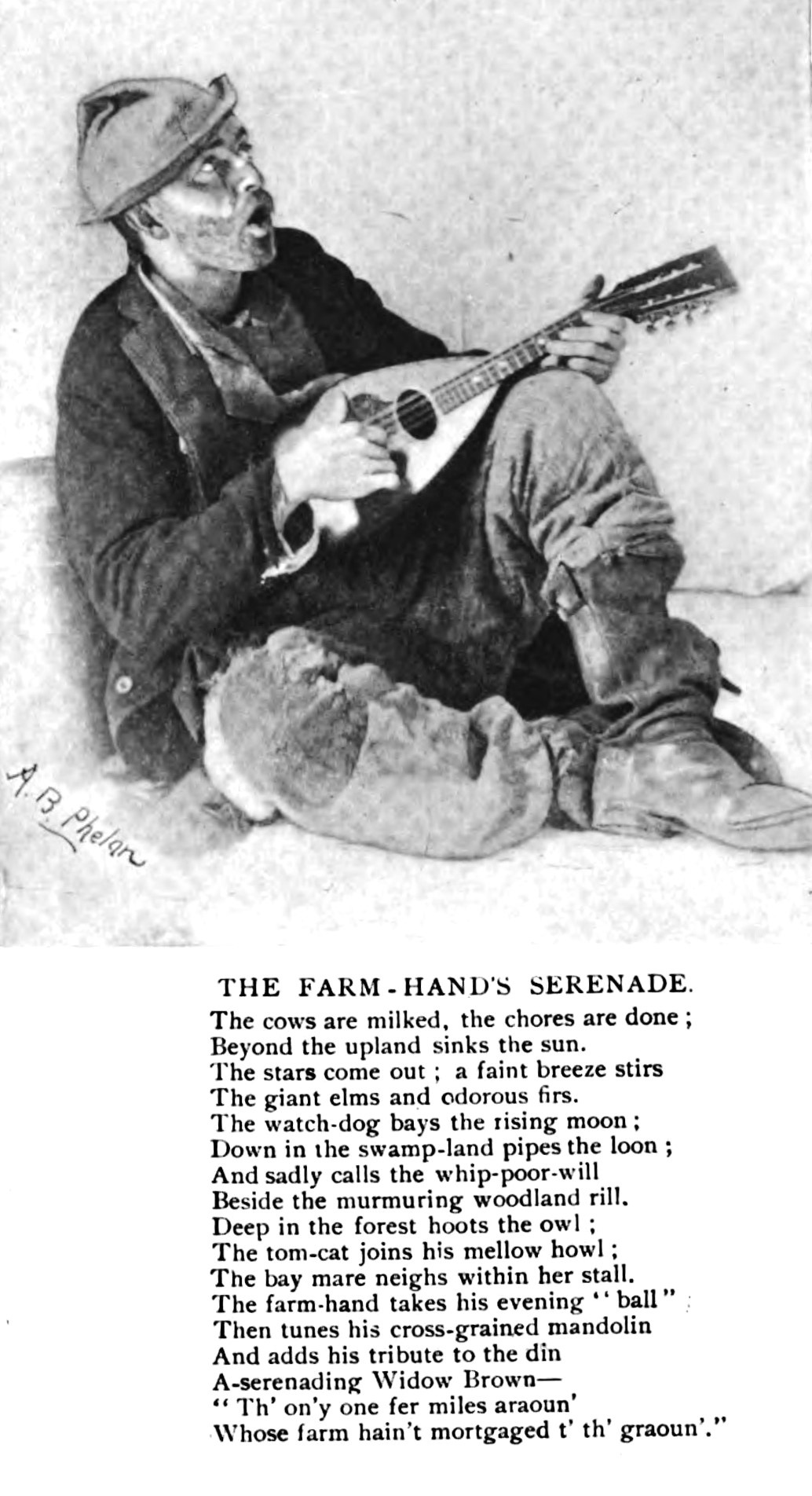
The Farm Hand Serenade, by photographer A. B. Phelan, July 1897, p16, from Judge's Library A Monthly.
.
The Road, by Jack London, by Macmillan Publishing, 1907.
.
1) The Walsenburg World, Co. Volume VIII, Number 38, January 6, 1897, page 4.
2) Boulder Daily Camera, Co. Volume 10, Number 33, May 3, 1900, p 2.
3) Washington County Leader, Co. Volume V, Number 7, November 8, 1901, page 6.
4) The Silver Standard, Co. Volume XVII, Number 43, August 29, 1903, page 6
5) Akron Weekly Pioneer Press, Co. February 23, 1906, page 8.
6) The Castle Rock Journal, Co. June 7, 1907, page 6.
7) Durango Semi-Weekly Herald, Co. May 9, 1910, page 2.
8) Twin Lakes Miner, Co. August 5, 1911, p2 (illustration).
9) The Keota News, Co. Volume 3, Number 19, September 26, 1913, page 2.
10) The Delta Independent, Co. Volume 36, Number 2, January 25, 1918, p 7.
11) The Telegram-Reveille, Co. Volume XVI, Number 44, December 6, 1918, page 3 (prohibition).
12) Wet Mountain Tribune, Co. September 29, 1922, page 3.





Very interesting history, thank you