








Posted 7 days ago
 glasfreund
(49 items)
One thing is certain: the “Loetz-Austria” signature cannot be used to verify the authenticity of a Loetz glass. The only decisive factors are the glass itself—its shape, decoration, glass characteristics, colors, type of iridescence, and overall quality of workmanship. If you cannot identify a Loetz glass by its appearance, then you should not trust any signature either. At no time has it served as a mark of authenticity. The current market value of a “Phänomen” glass is independent of whether it bears a signature or not. Two identical glasses with the same decor—one signed, the other unsigned—are of equal value. So far, the Loetz-Austria signature has had only sentimental value for collectors and buyers.
If we assume that customs regulations were not the decisive factor behind the Loetz-Austria signature, this raises the question of what criteria the glassworks might have used to sign certain “Phänomen” glasses frequently, less frequently, or not at all. Loetz must have made distinctions, because there are clearly Phenomenon versions that may not have been signed at all, or at least extremely rarely, while others were signed more frequently, and still others almost entirely. Although no simple correlation can be established between the different “Phänomen” genres and the frequency of the signature, more complex designs (multi-layered, difficult to execute, involving multiple applications) tend to be signed more often than simpler ones. This suggests that the Loetz glassworks also bestowed special esteem upon more elaborate Phenomenon decors by signing them. However, we cannot identify any fixed rules. We are faced with the inscrutable fact that even some of the finest Phenomenon glasses came onto the market without an engraved signature.
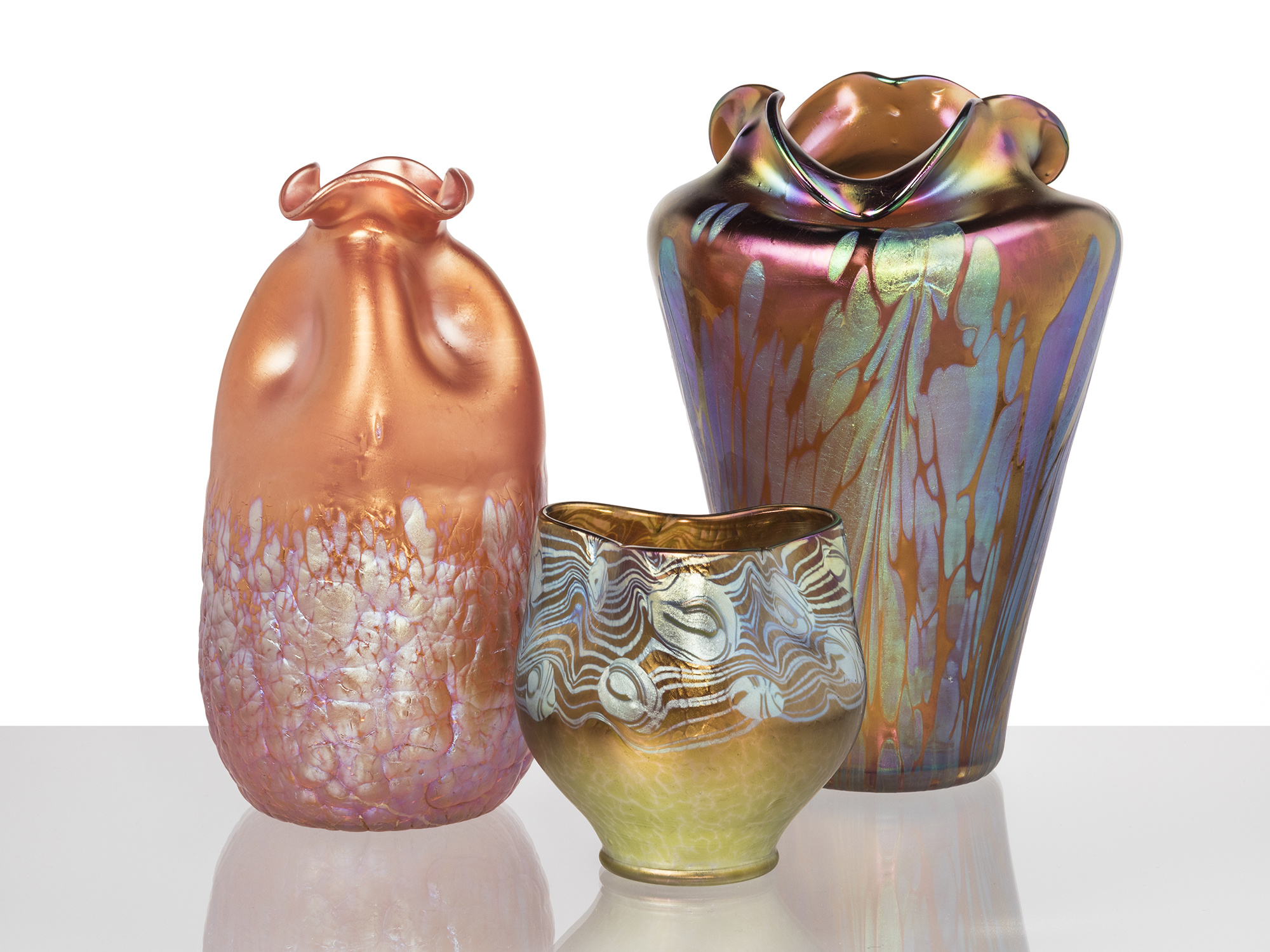
Only a small proportion of some of the more common Phenomenon variations are signed. These include decors that are very popular today, such as Gre 377 with its “lava surface” (1900), as well as “Argus” and “Medici” (1902), all of which were produced in large quantities.
After 1904, numerous other markings appeared on Loetz glassware. These include artists’ signatures or monograms, company logos etched in relief, later paper labels, and even the special markings for a series of table decorations. Examples of these markings can be found in the monographs on the Loetz factory.
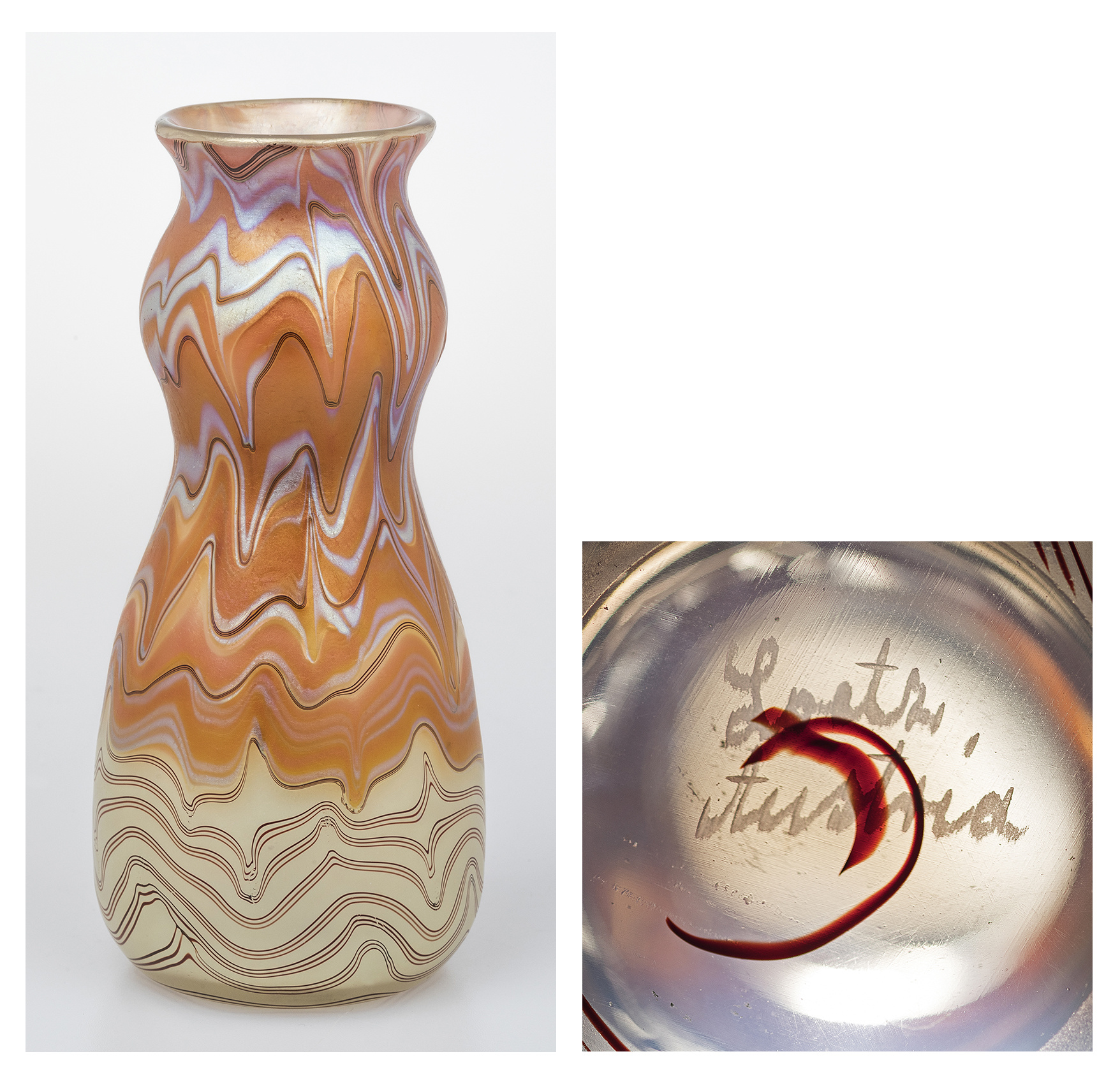
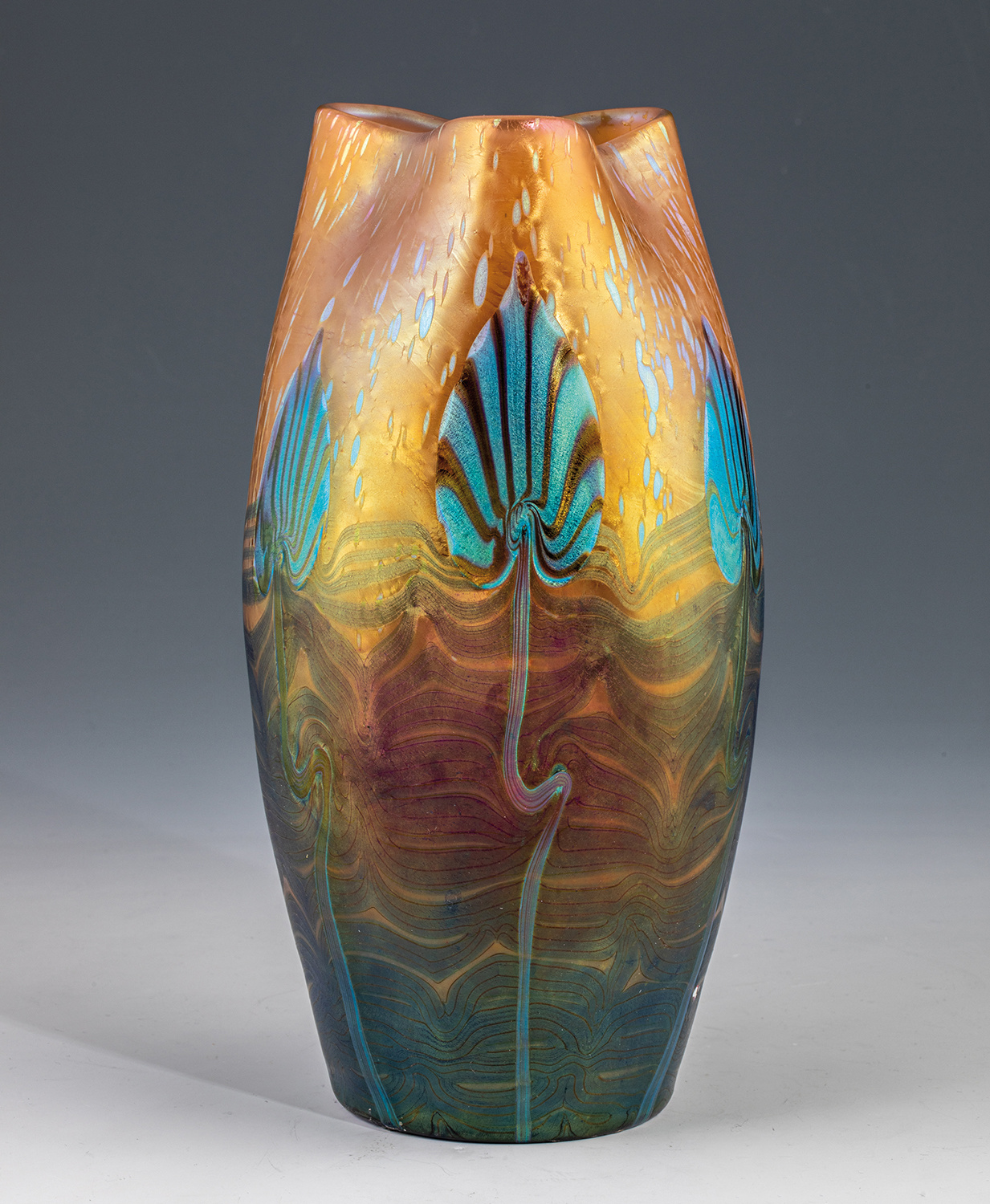
Fig. 24 Vase “thea mit rot (thea with red) Phänomen, Gre 1/728.” This “Phänomen” decor, which has only recently been correctly identified, is not very common. Most examples of this genre known are signed “Loetz Austria.”
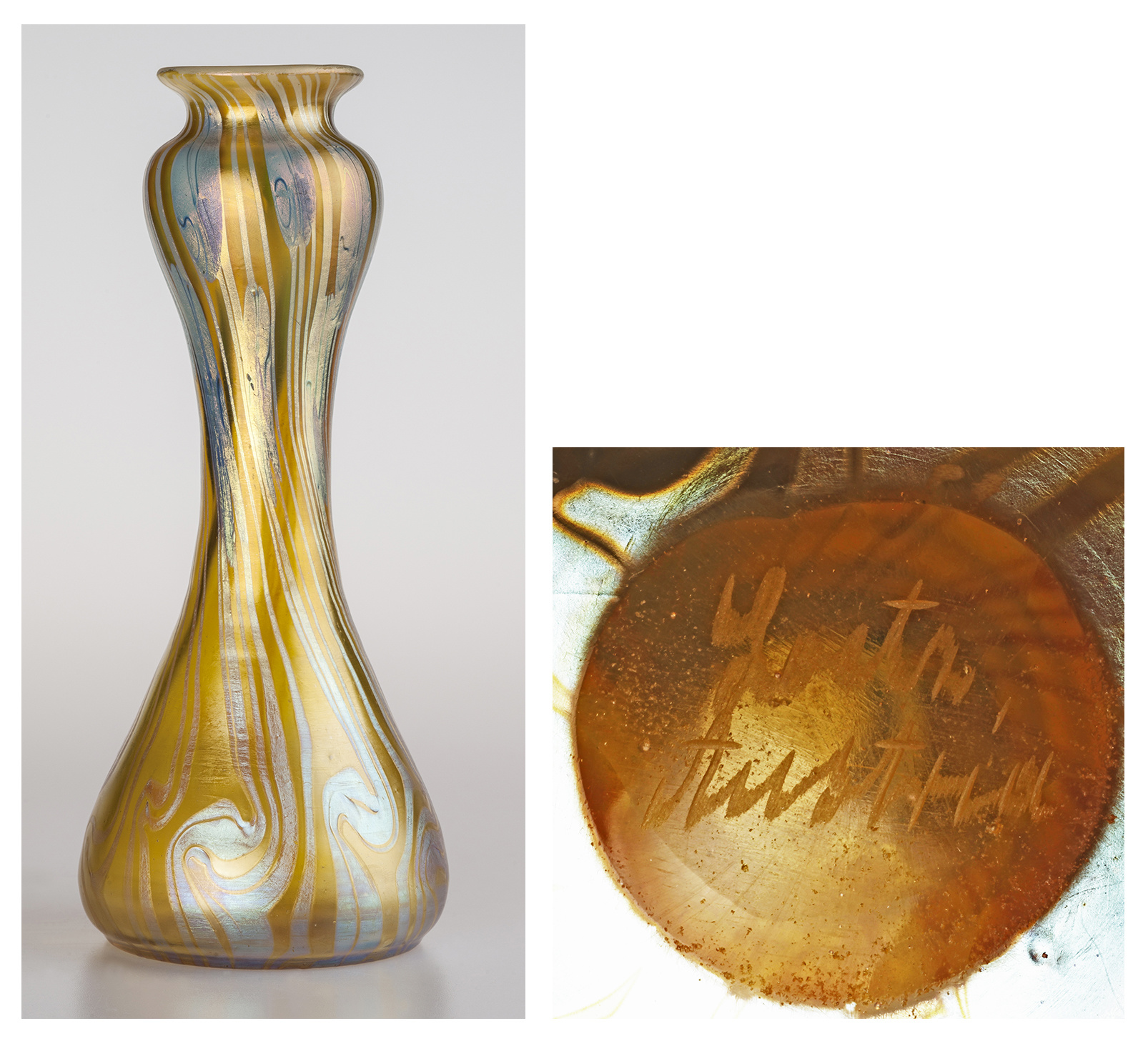
Fig. 25 Vase with an unidentified “Phänomen” decor, PN I-8121. This genre was created in 1900 and remained in production until at least 1902. Most vases featuring this decor are marked “Loetz Austria.”
Fig. 26 “Phänomen” decors that are very popular today: only a small number are signed “Loetz Austria.” From left to right: “rosa (pink) Gre 377,” 1900, unsigned; “maroon verl. (chestnut brown spreading) Gre 2/351 Argus,” 1902, signed “Loetz Austria”; “maroon verl. Gre 2/484 Medici,” 1902, unsigned.
Fig. 27 Vase with unidentified “Phänomen” decor and an unknown production number, circa 1902. An example of one of the outstanding Phenomenon glass pieces without an engraved signature, on display at the Glass Pavilion (PASK) in Klatovy, Czech Republic.
Used Literature
DKD 1899/1900
Deutsche Kunst und Dekoration (DKD) illustr. Monatshefte, Darmstadt 1899/1900
Lötz 1989
Lötz Böhmisches Glas 1880-1940, Band 1 Werkmonographie, Band 2 Katalog der Musterschnitte, München 1989
Lötz 2003
Lötz Böhmisches Glas / Bohemian Glass 1880-1940, Ostfildern-Ruit, Neue Galerie New York 2003
Loetz Austria 1972
Loetz Austria – Irisierende Farbgläser des Jugendstils, 2. Aufl., München 1972
Lnenicková 2011
Lnenicková, Jitka: Lötz / Serie II. Jitka Ln?ni?ková Klatový 2011
Lnenicková 2025
Lnenicková, Jitka: Lötz. Stories of the inspiration, Prag/Klatový 2025
Neuwirth 1986
Neuwirth, Waltraud: Loetz Austria 1900, Wien 1986
Ploil/Sharp 2017
Ploil, Ernst und Toby Sharp: Lötz 1900, Wien 1917
Text and images by Volkmar Schorcht unless otherwise noted.
Link to part 1
https://www.collectorsweekly.com/stories/329197-loetz-austria-the-mystery-of-the-signat?in=666-activity
Link to Part 2
https://www.collectorsweekly.com/stories/329219-loetz-austria-the-mystery-of-the-signa?in=441-activity
Link to Part 3
https://www.collectorsweekly.com/stories/329234-loetz-austria-the-mystery-of-the-signat?in=666-activity
Link to Part 4
https://www.collectorsweekly.com/stories/329252-loetz-austria-the-mystery-of-the-signat?in=666-activity
Link to Part 5
https://www.collectorsweekly.com/stories/329270-loetz-austria-the-mystery-of-the-signat?in=666-activity
Link to Part 6
https://www.collectorsweekly.com/stories/329278-loetz-austria-the-mystery-of-the-signat




Wonderful exploration of the subject. Thank you so much for sharing here.
Thank you, it's always good to get some feedback.