








Posted 12 years ago
loveyardsa…
(31 items)
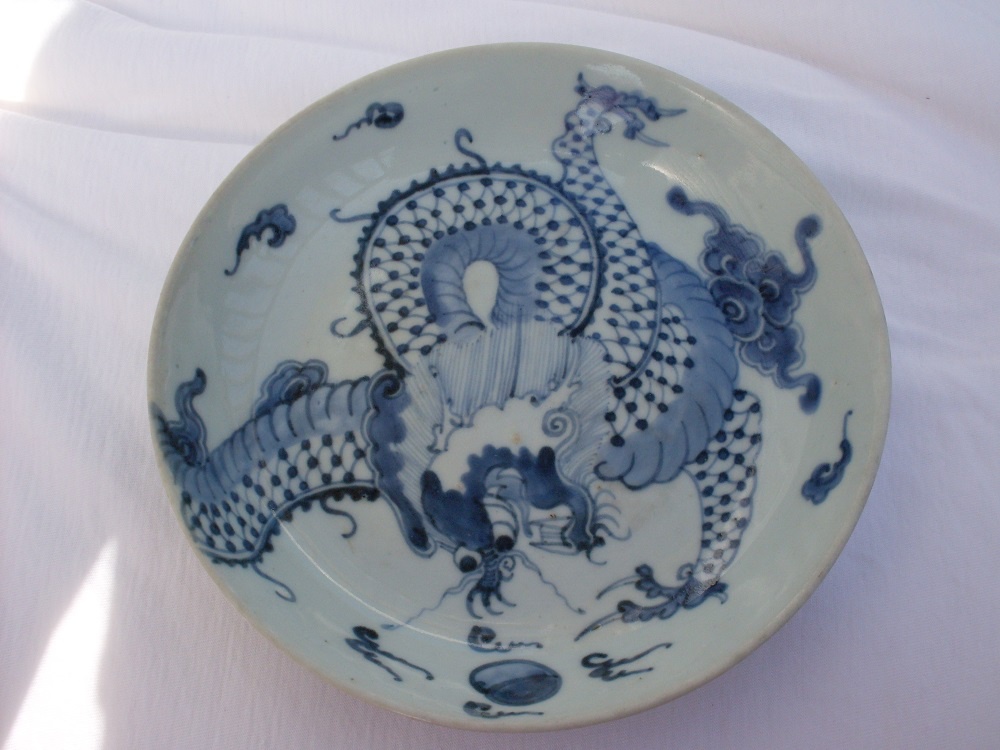
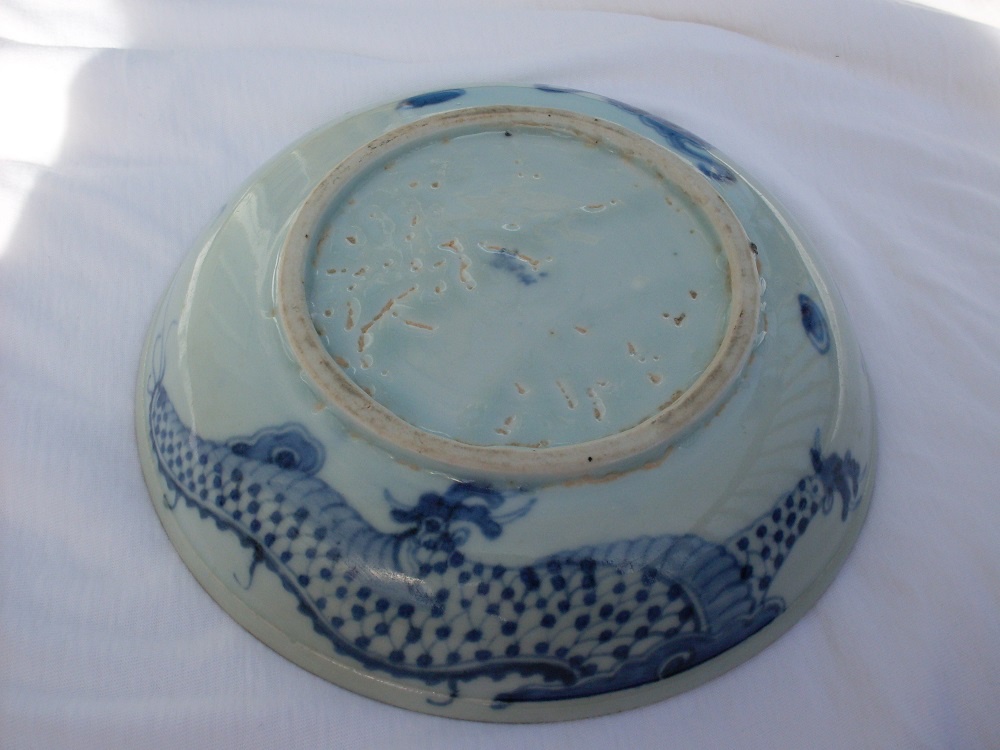
This is another bowl I have collected over the years. It is a light green with blue dragon with his tail over the side which is I think over the wall dragon bowl. There is a mark that is very faded that you can't make out. Any idea?




You are quite right, it's "over wall dragon bowl" from mid Qing/Ching. Not like the high end ones in its kind, this one is called 'grass root dragon' for low end market. I think it's real.
Shrine thank you for the comment.
Thanks again renedijkstra so you think this is a real kangxi? Would you say it's on the high end or low end? The values are all over the place. I posted this 6 years ago and I do still have it.
insert( rechecking allen., wang cheng, waki- li zhang escape Stansford)
bit scared about this assesment, because my second option was guanghu kitchen sink, because of the so called crosshatch and dots plating of the dragon
so i digged up some very ferocious assesments, who lingered on for a very long time between major experts
opinions
1 MEijji period abbriviated marking ( tiny minority point of view, dismissed as ludocrous)
an swatow (ming) point of view) possible but to restricted ( a bit larger minority pient of view, too restricted)
3 what remains is an guanghxu piece who got crosshatch dots in combination with a kitchen qing glazing, hugh minority point of few, but is this logical almost 90 % of the porcelain is mingyao (folksware)
so actually when the smoke and the mood got completely f,,,,,, the slight majority point of view due to the bottom glazing it is assessed at 1700till 1750, so late kangzhi to early qianlong ( although the bottom type of recessing is strange )
well i can live with that , who the f, am i, these are major players, actually i did not knew that the extension was until early qianlong , although time wise it is little spread
i am still in doubt actually , they probably are right the shining of the the rectangers
almost a sort of thin embossing at the tail of the dragon could be an early qianlong determinent, didn,t see it actually from the get the get go , because i was fixed on the glazing that,s the main indicator ( timespan difference is narrow and not so important)
actually i disagree with Shrine, IMO this not a mid Qing, dragong are boring , because they all look but the actually you got 5 mods of design, and when it might be an over the wall late kangzhi or early quinlong, over the wall plates are quite rare in this period
no dillution, good contrast , cross hatch and dots mod is taking care of, simple but quite sufficient, i think this better than average
WTF from elementary school on i still don,t know, when to use THEN or THAN, ( moron)
An interesting dish.
If I just looked at the underside I would have been tempted to say late Ming Chinese Swatow ware.
If I looked at the 3 clawed dragon I might have said Japanese.
But the front, the shape, and the firing defects all, to me, scream out 18th century Chinese, although the foot rim looks 19th century. It may possibly have been made for the Japanese market.
Regards
Tony allen = major export
If the second character is obscured. How do you know it actually says Kutani? I believe this is an 18th century Qing dish made in South China. Better kitchen QIng if you may. And lots of kitchen Qing dishes have two character marks on the
reverse. pyromaniac known expert
I agree Ian (pyromaniac).
Both China and Japan regularly copied one another's wares, including traditional designs and marks. Most were made to deceive, and I find it amusing to think the deception is still working some 200 to 300 years later.
Regards
Tony allen consensus support for with pyromaniac
Ed,
I have sat quietly by waiting for someone else to respond to your comments, but I think you must have traumatized them with your mixing of facts and history.
I simply do not know where you get your information from, as most (probably over 50%) is not to be found either in my experience or in my vast library of reference texts.
What may I ask has the Meiji restoration (1868) got to do with this dish?
The size of this dish is not given, but the shape is typical of those from the 18th century and very early 19th century. This example is in fact more finely potted than the more frequently encountered Chinese examples which often have underglaze red designs of birds, fish etc.
Nor are the scales painted in the "cross-hatch and dot" manner common to most of the late 19th century dragons.
Perhaps Anthony Lee would care to venture his opinion, as Ian and I are seeing this with different eyes.
Regards
Tony Allen addendum
possible conclusion we stick to TONY ALLEN, because we are on this for years
actually what TONY ALLEN is debunking the THE CROSS AND DOTS theory , which is the plating of the dragon in the famous GUANGXU PERIOD
the implies he is also bedunking the so called MING ( SWATOW THEORY), because the reverse ruptures gives an impresssion of swatow, but is is conside to be peoples ware and it lingers on in time
actually TONY ALLEN did this so lets compromise something like grosso mode ( late) QIANLONG to very earlly DAOGUANG
creits go to TONY ALLEN
kia ora
Waki