







Posted 15 days ago
 glasfreund
(49 items)
Even though we do not know when the collection for Paris—nearly all of which featured new shapes and new decors—took shape in the furnace hall at Klostermühle, it cannot have been just shortly before the exhibition opened in April 1900. It is far more likely that it was produced well in advance, as early as the previous year. The 87 documented designs for the Paris exhibition bear consecutive production numbers dating from 1900. These numbers were apparently assigned all at once at a later date, probably early in 1900. The assumption that the exhibition pieces were produced as early as 1899 can also explain why they were still signed with the circle mark and the addition “Lötz” rather than “Loetz Austria.” The new Loetz-Austria signature had not yet been introduced.
Some of the later designs from 1899 are stylistically so closely related to the Paris collection that they must have been created at the same time. These, too, were exhibited in Paris, as evidenced by acquisitions made by the Victoria and Albert Museum in London while in Paris. This also supports the argument that all of the exhibition glassware for Paris was produced as early as 1899.
How do these interpretations reconcile with the fact that most known glasses featuring the shapes and decors of the Paris collection are marked with the “Loetz-Austria” signature rather than “Lötz” and the circle mark? The paper pattern records indicate that a number of models from the Paris World’s Fair were reordered during the course of 1900. These reorders are apparently engraved with “Loetz Austria.” The majority of the known pieces from the Paris collection were likely produced during and after the exhibition, and even years later, and were therefore signed exclusively with “Loetz Austria.”
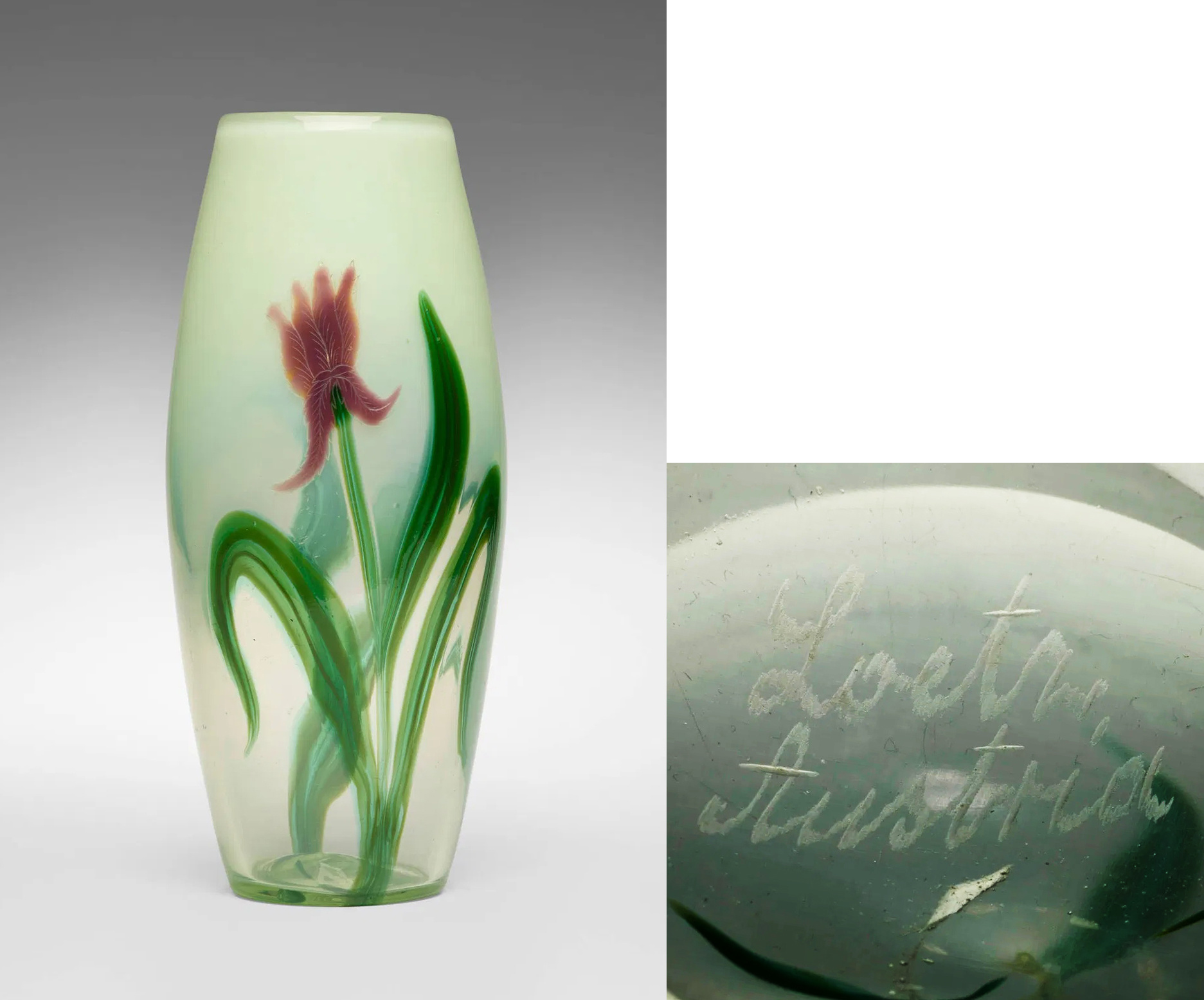
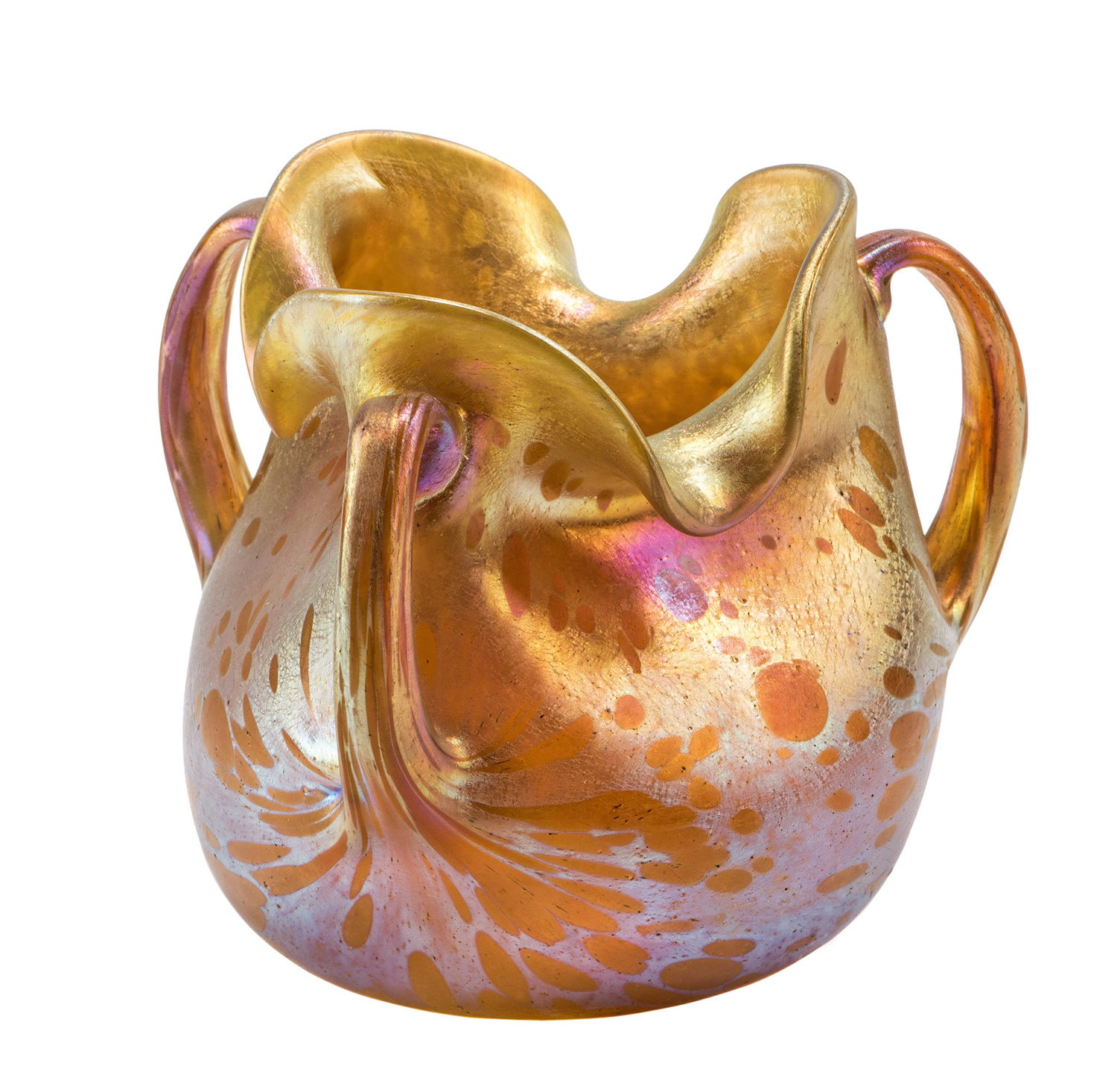
The Loetz-Austria signatures appear almost exclusively on Phenomenon glass. There are only a few exceptions. These include pieces made using the marquetry technique, which Loetz also presented at the 1900 World’s Fair, described as “opal verlaufend mit grünen Blättern und rother Blume” (spreading opal with green leaves and a red flower). Formally, they do not belong to the group of Phenomenon glasses, as they are executed without metallic reflections. Only a few vases with this decor are known. Nearly all of them bear the Loetz-Austria signature.
Could this mean that the introduction of the “Loetz Austria” engraving is directly linked to the start of the new century? Glasses from the production period before and after 1900 should provide the answer here: not a single glass, but a statistically significant number. What is the proportion of glasses bearing the “Loetz Austria” signature among the Phänomen decors from 1898 and 1899, and what is the proportion among those from 1900? If the signature wasn’t introduced until 1900, the glasses with earlier decors would, on average, be less likely to bear the signature. After all, they were already being produced before the Loetz-Austria signature existed. Only the pieces produced from 1900 onward can bear the signature. Can we identify trends here based on the chronological sequence of the Phenomenon decors? Loetz gives us a hand here. The year of introduction can be determined from the genre number of a specific “Phänomen” version. This yields the chronological order of all known decors. With a statistically relevant number of glasses for each genre it is easy to figure out the proportion of those signed “Loetz Austria.” Here, the internet helps with its vast array of images and information that can be analyzed. The rest is hard work. I could include a total of 3,400 glasses in the analysis.
Of course, the result depends on a number of rather uncertain factors. Ultimately, however, not a single figure is concerned, but the trend. And that is precisely what the statistics show: The percentage of glasses signed “Loetz Austria” tends to increase for genres from 1898 and 1899; it remains, roughly speaking, at a high level from 1900 to 1902, and then drops significantly again in 1903. This is exactly the pattern one would expect if the “Loetz Austria” signature had been introduced in early 1900 and had become increasingly rare starting in 1903. But the statistics reveal an additional very interesting aspect. It becomes clear that the glassworks did not sign all Phenomenon genres with the same frequency. There are clearly Phenomenon genres that may not have been signed at all, or at least extremely rarely, while others were signed more frequently, and still others almost entirely.
Loetz-Austria signatures can also be found occasionally on glasses featuring the “Asträa” decor. Here, however, they appear only on pieces with extended handles and on individual items considered to be designs by Koloman Moser. That's only a few percent of Asträa glasses.
Glasses that do not belong to the “Phänomen” series were generally left unsigned. This is not surprising when it comes to simpler colored glasses and decors. But why did higher-quality decors such as “Pampas,” “Norma,” “Merkur,” “Silberiris,” “Diaspora,” “Formosa,” “Aeolus,” “Orbulin,” and “Damasc” always remain unsigned? Was it solely the lower price that precluded the signature? Unlikely. Larger Pampas pieces cost comparatively more than some signed Phenomenon glasses. Evidently, neither price, size, shape, nor the intended use of the product played a role. With only few exceptions, the signature was reserved for the Phenomenon glasses.
Despite this, many items featuring Phenomenon decors remained unsigned. This is easily understandable for products manufactured on behalf of other companies. These included glasses produced for the firm E. Bakalowits Söhne in Vienna, which were sold without a signature. Nevertheless, there were exceptions here as well. A Phenomenon decor registered for Bakalowits was adopted into Loetz’s series production and is frequently signed (PG 85/3780). In addition, there are also individual glasses from the production for Bakalowits that bear the Loetz-Austria engraving. These are evidently particularly high-quality pieces that likely served as a showcase for Loetz’s craftsmanship.
Will be continued.
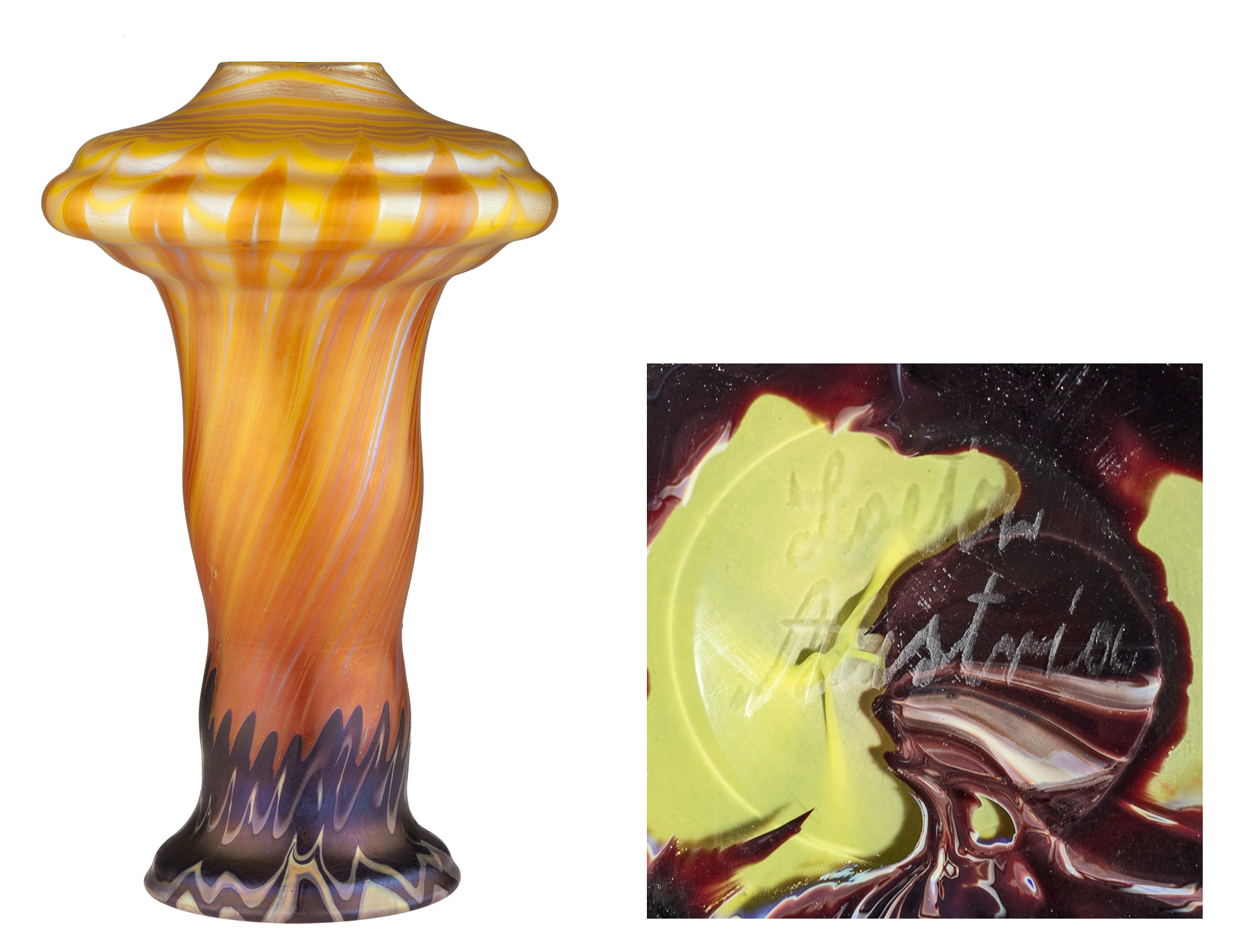
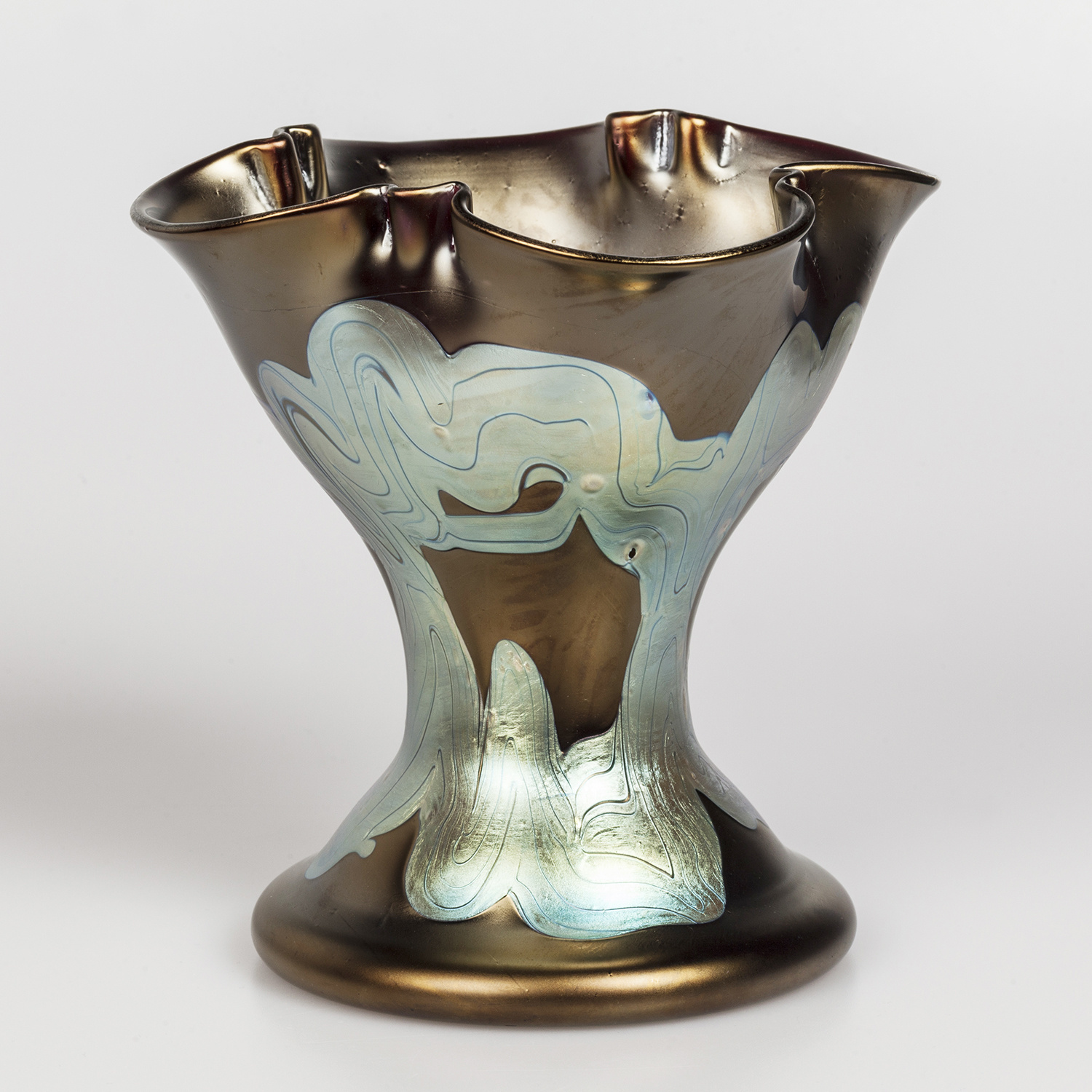
Fig. 16 Vase from the collection for the 1900 Paris World’s Fair, “metallgelb (metallic yellow) Phänomen Gre 356,” PN II-370, 1900, signed “Loetz Austria.” One of Franz Hofstötter’s designs for the Paris collection.
Fig. 17 Vase “opal verl. mit grünen Blättern und roter Blume (spreading opal with green leaves and red flower),” a decor for the 1900 Paris World’s Fair, PN Com. 2272/343, 1900, signed “Loetz Austria.” Photo: courtesy of Rago Auctions.
Fig. 18 Some glasses featuring the “Asträa” decor and extended handles are signed “Loetz Austria.” Photo: courtesy of Quittenbaum Auctions
Fig. 19 Glassware produced on commission, such as for E. Bakalowits Söhne in Vienna, was generally not signed: vase rubin (ruby) Phänomen Gre 7773, PN 85/3723, 1899/1900, unsigned.
Text and images by Volkmar Schorcht unless otherwise noted.
Link to part 1
https://www.collectorsweekly.com/stories/329197-loetz-austria-the-mystery-of-the-signat?in=666-activity
Link to Part 2
https://www.collectorsweekly.com/stories/329219-loetz-austria-the-mystery-of-the-signa?in=441-activity
Link to Part 3
https://www.collectorsweekly.com/stories/329234-loetz-austria-the-mystery-of-the-signat?in=666-activity
Link to Part 4
https://www.collectorsweekly.com/stories/329252-loetz-austria-the-mystery-of-the-signat?in=666-activity



Thank you for sharing your research!