




Posted 17 days ago
 glasfreund
(49 items)
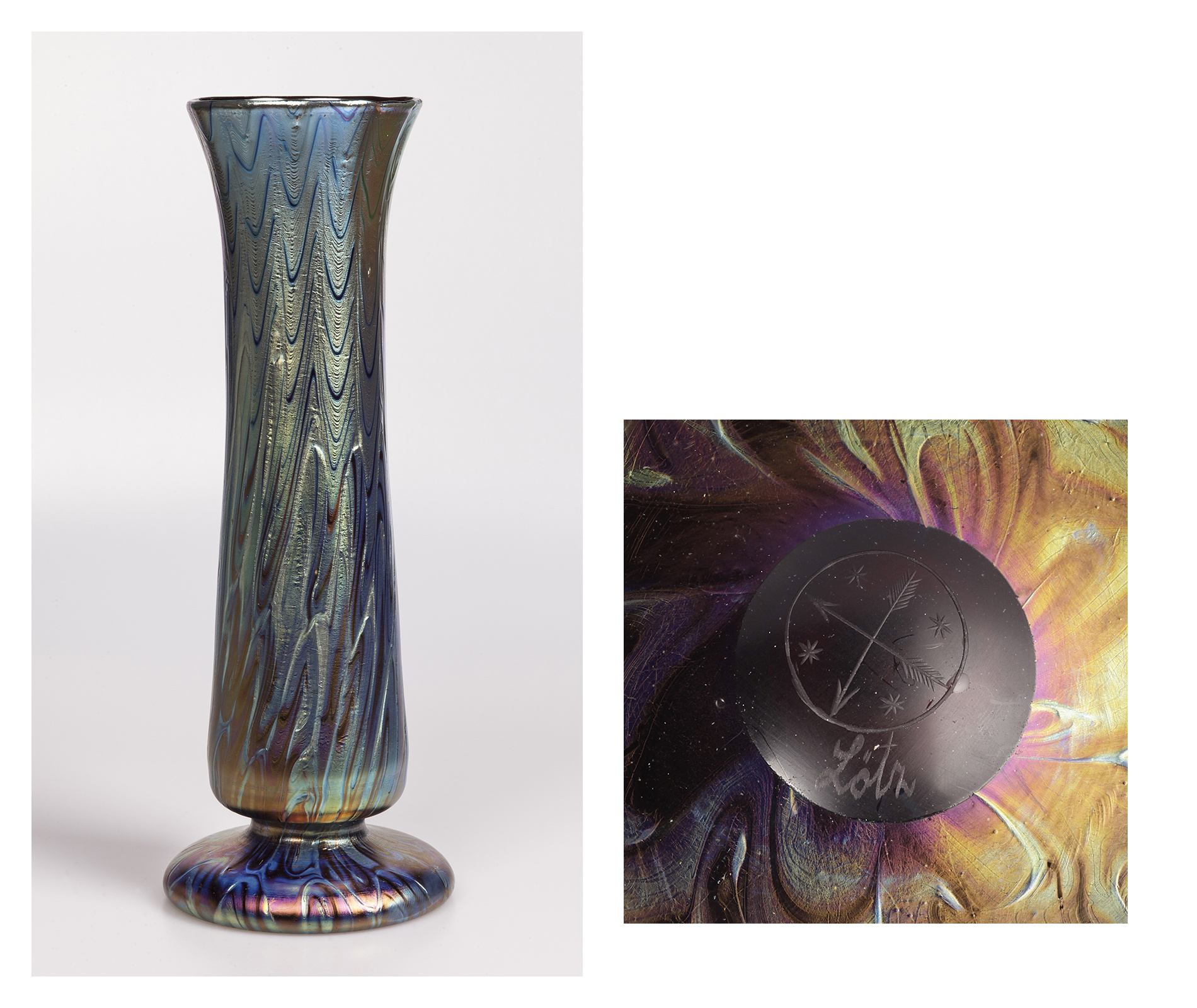
The circular mark with the added inscription “Lötz” is of particular significance. This signature was undoubtedly reserved for the glassworks’ finest pieces. It appears only on exceptional items intended for exhibitions and museums. We can consider glasses bearing this signature as a showcase of the Loetz glassworks’ contemporary achievements.
The use of the engraved circle mark with the addition “Lötz” can be traced back to glasses that were exhibited or sold at the 1900 Paris World’s Fair. This includes not only the collection of 87 glasses that Loetz documented as World’s Fair pieces, but also older production numbers dating as far back as 1898 (see Ploil/Sharp 2017, p. 26: A copy of an invoice dated August 2, 1900, listing 19 glasses acquired by the V&A Museum. Most of these glasses can be found on the V&A Museum’s website, along with information on their signatures). The signature with the addition “Lötz” also appears on glassware that was exhibited at the Vienna Winter Exhibition of 1899/1900 from November 21, 1899 to January 1, 1900 (see the illustration of Lötz glasses on p. 268 in DKD 1899/1900; both vases on the right [PN I-7503 and I-7957] have appeared on the market bearing the circle mark and the Lötz inscription). The paper pattern for I-7957 bears the notation “Aus” for “Ausstellung” (exhibition). The Šumava Museum in Kašperské Horni holds another vase (PN I-7953; Inv. No. S 318) from the same exhibition, also featuring the exhibition notation on the paper pattern and the circle mark with the addition “Lötz.”). A plate, two vases, and a stemmed glass at the Vienna Museum of Applied Arts, cataloged on November 28, 1899, also bear the circle mark with the addition “Lötz.” What all these glasses have in common is that they were not manufactured or signed until the end of 1899—likely for the Vienna Winter Exhibition and the Paris World’s Fair. The acquisitions made by the Victoria and Albert Museum at the World’s Fair in Paris demonstrate that Loetz also exhibited and sold numerous models that were not part of the specific collection of 87 glasses created for the 1900 World’s Fair in Paris (PN II-351 to II-437). This supports the assumption that other glasses bearing the same signature were also intended for the exhibitions in Vienna and Paris.
Based on the available information and signed glasses, it can be concluded that the signature with the circle mark and "Lötz" was used, with a few exceptions, only in the years 1898 and 1899.
It is worth noting the spelling of the word mark “Lötz” with the German umlaut in the signature. It corresponds to the original spelling of the company name, which the glassworks also used in its international correspondence at the time. The assumption that this signature was used only for the German-speaking market is refuted by its use at the Paris World’s Fair. The spelling “Loetz” first appears in the later signature “Loetz Austria.”
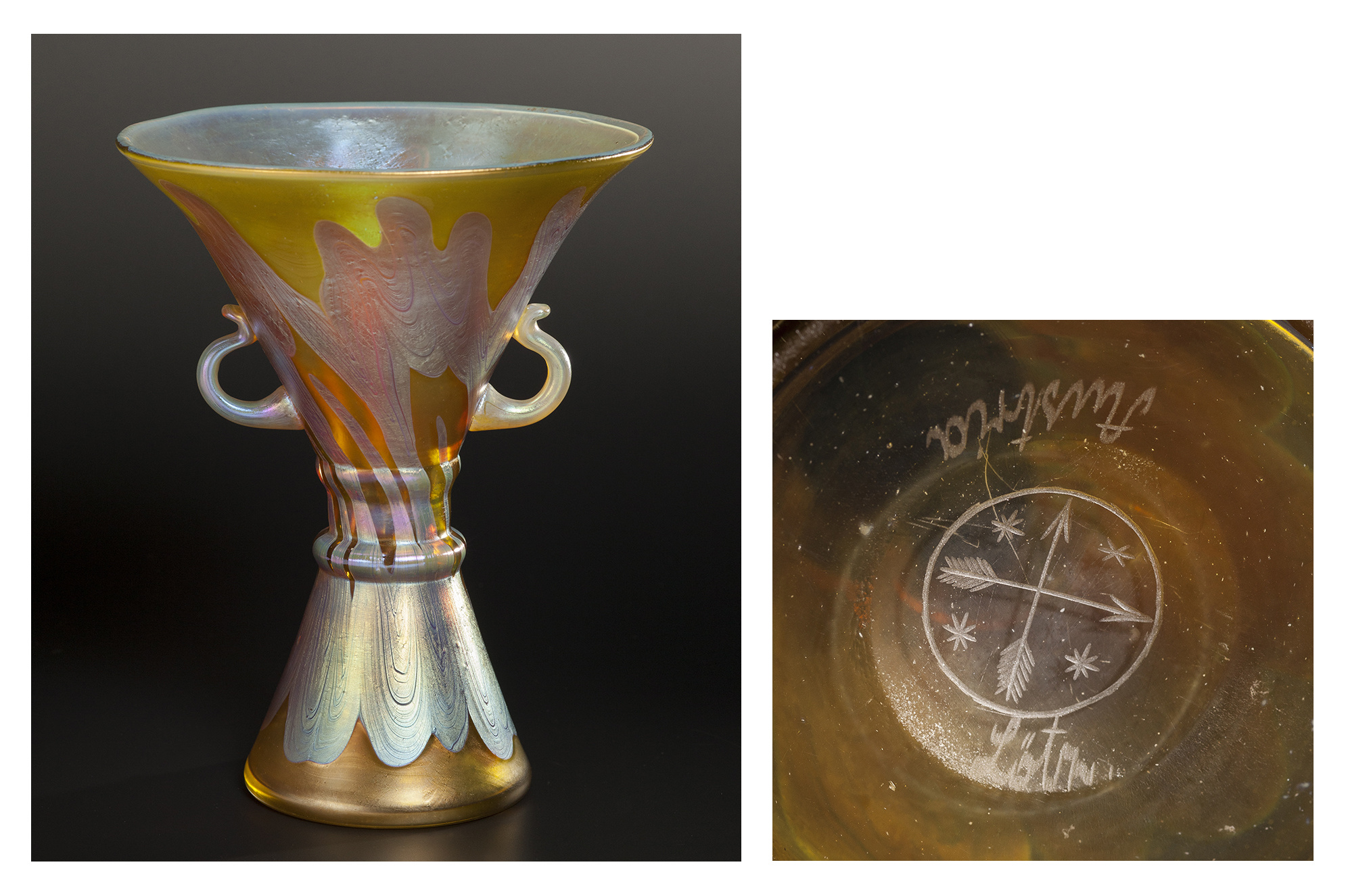
The occasional engravings of the circle mark, along with “Lötz” and “Austria,” cannot be considered part of the standard markings. On some of these glasses, the Loetz-Austria marking is located in the center of the polished pontil mark, while the circle mark is offset toward the edge (see Ploil/Sharp 2017, p. 228). The latter has been added. The handled vase shown here is signed with the authentic circle mark and the word “Lötz,” in the pontil mark. The word “Austria” has been added, as evidenced by the altered stroke of the Austria engraving.
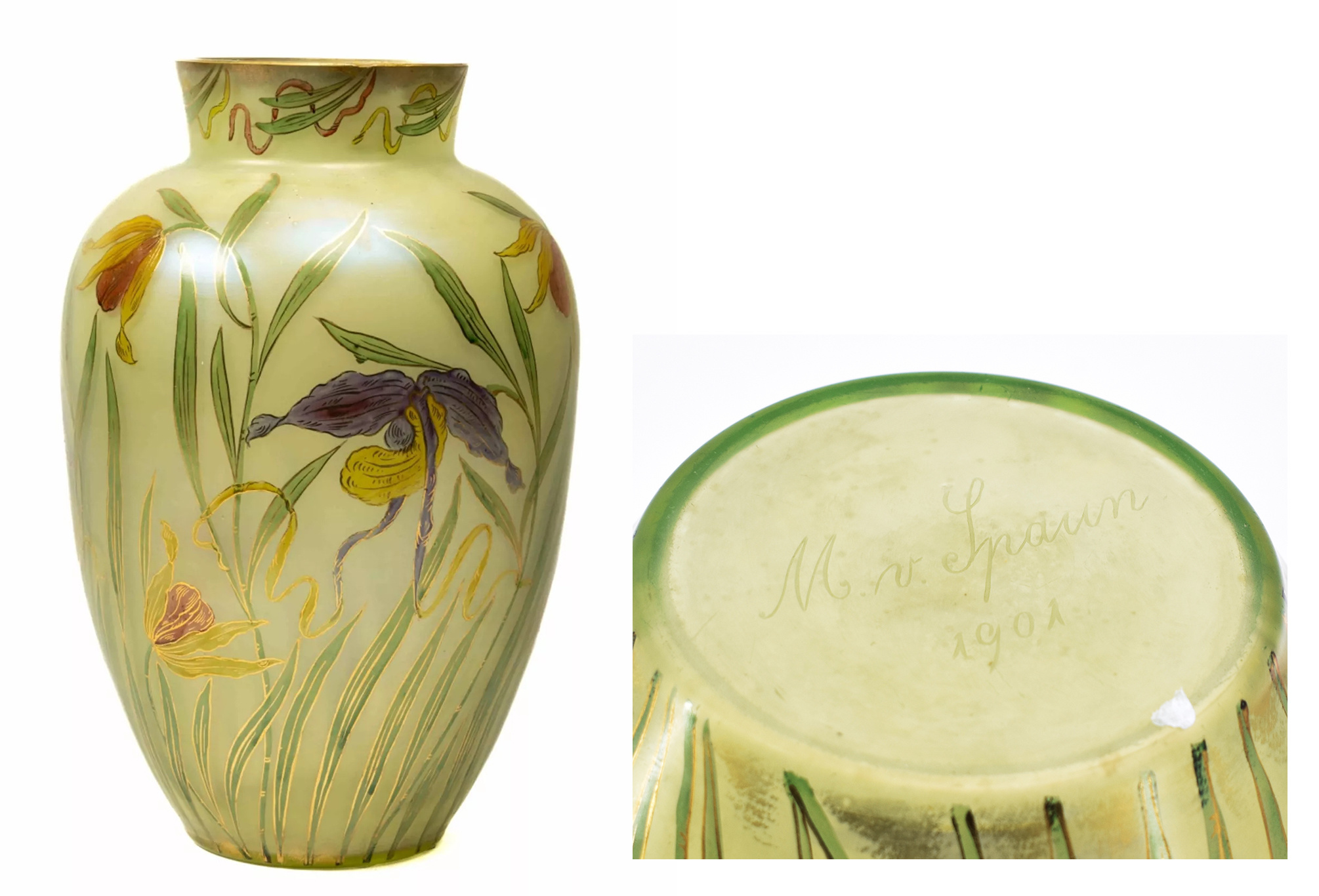
Only a few examples are known of a signature that has not yet been documented in the literature. It reads “M. v. Spaun 1901” and is also engraved on the polished pontil mark. It seems likely that glasses with this signature were personal gifts from the glassworks owner, Max Ritter von Spaun.
Will be continued.
Fig. 9 Large vase “rubin (ruby) Phänomen Gre 7966”, PN I-7469, shape from 1898, decor from 1899, circle mark with the addition “Lötz”. It was probably intended for the Vienna Winter Exhibition of 1899/1900.
Fig. 10 Handle vase “candia Phänomen Gre 7773”, PN I-6652, shape from 1896, decor from 1899, circle mark with the additions “Lötz” and “Austria”
Fig. 11 Large “Arcadia” vase, PN II-275, shape from 1899, decor I/1 from 1900, very rare signature “M. v. Spaun 1901”
Text and images by Volkmar Schorcht unless otherwise noted.
Link to part 1
https://www.collectorsweekly.com/stories/329197-loetz-austria-the-mystery-of-the-signat?in=666-activity
Link to Part 2
https://www.collectorsweekly.com/stories/329219-loetz-austria-the-mystery-of-the-signa?in=441-activity



Following this subject with great interest. Thank you for your scholarly research.