






Posted 15 years ago
 IVAN49
(46 items)
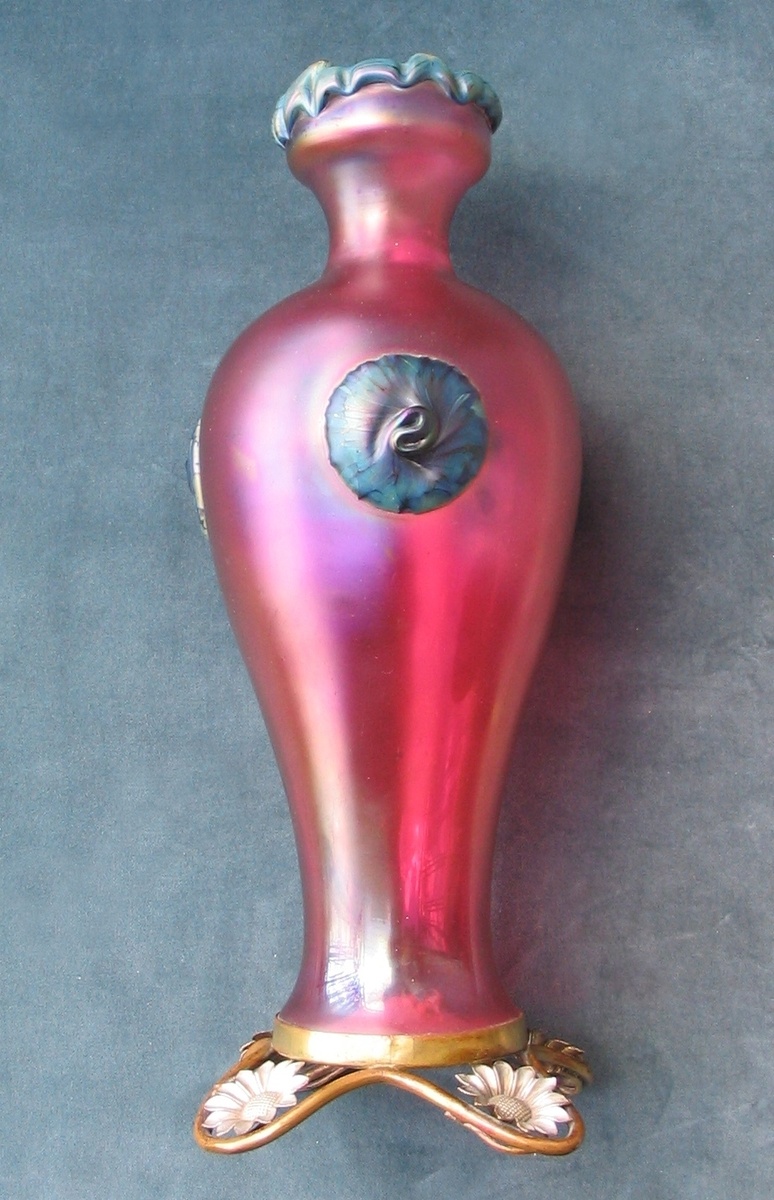
Bohemian vase, iridescent opalescent pink-red glass with 3 papillion prunts. polished pontil. It is mounted on gilded brass stamped daisies, 16 inches tall. Maker unknown.
Passau Museum catalog, Band IV has vases in the same shape (IV.302) and color (IV.307) listed as Glasfabrik Elisabeth (later Pallme-Koenig), 1900-1910. There is even a bowl with the same color prunts (IV.305), however the prunts on that piece come to a point in the middle.The documented examples point to Pallme-Koenig, but there is a very real possibility that it may be Kralik production.
Acknowledgement: The attribution mentioned above is given by Alfredo Villanueva and Craig Orkney. Thank you.




Hi Ivan ,I love the mount on this piece as it enhances the shape and does not obscure or over dominate the glass .Quite a beauty!!
Thanks for the comment. The mounting is in fact an empty cylinder twisted in Jugendstil manner and the stems of the daises are soldered to it. Not as expensive process as ``lost wax`` bronze mount. Still, stamping those daisies out of brass sheet is not profitable unless hundreds of flowers were made, most probably for different use e.g. picture frames. Namely, the stamping steel tool is expensive. Had they made hundreds of those vases at least some would have survived. It must have been mounted elsewhere and the vase itself was naturally made by another maker. Another curiosity: daisies are silver plated and the center is gilded. Both Craig and Alfredo agreed it could be very high end Kralik, but we cannot document it. Nothing similar has been seen so far.
A late comment: color, shape, prunts and the rim speak to 99% for Glasfabrik Elisabeth!