






Posted 6 months ago
 glasfreund
(41 items)
{German below}
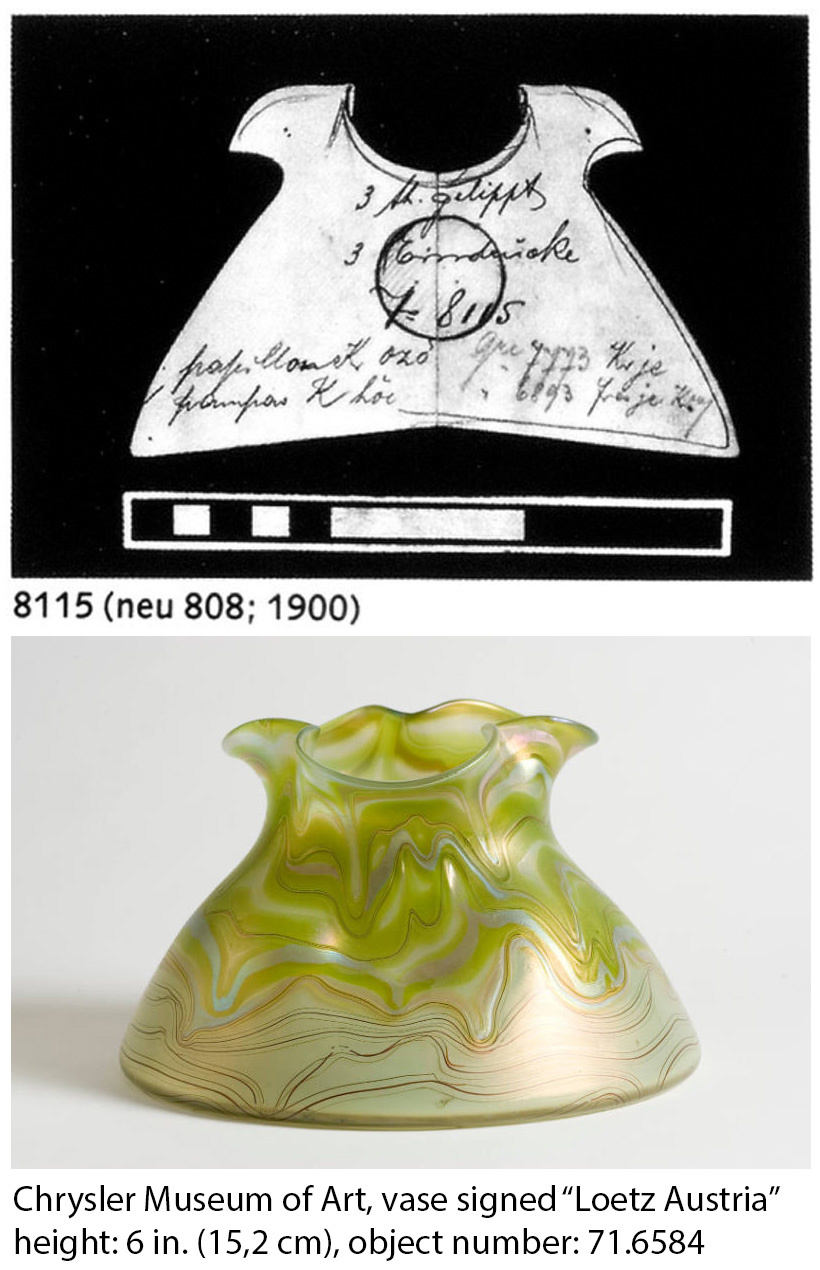
Anyone looking for examples of Genre 1/728 phenomenon in the two Lötz publications from 1989 (Lötz Böhmisches Glas 1880-1940) and 2003 will not find them, at least not directly. So, the search begins in the entries on pattern cuts and in the invoice books of the same publications and in the large edition of the Series II paper pattern cuts from 2011. And they do exist. The oldest pattern 8115 dates from Series I of 1899, newly numbered 808 in 1900. The largest of the three versions (8115/5 ½“) bears the entry “1 Phänomen Gre 1/728 Eilig!”. This easily identifiable three-lipped form was produced in many decor variants, including well-known Phänomen genres such as Gre 6893, Gre 7773 and Gre 1/64. Years ago, I noticed the vase identical in form on page 204 in the book “Art Glass Nouveau” by Ray & Lee Grover from 1978. The vase from the Chrysler Art Museum is illustrated with a phenomenon decor made up of narrow bands of greenish, combined with shimmering blue silver threads and thin volcanic threads. The shape of the vase is clear, though it is slightly larger than the 5 ½-inch pattern. This allows for two interpretations. The vase could have been made slightly larger. However, it is more likely that, in addition to the 3 ½-, 4 ½-, and 5 ½-inch cuts, there was also a 6 1/2-inch cut that did not survive. The vase featured in Grover's book is available on the Chrysler Art Museum website (Fig. 1). I had a suspicion that I had discovered an example of the 1/728 Genre, but it did not come to fruition. It was only recently that I came across this decor again (Fig. 3) and began searching for clues.
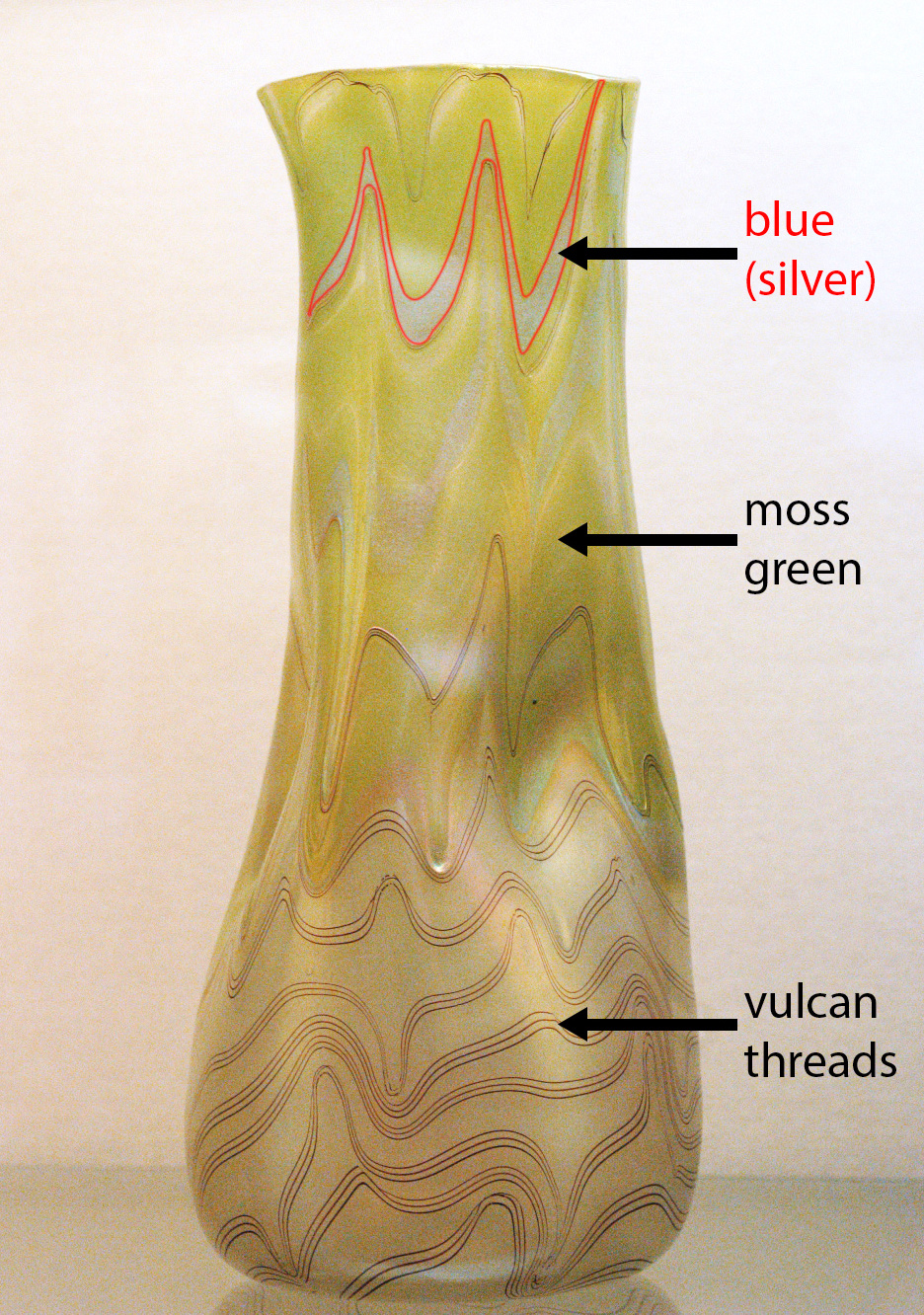
Vases with this decor are not that rare and the decor is available in two color versions, each with candia and thea as base color. The Lötz designations are “candia/thea Phänomen Gre. 1/728 mit moosgrün, blau & vulcan Fäden” (candia/thea phenomenon Gre. 1/728 with moss green, blue & volcanic threads) and “thea/candia Phänomen mit rot Gre. 1/728” (thea/candia phenomenon with red Gre. 1/728”, short moss green and red (cf. entries on paper patterns II-115/I and II-847). As the threads are applied very thinly to the glass, the moss green threads appear quite light, even yellowish green on a candia ground. But what does the word “blue” in the decor description refer to? Apparently, the silver threads have a bluish iridescence, a play of colors that can also be found in the Genre 1/104 phenomenon. There are only seven pattern cut or invoice book entries that mention the 1/728 Genre, but significantly more glasses with the decor exist. This is not unusual, as only very few patterns from the years 1901 to 1903 have survived, i.e. from the production period of the Gre 1/728 decor.
Why are the few glasses with the well-characterized decoration 1/728 that appear on the market from time to time not to be found in the relevant literature? This is an example of the frequent occurrence of the incorporation of incorrect information or assumptions. Since 1989, we have found the decor under the Phänomen Genre “2/679” in the first Lötz compendium, and it has “lived” with this name ever since. No one has ever questioned the attribution of the decor. This is indeed surprising. The Gre 2/679 is only mentioned once on the eponymous pattern cut II-2/679 as “maron Gre 2/679” and is entered in writing on the pattern drawing. However, the decor drawing shows an entirely different pattern and is not at all similar to the decor discussed here. The maroon base color (cf. Medici decor) does not occur with the moss green or red, and vulcan thread decorations. Consequently, the attribution to Genre 2/679 must be based on an error. Phänomen Genre 1/728 is correct!
Fig. 1: Vase PN I-8115 from the Chrysler Museum of Art showing phenomenon Gre 1/728 with moss green (photo credits: Chrysler Museum of Art),
Fig. 2: Vase from the Passau Glass Museum (inv. no. Hö 67 970), used as reference for phenomenon Gre 2/679 in Loetz 1989 and Loetz 2003 (B 144, p. 307), but in Gre 1/728 with moss green, blue & vulcan threads (photo by author),
Fig. 3: Small vase with thea Phänomen Gre 1/728 with red (photo credits: Dorotheum, Vienna),
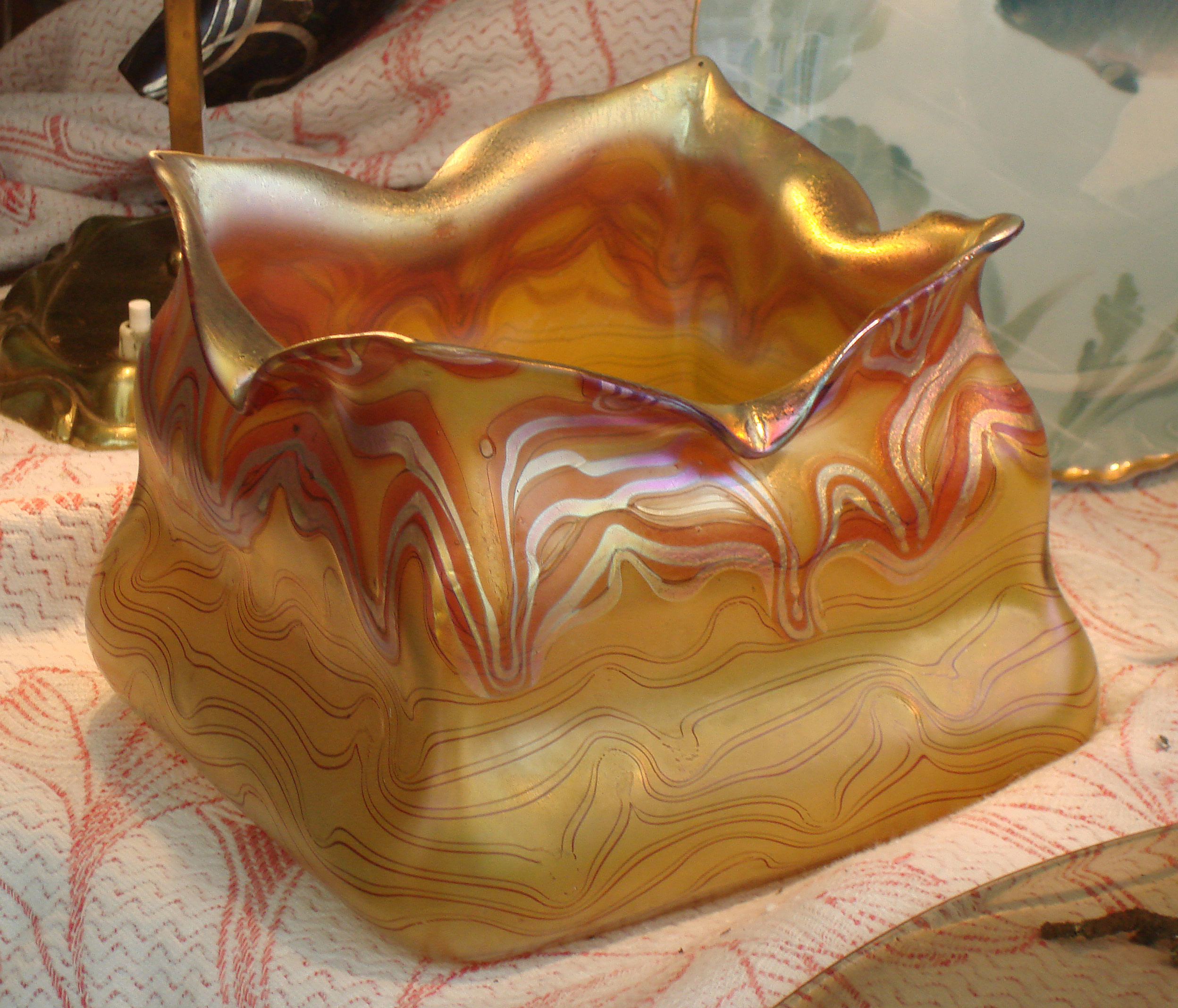
Fig. 4: Jardiniere with candia Phänomen Gre 1/728 red (photo by author).
Wer in den beiden Lötz-Publikationen von 1989 (Lötz Böhmisches Glas 1880–1940) und 2003 nach Beispielen für das Phänomen Genre 1/728 sucht, wird nicht fündig, jedenfalls nicht direkt. Also beginnt die Suche in den Eintragungen auf Musterschnitten und in den Fakturbüchern in selbigen Publikationen und in der großen Ausgabe der Papiermusterschnitte der Serie II von 2011. Und es gibt sie. Der älteste Schnitt 8115 stammt noch aus der Serie I von 1899, neu aufgenommen als Nummer 808 im Jahr 1900. Auf der größten der drei Versionen mit 14 cm (8115/5 ½") befindet sich der Eintrag „1 Phänomen Gre 1/728 Eilig!“. Diese einfach zu identifizierende dreilippige Form ist in vielen Dekorvarianten hergestellt worden, darunter auch in bekannten Phänomen Genres wie Gre 6893, Gre 7773 und Gre 1/64. Vor Jahren ist mir die formidentische Vase auf Seite 204 im Buch „Art Glass Nouveau“ von Ray & Lee Grover aus dem Jahr 1978 aufgefallen. Die Vase aus dem Chrysler Art Museum ist mit einem Phänomendekor abgebildet, das sich aus schmalen Bändern mit grünlichen, verbunden mit blau schimmernden Silberfäden sowie dünnen Vulcanfäden zusammensetzt. Die Vase ist eindeutig in ihrer Form, allerdings etwas größer als der Schnitt mit 5 ½ Zoll. Das lässt zwei Interpretationen zu: die Vase ist etwas größer ausgeführt worden, wahrscheinlicher aber gab es neben den 3 ½, 4 ½ und 5 ½ auch einen Schnitt mit 6 ½ Zoll, der nicht überliefert ist. Die Vase aus dem Buch der Grovers ist heute auch auf der Museums-Webseite zu finden (Bild 1). Der Verdacht, hier ein Beispiel für das Genre 1/728 entdeckt zu haben, keimte zwar auf, gelangte aber nicht zur Blüte. Erst kürzlich bin ich wieder auf diesen Dekor gestoßen (Bild 3) und auf Spurensuche gegangen. Gläser mit diesem Dekor sind gar nicht so selten und es gibt den Dekor in zwei Farbversionen, jeweils mit candia und thea als Grundglas. Die Bezeichnungen von Lötz lauten „candia/thea Phänomen Gre. 1/728 mit moosgrün, blau & vulcan Fäden“ und „thea/candia Phänomen mit rot Gre. 1/728“, kurz moosgrün und rot (vgl. u.a. Eintragungen auf Schnitten II-115/I und II-847). Da die Fäden sehr dünn auf dem Glas appliziert sind, erscheinen die Moosgrün-Fäden ziemlich hell, auf candia Grund sogar gelblichgrün. Doch worauf verweist die Angabe „blau“ in der Dekorbezeichnung? Dem Augenschein nach sind die silberhaltigen Fäden bläulich irisiert, ein Farbenspiel, das auch im Phänomen Genre 1/104 zu finden ist. Es gibt nur sieben Musterschnitt- bzw. Fakturbucheintragungen, die den Gre 1/728 nennen, dafür deutlich mehr Gläser mit dem Dekor. Das ist nicht ungewöhnlich, da nur sehr wenige Schnitte aus den Jahren 1901 bis 1903, also aus der Herstellungszeit des Dekors überliefert sind.
Warum sind die zwar wenigen, dennoch auf den Markt hin und wieder auftauchenden Gläser mit dem doch gut charakterisierten Dekor 1/728 nicht in der einschlägigen Literatur zu finden? Hier kommt etwas ins Spiel, das wir gar nicht so selten erleben – das Einrasten falscher Angaben oder Annahmen. Wir finden den Dekor nämlich unter Phänomen Genre 2/679 bereits seit 1989 im ersten Lötz-Kompendium und seither „lebt“ er mit dieser Namensgebung fort. Niemand hat die Dekorzuschreibung bislang in Frage gestellt. Das ist wiederum überraschend. Der Dekor wird nur ein einziges Mal auf dem namensgebenden Musterschnitt II-2/679 als „maron Gre 2/679“ erwähnt und ist schriftlich eingetragen auf der Dekorzeichnung des Musterschnitts. Die Dekorzeichnung zeigt jedoch ein völlig anderes Muster und ist nicht mit dem hier besprochenen Dekor verwechselbar. Maron als Grundfarbe (vgl. die Medici-Gläser) kommt mit dem Dekor aus moosgrünen, roten und Vulcan-Fäden nicht vor. Folglich muss die Zuschreibung an das Phänomen Genre 2/679 auf einen Irrtum beruhen. Richtig ist Phänomen Genre 1/728!
Bild 1: Vase PN I-8115 aus dem Chrysler Museum of Art mit dem Phänomendekor Gre 1/728 mit moosgrün (Photo: Chrysler Museum of Art).
Bild 2: Vase aus dem Passauer Glasmuseum (Inv.-Nr. Hö 67 970) als Referenz für Phänomen Gre 2/679 in Loetz 1989 und Loetz 2003 (B 144, S. 307), jedoch im Gre 1/728 mit moosgrün, blau und vulcan Fäden (Photo: Autor).
Bild 3: Kleine Vase mit Dekor thea Phänomen Gre 1/728 rot (Photo: Dorotheum, Wien).
Bild 4: Jardiniere mit Dekor candia Phänomen Gre 1/728 (Photo Autor).



I can only agree. PG 1/728 is the correct genre number for all examples previously known as PG 2/679. You've done some really good research on that.
Fantastic research. Thank you.
This has long been the decor that I love the most!