






Posted 3 days ago
 Loetzforever
(111 items)
This is the same form as PN II 4547 (1907), which was produced in Ausführung 2, 4, 5, and 2 with gold, and also without overlays. The following companies ordered these variants: Weiss & Biheller London, the Vienna Arts and Crafts Association, Neurath & Klein Vienna, Fürstenberg & Co. Berlin, and Ludwig Fränkel Berlin.
The vase PN II 5099 was produced in several sizes.The pattern catalog shows five different sizes. The largest of these had a height of 45.6 cm. So far, only one example of this design has been shown on the Lötz.com website. This first object (Easter Egg PN II 5338) of its kind was identified by Warren Galle. The Lötz book (Ricke) already drew attention to this version in its pattern catalog, but until now, no known photograph of such an object existed. The pattern catalog shows a small series of Version 48, from PN II 5095 to PN II 5109. It is unknown for whom these pieces were made; all patterns originate from the Lötz company pattern book number 4713-5354. In 1908, two more copies in this decor were produced for Karl Palda in Vienna (PN II 5526). Furthermore, in 1908, there were still some Easter eggs in this design, such as PN II 5337 to PN 5342. These were produced for the following companies: Julius Schiller of Arntsdorf near Haida (who ordered goods from Lötz between February 1908 and March 1911), Ludwig Fränkel of Berlin (who was Lötz's permanent representative in Berlin and ordered countless pieces from Klostermühle), P. Raddatz & Co. of Berlin (who ordered goods, probably as early as the 19th century, until 1932), and for the Rheinische Glashütten Aktiengesellschaft (Rhenish Glassworks Corporation) in Cologne (who placed orders for large quantities of glass between 1904 and 1910). Source: "Lötz Series II, Glass Pattern Cuts from 1900 to 1914, Jitka Lnenickova" and Ebay.
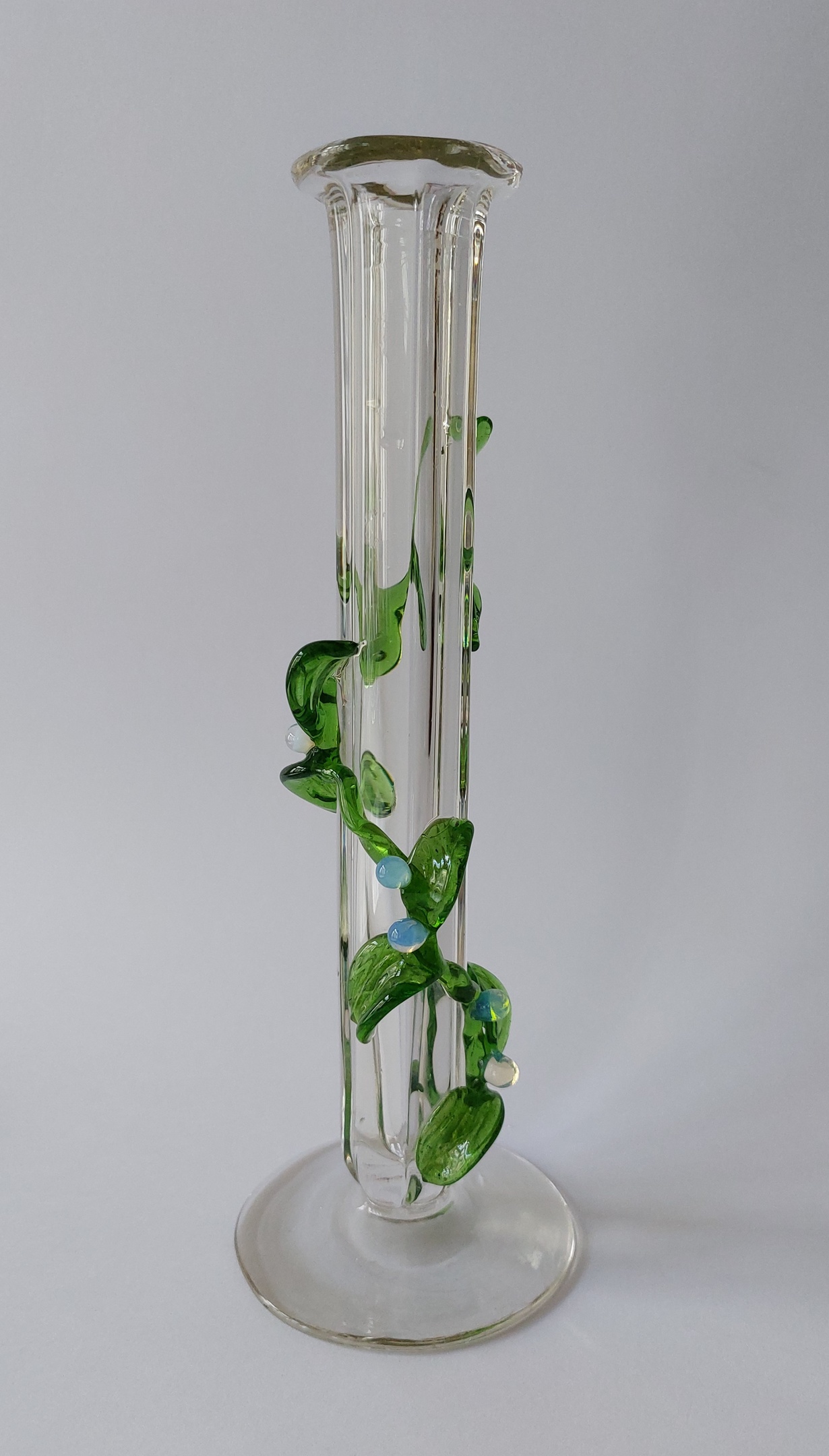
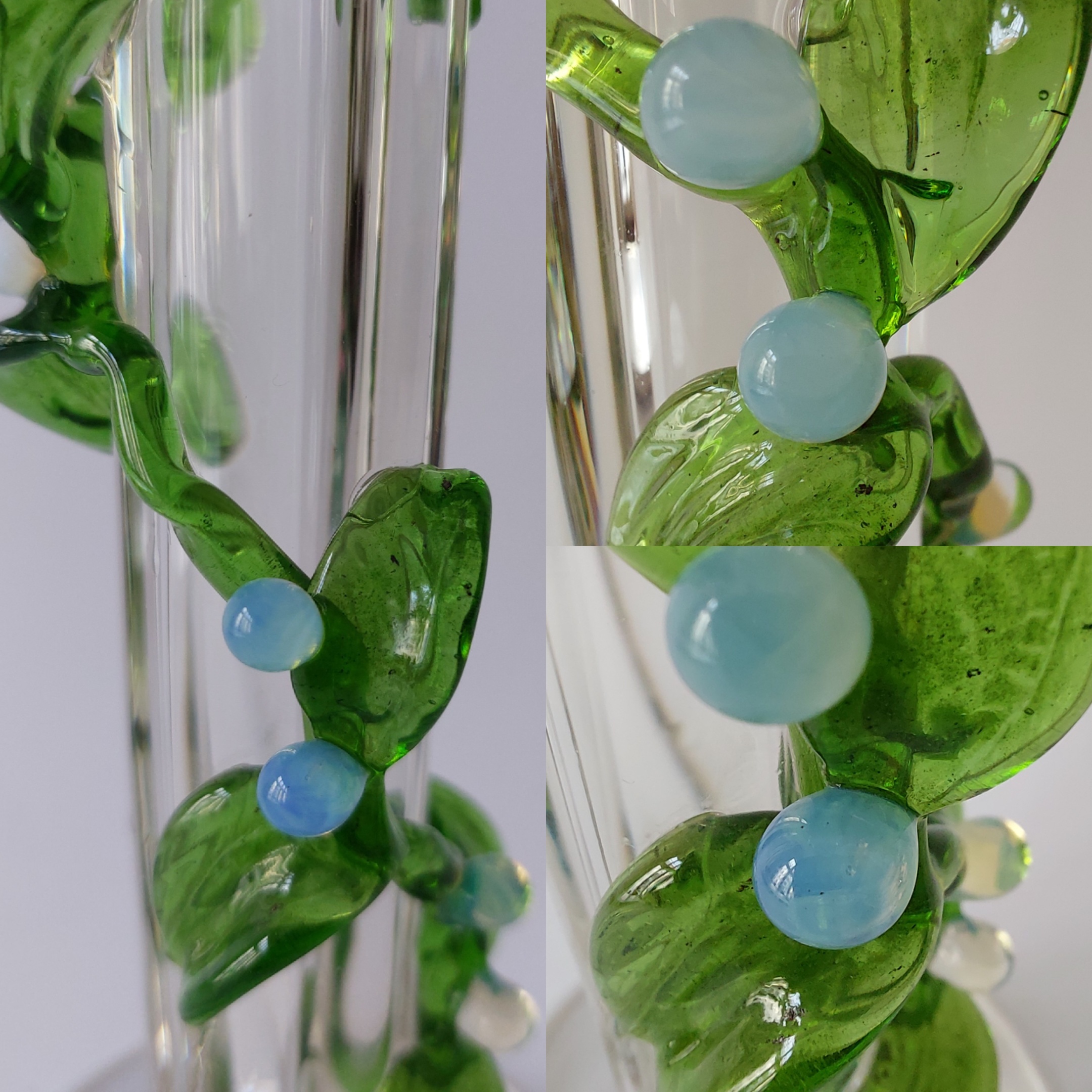
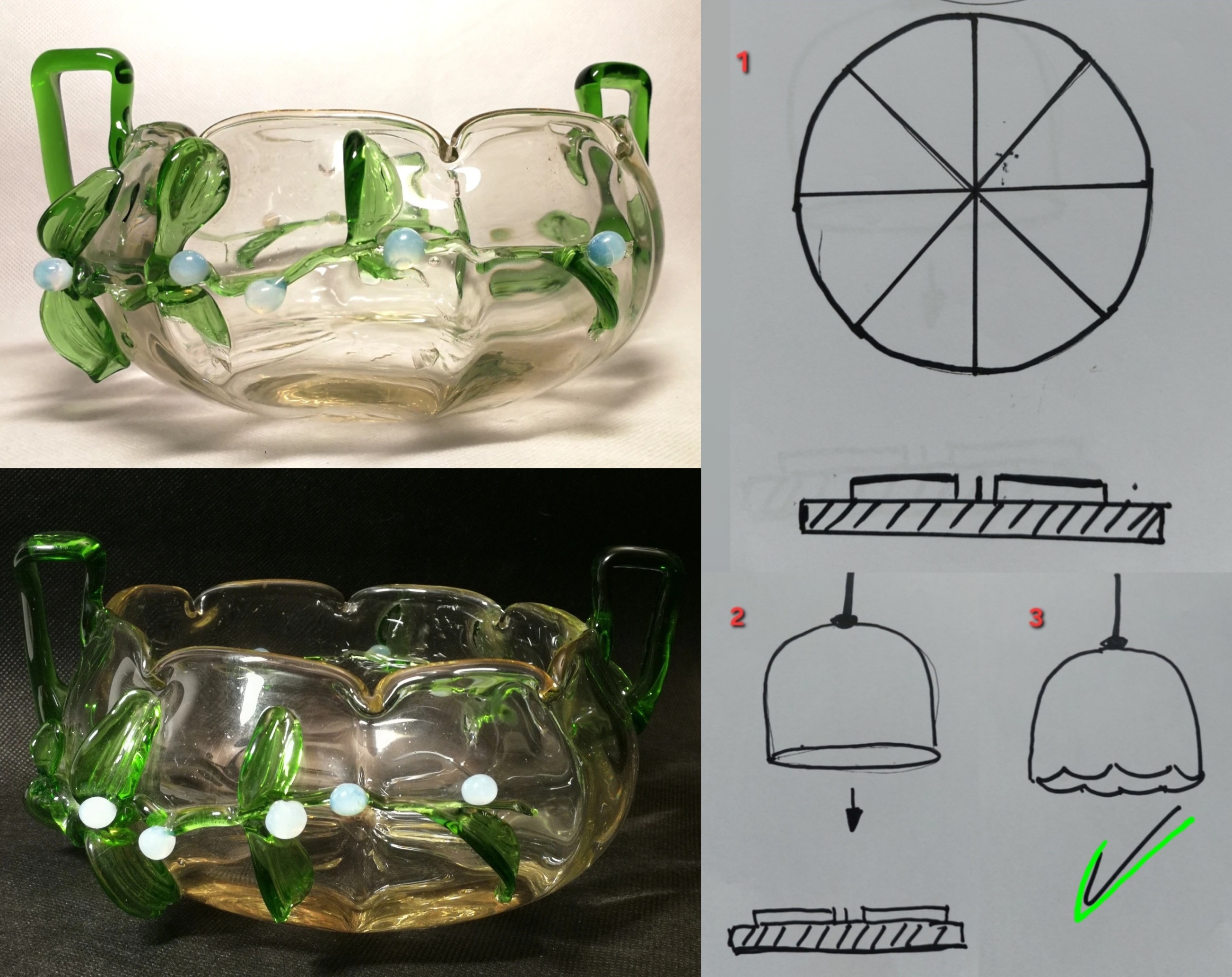
Design 1907, PN II 5099/9, Ausführung 48. Rolled colorless crystal glass tube fused to a flat colorless base ("shear foot") in crystal glass, this adorned with a yellow-green seven-leaved mistletoe sprig, and additionally with seven fused brilliant opal-colored beads. Height 23 cm
During my research on this decoration, I repeatedly came across the term "knife board," mostly in connection with candlesticks such as PN II 7982 to PN II 7991. I had long wondered what this term actually meant in Lötz's patterns. With PN II 5104 and others, I now believe I have found the explanation. The still-hot object is pressed upside down onto a board in which six or eight metal knives are embedded. This creates indentations in the upper rim of the vessel, which are then neatly fused together in the kiln. See the sketch on the last collage.
https://www.loetz.com/decors-a-z/ausfuehrungen/ausf-48
https://www.loetz.com/decors-a-z/ausfuehrungen/ausf-4
Loetz: 1907, PN II 5099/9, Ausführung 48.
Es handelt sich hierbei um die gleiche Form wie PN II 4547 (1907), welche in den Ausführungen 2, 4, 5, und 2 mit Gold, ferner auch ohne Auflagen hergestellt wurde. Folgende Firmen bestellten diese Varianten: Weiss & Biheller London, der Wiener Kunstgewerbliche Verein, Neurath & Klein Wien, Fürstenberg & Co. Berlin und Ludwig Fränkel Berlin.
Die Vase PN II 5099, wurde in mehreren Größen hergestellt. Im Schnittmusterverzeichnis sind fünf verschiedene Größen abgebildet. Die Größte davon hatte eine Höhe von 45,6 cm.
Bisher wurde lediglich ein Stück dieses Dekors auf der Webseite Lötz.com gezeigt. Dieses erste Objekt (Osterei PN II 5338) seiner Art wurde von Warren Galle identifiziert. Im Lötzbuch (Ricke) wurde schon im Dekorkatalog auf diese Ausführung aufmerksam gemacht, allerdings gab es aber bis dato kein bekanntes Foto eines solchen Objekt's. Im Schnittmusterverzeichnis ist eine kleine Serie der Ausführung 48, von PN II 5095 bis PN II 5109, zu sehen. Für wen diese Stücke gefertigt wurden ist nicht bekannt, alle Schnittmuster entstammen aus dem Musterbuch der Firma Lötz mit der Nummer 4713-5354. 1908 wurden für Karl Palda in Wien noch zwei Ausfertigungen in diesem Dekor hergestellt (PN II 5526). Ferner gab es 1908 noch einige Ostereier in diesem Dekor, wie PN II 5337 bis PN 5342. Diese wurden für folgende Firmen hergestellt: Julius Schiller Arntsdorf bei Haida, (bestellte vom Februar 1908 bis März 1911 Waren bei der Firma Lötz), Ludwig Fränkel Berlin (war die ständige Vertretung der Firma Lötz in Berlin und bestellte unzählige Stücke in Klostermühle), P. Raddatz & Co. Berlin (bestellte Waren, wahrscheinlich schon im 19. Jahrhundert bis 1932), und für die Rheinischen Glashütten Aktiengesellschaft Köln (Bestellungen von großen Mengen an Glas von 1904 bis 1910).
Quelle: "Lötz Serie II, Glasmusterschnitte von 1900 bis 1914, Jitka Lnenickova" und Ebay.
Entwurf 1907, PN II 5099/9, Ausführung 48. Auf flachem farblosen Fuß ("Scherfuss") in Kristall-Glas aufgeschmolzene gewalzte farblose Kristall-Glas-Röhre, diese mit einem gelbgrünen siebenblättrigen Mistelzweig belegt, zusätzlich sieben aufgeschmolzene brillantopalfarbene Perlen. Höhe 23 cm
Während der Recherche über dieses Dekor bin ich zum wiederholten Mal über den Ausdruck "Messerbrett" gestolpert, meistens bei Leuchtern wie zum Beispiel PN II 7982 bis PN II 7991. Schon lange Zeit zuvor hatte ich überlegt, was dieser Begriff in den Schnittmustern von Lötz eigentlich bedeutet. Bei PN II 5104 und anderen denke ich jetzt, die Erklärung gefunden zu haben. Das noch heiße Objekt wird kopfüber auf ein Brett in dem sechs oder acht Metallmesser eingelassen sind gedrückt. Dadurch entstehen Einkerbungen im oberen Rand des Gefäßes, die dann noch im Ofen sauber verschmolzen werden. Siehe dazu die Skizze auf der letzten Collage.
https://www.loetz.com/decors-a-z/ausfuehrungen/ausf-48
https://www.loetz.com/decors-a-z/ausfuehrungen/ausf-4



Beautiful! Hard enough to find, even more so without damage! Nice write up!
Fantastic explanation of the 'knife board' producing the scalloped rim. Thank you.