




Posted 14 years ago
 beyemvey
(214 items)
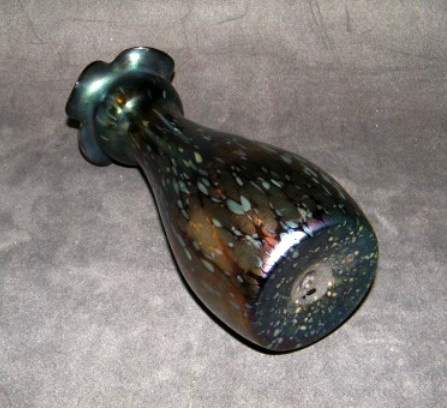
I purchased these three vases over a period of the past eight years. When I bought them, all three were attributed as "Rindskopf Oil Spot" decor. On the left is a 5" bowl. The second photo is a 9" vase, and the third and fourth photos are of an 11" vase. All three have the same dark amethyst base glass. All three have similar pontils and show signs of base grinding for leveling. All three have an identical polished quatrefoliate ruffled rim.
There is evidence supporting a Rindskopf attribution for these, but there are also other oil spot vases, both in amethyst and cobalt base glass, attributed as Kralik Astrolit. I am interested in hearing discussion from those who may care to offer an opinion regarding this topic. My current belief is that these three examples are by Rindskopf, but I don't doubt that there may be other similarly styled oil spot glass that may be by Kralik or even other makers. Please feel free to offer advice in the comments section below. I will offer two comments after I post this main article to an example of a known Rindskopf decor in a similar shape as the third vase, and to examples of what is identified as Kralik Astrolit.



In support of the Rindskopf attribution for these three... 1st the fact that the base glass bears isvirtually identical to a Rindskopf "Amethyst Loop" vase in my collection. I also found several examples of Rindskopf's well known pulled feather on red base glass decor. This example on the Verre d'Art site is virtually identical in shape to the third vase in my photos, with the exception that the rim is trefoliate vs. quatrefoliate. http://home.earthlink.net/~verredart1/glass/Rindskopf%20-%20Brick%20Red%20%20pulled%20feather%20Vase2.jpg
More photos of the vase can be found near the bottom of Verre d'Art's Rindskopf page. http://home.earthlink.net/~verredart1/glass/Rindskopf.html
Examples of vases attributed as Kralik Oil Spot Blue may be found on kralik-glass.com at the following link...
http://www.kralik-glass.com/kralikoilspotbluearray.html
These both appear to have a cobalt base glass. My current thinking is that both Kralik and Rindskopf probably made oil spot decor variants that were similar.
Thanks Alfredo! Your comments coincide with my beliefs. Notice in my fourth photo above, the pontil is fairly deep, about 1/4". Also the base glass on your cobalt Astrolit vases is very transparent, while the base glass on these three is almost completely opaque. It is only when held directly to a very bright light source that the slightest trace of amethyst colored light passes through. No doubt both Kralik Rindskopf, and others made similar vases to keep up with the popular styles of the day. PS - I love your website! https://sites.google.com/site/loetzandglass/Home
Wow, I almost missed this too Al, The second vase from left at the top of your Rindskopf ID by shape & decor page has a similar rim treatment. (pink cased w/ white) - Cheers! https://sites.google.com/site/loetzandglass/rindskopf-id-by-shape-and-decor
beautiful -- thanks for all the information and your posting
A link to Alan's very interesting post... http://www.collectorsweekly.com/stories/162514-rindskopf-art-nouveau-pinched-iridesc?in=activity