










Posted 10 months ago
 Loetzforever
(110 items)
Although snakes aren't among my favorite animals and I have great respect for them, I was very taken with this object. Scientists now believe that the fear of snakes is in our genes. Here's a brief excursion into snakes in mythology. The snake is associated with some of humanity's oldest rituals and represents the dual expression of good (peace, happiness, wealth) and evil (e.g., death by poison, Medusa, the Fall of Man in Paradise, etc.). In ancient Greece, it was considered the protector of the underworld and symbolized the religious connection with the earth's depths. Some specimens are even venerated as protectors of children and livestock. Their shedding of their skin represented rebirth, eternal youth, and immortality. Snakes were also believed to have divinatory powers. In Plato's mythology, the snake biting its tail symbolizes eternity. This is a pictorial symbol, called Uroboroi, that was already documented in ancient Egyptian iconography. The staff wrapped around a snake (called the Rod of Aesculapius) was originally an attribute of the god of medicine in Greek mythology; even today it is the symbol of medicine and pharmacy. Since January 29, 2025, we have been celebrating the Year of the Snake (Chinese horoscope), which I hope will bring us all good luck.
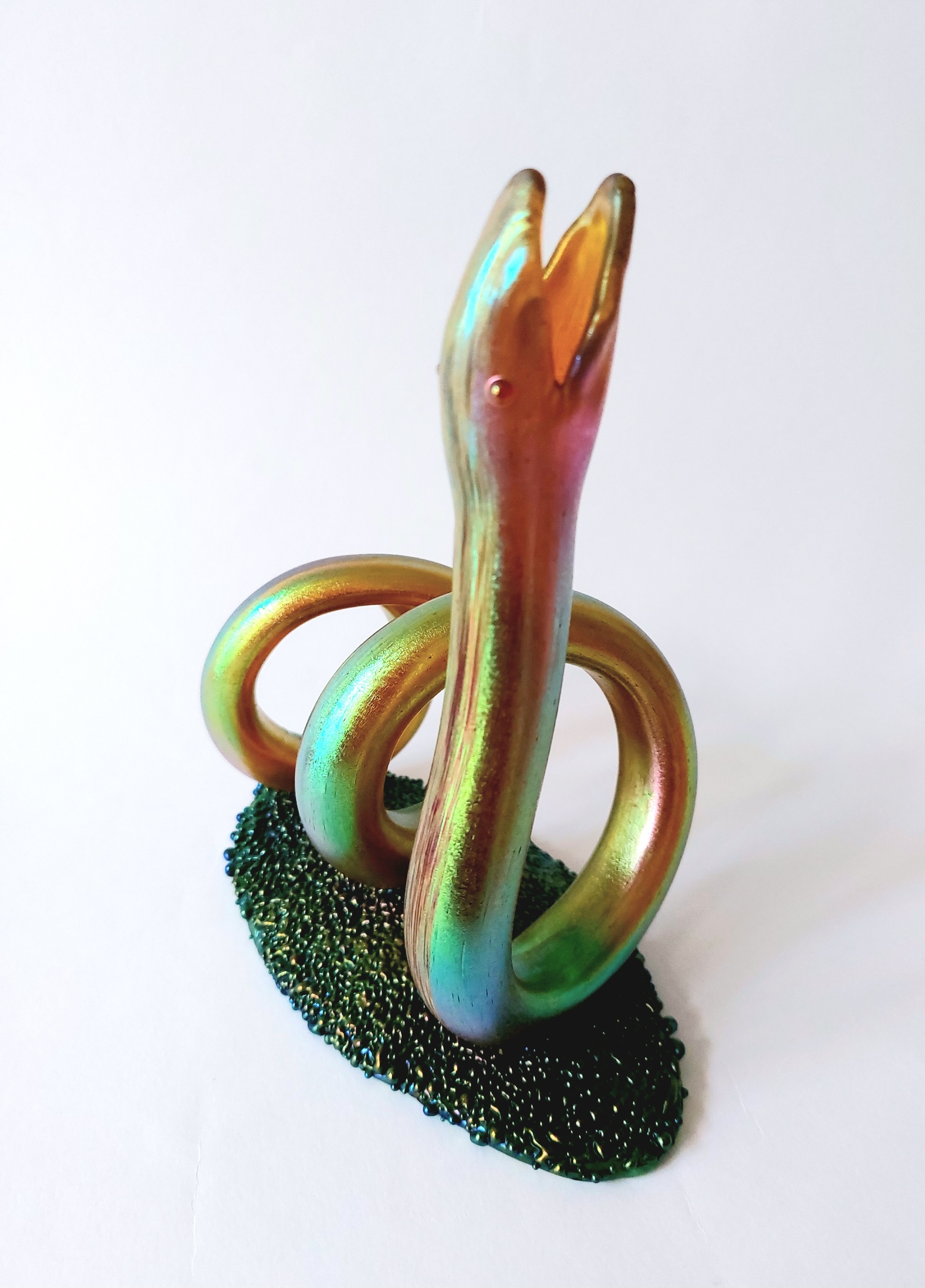
Thanks to the generosity of a dear friend, I was able to acquire this snake. Many years ago, I was offered a very large Lötz snake. It had crawled over from Portugal; unfortunately, the tip of its tail had broken off and been replaced by a piece of metal, which is why I didn't buy it. Now I had to wait 40 years for the next opportunity. I think it was worth it. The Lötz company is known to have produced several vase models with snakes (https://www.loetz.com/decors-a-z/silberiris/silberiris-w-snakes). However, there are only three patterns (PN II 1271, PN 1272, and PN 1273) in the shape of a complete animal.
According to the description on the patterns, only six pieces were produced for the companies Neurath & Klein in Vienna and Ludwig Fränkel in Berlin in the Candia silver iris, Candia silver iris with Creta, and Neptune with a silver-spotted interior. I am not aware of any other examples except those in the Sumavy Museum. This one is illustrated in the book "Lötz," Volume I (Ricke), page 169. Mrs. Adlerova wrote that this figure was very successful. If so, where did they go?
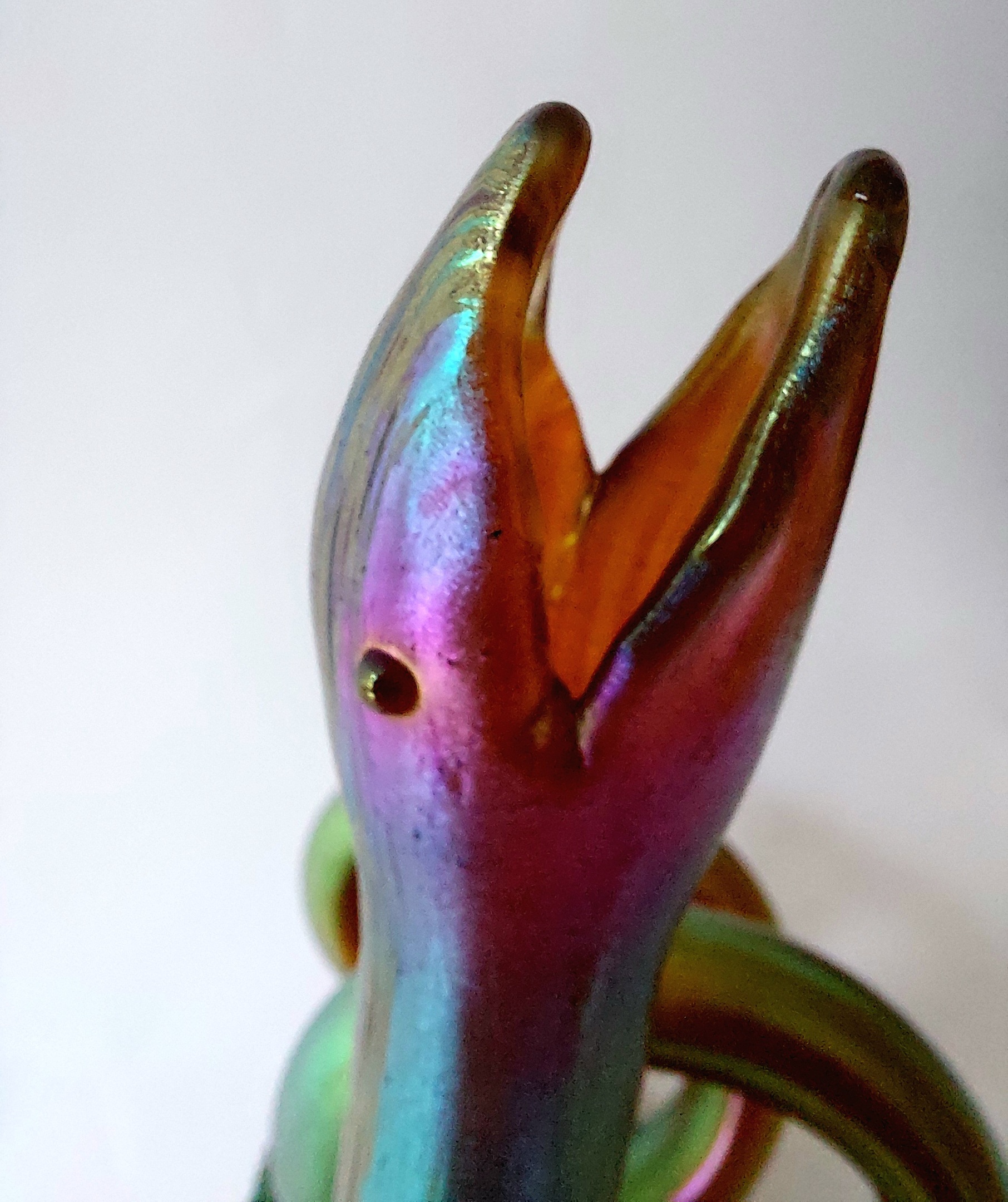
Design: 1904, PN II 1272, Candia silver iris with Creta. The base was made of green glass with melted, sculptural grains. On top is the body of the snake. This was freely fashioned as a spiral from a conical, colorless glass tube sprinkled with silver-yellow powder and a strip of violet flakes. The head was blown out and shaped with scissors. Its mouth was formed into a friendly smile. The eyes were then melted in red, and the whole piece was then reduced and iridescent. Height: 18.5 cm.
For Neptune, with its silver-flecked interior, see here:
https://www.collectorsweekly.com/stories/317394-loetz-neptun-1903?in=666-activity
https://www.collectorsweekly.com/stories/298893-loetz-animals-in-crystal-martele-and-cr
Lötz: Schlange PN II 1272,1904
Obwohl Schlangen nicht zu meinen Lieblingstieren gehören und ich großen Respekt vor Ihnen habe, war ich doch sehr angetan von diesem Objekt. Mittlerweile sind Wissenschaftler der Meinung, dass die Furcht vor Schlangen in unseren Genen liegt. Hier ein kurzer Exkurs über Schlangen in der Mythologie. Die Schlange wird mit einigen der ältesten Rituale der Menschheit in Verbindung gebracht und stellt den doppelten Ausdruck von Gut (Frieden, Glück, Reichtum) und Böse (z.B. Tod durch Gift, die Medusa, der Sündenfall im Paradies usw.) dar. Im alten Griechenland galt sie als Beschützerin der Unterwelt und symbolisierte die religiöse Verbindung mit der Erdtiefe. Einige Exemplare werden gar als Beschützer der Kinder und des Viehs verehrt. Ihre Häutung stand für Wiedergeburt, ewige Jugend und Unsterblichkeit. Schlangen wurden aber auch wahrsagende Fähigkeiten zugesprochen. Bei Plato symbolisiert die sich in den Schwanz beißende Schlange die Ewigkeit. Dies ist ein bereits in der Ikonographie des Alten Ägyptens belegtes Bildsymbol, genannt Uroboroi. Der von einer Schlange umwundene Stab (genannt Äskulapstab) war ursprünglich ein Attribut des Gottes der Heilkunde in der griechischen Mythologie, noch heute ist er das Symbol für den Ärztestand und der Pharmazie. Seit dem 29. Januar 2025 feiern wir das Jahr der Schlange (chinesisches Horoskop) welches uns allen hoffentlich auch viel Glück bringen mag.
Durch einen lieben Freund und dessen Großzügigkeit konnte ich diese Schlange erwerben. Vor sehr vielen Jahren wurde mir schon einmal eine sehr große Lötz-Schlange angeboten. Diese kam aus Portugal angekrochen, leider war ihre Schwanzspitze abgebrochen und durch ein Stück Metall ersetzt, deshalb hatte ich sie nicht gekauft. Nun musste ich 40 Jahre auf die nächste Gelegenheit warten. Ich finde es hat sich gelohnt. In der Produktion der Firma Lötz sind etliche Vasen-Modelle mit Schlangen bekannt (https://www.loetz.com/decors-a-z/silberiris/silberiris-w-snakes). Es gibt aber nur drei Schnittmuster (PN II 1271, PN 1272 und PN 1273) in der Gestalt eines kompletten Tieres.
Laut der Beschreibung auf den Schnittmustern wurden insgesamt lediglich 6 Stück für die Firmen Neurath & Klein in Wien und Ludwig Fränkel in Berlin in den Dekoren Candia Silberiris, Candia Silberiris mit Creta und Neptun innen Silber gefleckt hergestellt. Mir ist außer im Museum Sumavy kein weiteres Exemplar bekannt. Dieses ist im Buch "Lötz" Band I (Ricke), Seite 169 abgebildet. Frau Adlerova schrieb hierzu, dass diese Figur sehr erfolgreich war. Wenn dem so ist, wo sind sie geblieben?
Entwurf: 1904, PN II 1272, Candia Silberiris mit Creta. Der Sockel wurde aus grünem Glas mit aufgeschmolzenen plastischen Körnern gestaltet. Darauf befindet sich der Körper der Schlange. Dieser wurde aus einem konischen, farblosen mit Silbergelbpulver und einem Streifen mit violetten Kröseln bestreuten Glasrohr frei als Spirale gearbeitet. Der Kopf wurde aufgetrieben und mit der Schere gestaltet. Ihr Maul wurde zu einem freundlichen Lächeln geformt. Anschließend wurden noch die Augen in Rot aufgeschmolzen, das Ganze dann reduziert und irisiert. Höhe 18,5 cm.
Zu Neptun innen Silber gefleckt siehe hier:
https://www.collectorsweekly.com/stories/317394-loetz-neptun-1903?in=666-activity
https://www.collectorsweekly.com/stories/298893-loetz-animals-in-crystal-martele-and-cr




Love it, beautiful
Thank goodness for dear friends! :) Congratulations on a great addition to your collection!
year of snake 25 good luck