






Posted 12 years ago
 cogito
(124 items)
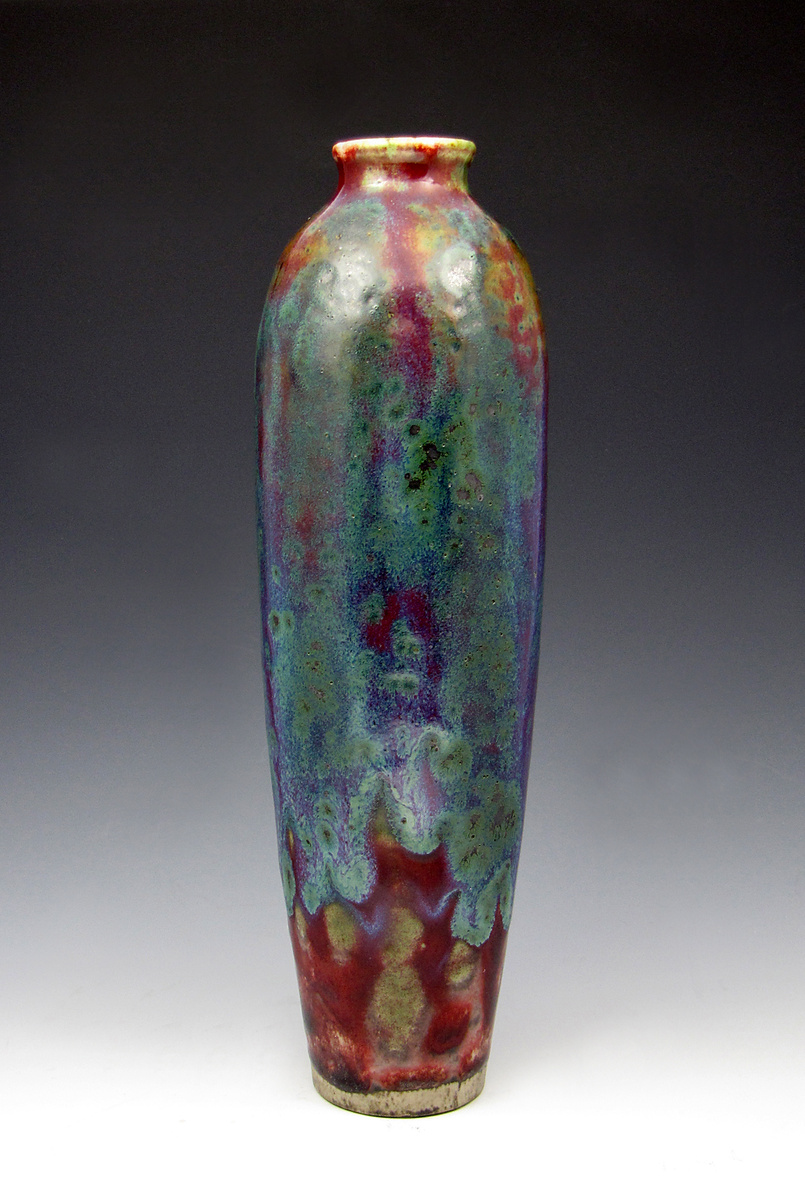
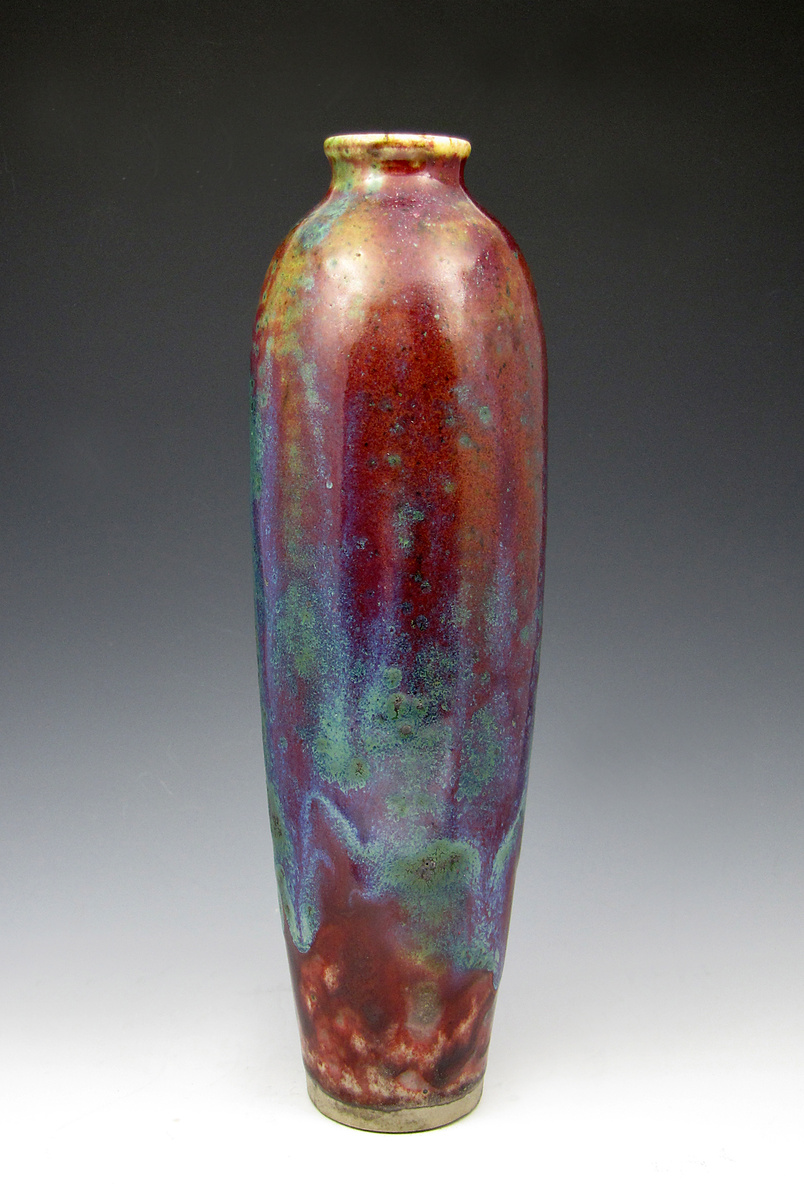
Elegantly simple, elongated stoneware bud vase rendered by Dalpayrat in his famed mottled sang de boeuf (oxblood) high-fire flambé glaze. By varying the oxygen exposure during the firing process, Dalpayrat produced a riot of organic glaze forms and spectral colors on this petite bud vase. Signed “Dalpayrat” underneath and stamped as form number 47. Dimensions: 7"(H) x 2"(W).
Adrien-Pierre Dalpayrat (French, 1844–1910) was born in Limoges. As a youngster with an interest in painting and design, he attended a local art school and subsequently trained at the Limoges Municipal School of Porcelain Painting. In the first decades of his career, Dalpayrat was a faïence painter, working at six different manufactories between 1867 and 1888. In 1889, he settled down near Paris in Bourg-la-Reine, a town with a long history of porcelain manufacture. At around this time, he dropped the designation of 'porcelain painter' and began to identify himself as a 'ceramist' or 'artist-ceramist.' From that time forward, he devoted his time mostly to stoneware, a material revered for its Japanese associations and in vogue at the time given the published and popular review of Asian art by Sigfried Bing. Dalpayrat's studio executed objects by Maurice Dufrêne, designer of furniture, textiles, glassware, silverware, and ceramics. Dufrêne was the director and manager of La Maison Moderne, an association of artists who worked together to create designs that could be produced in multiples.
Dalpayrat was well known for his sang de boeuf (oxblood) flambé pottery, so much so that the term "Dalpayrat red" was coined to designate his distinctive glaze. Modeled after the oxblood glazes on Chinese pottery centuries earlier, Dalpayrat's version diverges in interesting and organic ways with swirls of color and irregular surface characteristics that perfectly encapsulates the French Art Nouveau aesthetic. Perfected by 1892, Dalpayrat unveiled his oxblood glaze at the prestigious Galerie Georges Petit in Paris, where he exhibited 50 stoneware pieces based on models by Alphonse Voisin-Delacroix. His success with the high fire glazed stoneware was immediate, and since that fateful exhibition, Dalpayrat has been recognized as a master of the art form and a key figure in French Art Nouveau pottery.



Beautiful!....:-)
Another stunner, cogito!
Thanks! This one was a stretch, but no regrets. Just wait till you see the next thing...I feel like I won the antiques lottery.
I'm down under here waiting the next. Never get to see stuff like this here. I'm sure it exists but it is already in the vaults tucked away. Congratulations!
"A riot of organic glaze forms" is an apt description. It is gorgeous.
Were the batteries included? Sorry, the devil made me do it!
LOL. ;)
made me lmao too!
batteries aside, what a beautiful piece!!
wow! so gorgeous!